

Here is a combination of numbers that shouldn't need advertising at all.
Etsy.com runs at roughly 416–435M visits a month, according to Similarweb — May 2026, at 434.8M, was the strongest month of the spring. Google Trends shows the brand's search interest sitting on a high, flat plateau: down 3% versus the preceding quarter, up 4% year over year, the unmistakable signature of a company everyone already knows.
And yet in mid-May 2026, this thoroughly famous marketplace started pouring seven-figure-scale money into YouTube ads that show no product, no price, no seller, no discount, and no reason to click. A calendar. Kids in a pool. A best-friends necklace. A sweatshirt that says "OFFICIALLY DIVORCED." A logo.
Why does a company with more than 400 million monthly visits buy advertising that doesn't ask you to visit?
Because the visits were never the problem. The buyers were. And this campaign, read through the ad data rather than the press release, is the most public admission of that you will ever see a marketplace make.
Why a marketplace with 425M monthly visits still buys awareness advertising
Etsy buys awareness advertising because its traffic and its customer base moved in opposite directions: the site held 416–435M monthly visits through spring 2026 per Similarweb, while active buyers fell to 86.5 million at the end of 2025, down 3.4% year over year, according to Etsy's own Q4 and full-year 2025 results.
Traffic is not the same asset as demand. A marketplace at Etsy's age accumulates enormous non-commercial traffic — saved listings, Pinterest referrals, image search, people browsing for ideas they will buy somewhere else. What it cannot accumulate automatically is the reflex that sends a shopper to Etsy first when they want something for a specific person on a specific occasion.
That reflex is exactly what erodes quietly. It does not show up in a traffic chart until years after it starts, which is why the campaign looks, on the surface, like a healthy company spending money for no reason.
Twenty-one years of Etsy talking to the wrong side of its marketplace
Etsy spent the two years before this campaign marketing its sellers rather than its buyers, and the company says so itself, according to its newsroom announcement of May 26, 2026: two years of storytelling focused on the makers, with "Celebrate Being Human" described as expanding that frame to the 86.5 million buyers Etsy reported at the end of 2025.
Some history, because the history is the strategy. Etsy launched in 2005 — eleven years after Amazon — and built its entire existence on being what Amazon structurally cannot be: a marketplace of individual humans making individual things. That differentiation worked for two decades and produced one of the internet's genuinely beloved brands.
But every two-sided marketplace has to choose, day to day, which side it is courting. Sellers are the supply moat, and supply is the harder thing to rebuild, so the logic of prioritising them was never stupid. It simply assumed that differentiation markets itself.
The buyer decline the campaign is answering
The buyer numbers deteriorated for two consecutive years before the campaign launched. Etsy reported active buyers down 5% year over year to 86.6 million in Q3 2025, then 86.5 million at year-end, down 3.4%, per the company's Q4 and full-year 2025 results. By Q1 2026 the count was 86.6 million and the year-over-year decline had narrowed to roughly 2% — stabilising, but from a lower base than two years earlier.
While Etsy was introducing shoppers to its makers, those shoppers were being trained by Amazon's convenience, Temu's prices, and algorithmic feeds everywhere to treat buying as a reflex. On speed, price, and selection breadth, Etsy loses to both by design. That is not a failure; that is the definition of not being them.
What changed at the top in January 2026
Leadership change preceded the creative change by five months: Kruti Patel Goyal became CEO on January 1, 2026, and framed her mandate around "human connection, our sellers' creativity" in Etsy's own transition announcement. Josh Silverman moved to Executive Chair after eight years running the company.
Read the shareholder communications, then watch this campaign. "Celebrate Being Human" is the strategy document, filmed. The camera has turned 180 degrees — away from the people who sell on Etsy, toward the people the company needs to win back.
What "Celebrate Being Human" actually is: a life counted in 26,826 days
The campaign is a 60-second anthem film launched across the US and UK on May 26, 2026, built on a single arithmetic device: it counts out an average human life at about 26,826 days, 76 summers, 12 jobs, 6 best friends, 4 best dog friends, 15 great loves and 1,205 firsts, per Etsy's newsroom announcement and campaign coverage in Marketing Brew.
The film was created by agency Orchard, directed by Jess Kohl through Love Song, shot by Academy Award–nominated cinematographer Adolpho Veloso, and scored by Moses Sumney, with media planned and bought by MediaHub. It runs across broadcast TV, a long CTV roster, YouTube, Meta and TikTok.
Against that countdown the film stacks what Etsy calls "ministones" — the non-traditional milestones: heartbreak, moving out, paying off a loan, starting over. Brad Minor, Etsy's chief marketing officer, framed the thesis to The Drum as a conviction that "story, craft and human connection carry more value than convenience alone".
The enemy the film never names
The campaign attacks a mechanic rather than a competitor, and that choice is visible in what the creative omits: no price comparison, no delivery promise, no product grid — the three things Amazon and Temu win on.
The unnamed enemy is sameness. Algorithmic feeds, AI recommendations, the infinite scroll of identical cheap goods. Etsy is positioning against the very mechanics that make its larger rivals efficient, because efficiency is the one battlefield where those rivals cannot defend themselves without conceding the point.
What the AdSee AI YouTube ads library shows that the press release doesn't
The YouTube flight did not start on the announced launch date: two cutdowns of the anthem went live on May 15–16, 2026, ten days before the May 26 press wave, per the AdSee AI YouTube ads library. Together they had collected over 23M views by July 11, 2026.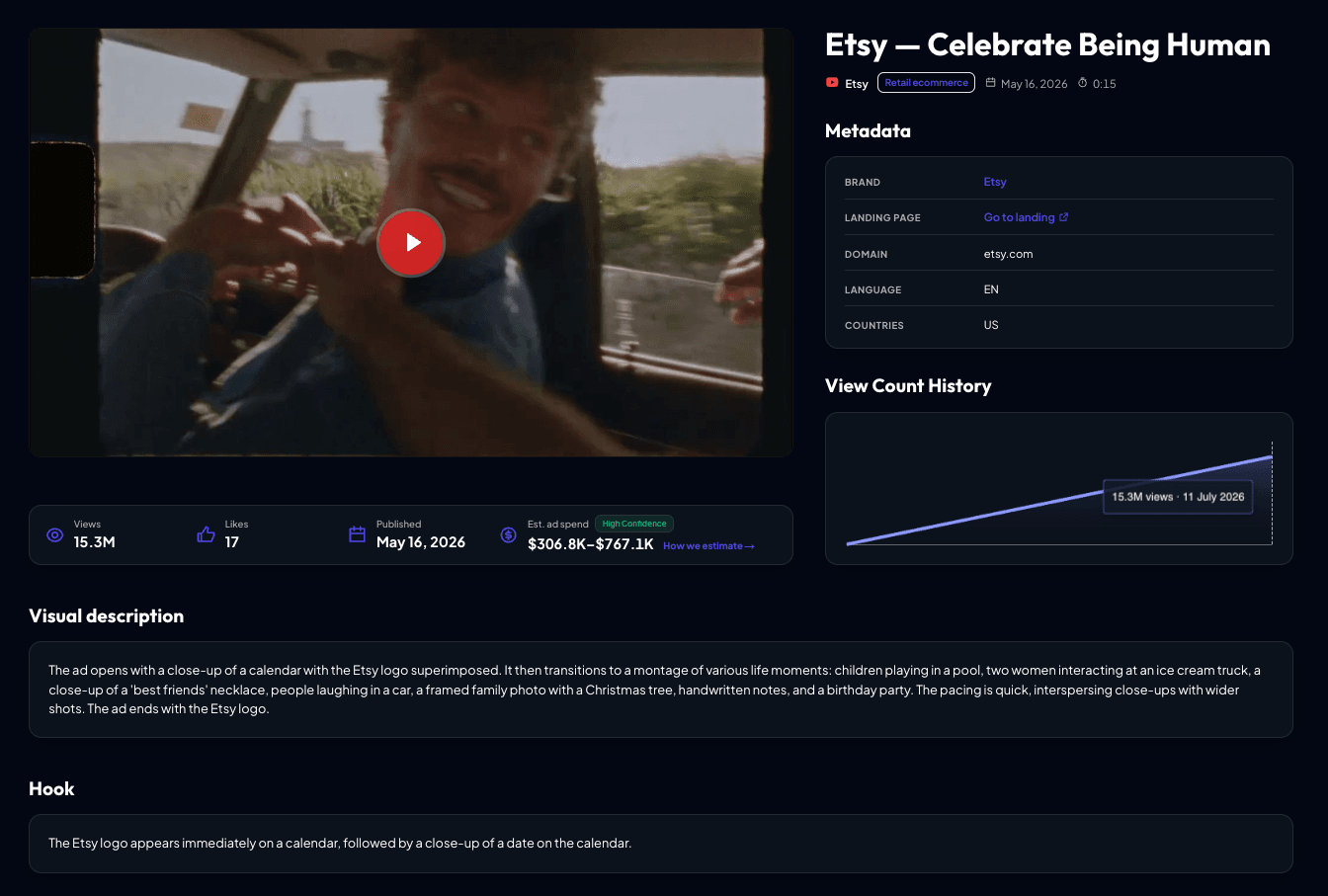
This is the layer no press release contains. Announcement copy tells you what a brand wants the launch date to be. Publish dates in an ads library tell you when the media actually started running, and the gap between those two facts is a strategy.
The 15-second cut is the frequency asset
The 15-second cutdown is built for reach, and its engagement rate proves it: 15.3M views against 17 likes by July 11, 2026 — roughly one like per 900,000 views, per AdSee AI. Estimated spend for that creative is $306.8K–$767.1K at high confidence.
A ratio in that range is the signature of forced in-stream inventory. Nobody chose to watch this. It was served, counted, and skipped or endured — which is the correct job for a short cutdown in an awareness flight, not a failure of the creative.
The 30-second cut is the resonance asset
The 30-second cutdown — the one carrying the divorce sweatshirt and the broken-heart necklace — earned more than four times the engagement rate of its shorter sibling: 38 likes on 7.9M views, about one per 208,000, per AdSee AI, on an estimated $159.9K–$399.8K at high confidence.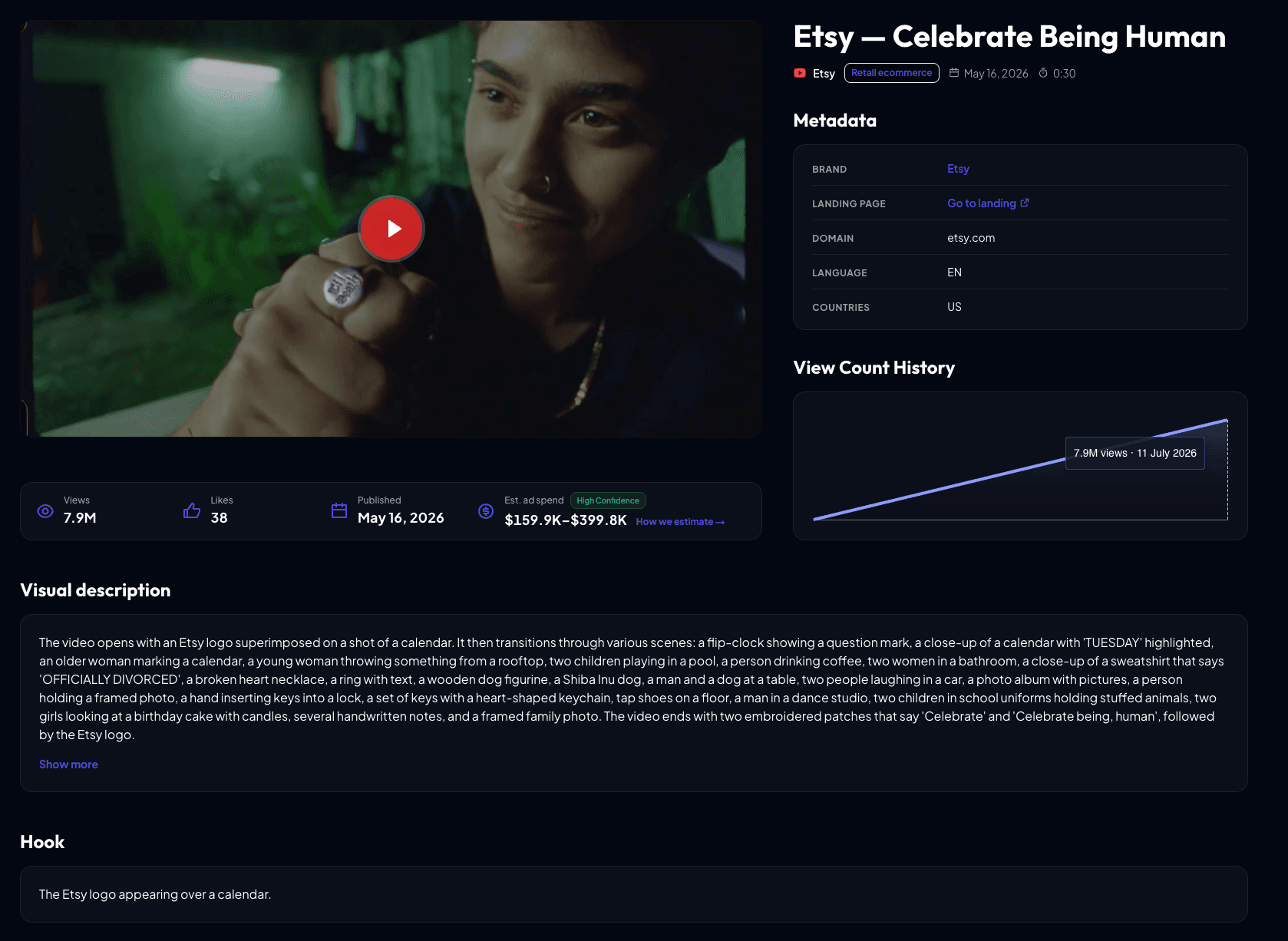
Same campaign, same film, two different jobs. The short cut hammers frequency; the long emotional cut is the one people actually feel enough to react to. When you take apart any campaign inside a YouTube ads library, that split — frequency asset versus resonance asset — is one of the most reliable tells of a deliberately structured media plan rather than a single asset dumped into a placement.
How Etsy pre-seeded YouTube ten days before its own launch date
Etsy's YouTube flight ran ten days ahead of its own announcement: creatives published May 15–16 against a May 26 launch date, per AdSee AI publish dates and Etsy's newsroom post.
The logic is straightforward once you have seen it. Press coverage lands on a fixed day; audience familiarity does not build on a fixed day. If the film has already been in rotation for a week and a half, the coverage arrives at people who half-recognise the footage, and recognition is the cheapest form of credibility a launch can buy.
This is not unique to Etsy. It is one of the most repeatable patterns visible when you compare publish dates against press dates across large advertisers, and it is invisible to anyone reading only the press release. Launch day should be the crescendo, not the first note.
What the like-to-view ratio tells you about a YouTube marketing campaign
Like-to-view ratio is the closest thing to a public lie detector for paid video, and Etsy's two cutdowns demonstrate the full range inside a single campaign: one per 900,000 views on the 15-second cut versus one per 208,000 on the 30-second cut, per AdSee AI.
The mechanic is simple. Liking a video requires a deliberate action from someone who was not looking for the video in the first place. When a creative sits in chosen viewing — discovery feeds, fandom content, native-feeling formats — content-level rates in the range of one like per few hundred views are normal. When a creative is served as forced in-stream reach, rates collapse by three orders of magnitude. The number tells you which inventory the money bought, without any access to the media plan.
Where the like-to-view ratio lies
The ratio breaks in at least four specific situations, and each one produces a misleading read rather than a slightly noisy one.
First, likes can be disabled or hidden on the channel, which produces a zero that means nothing. Second, ads targeting made-for-kids inventory carry structurally suppressed engagement affordances. Third, comparing a Shorts placement against a long-form in-stream placement compares two different user behaviours, not two creatives. Fourth, and most important for performance teams: the ratio says nothing whatsoever about installs, signups, purchases or retention. A creative can be loved and sell nothing.
Use it for what it is — a placement-type signal and a relative comparison within one advertiser — and it is one of the highest-value free metrics in ad analysis. Use it as a performance KPI and it will mislead you every time.
How much Etsy's YouTube campaign cost, and how that estimate is built
The two hero cutdowns correspond to a combined $466.7K–$1.17M in estimated US media spend at high confidence, per AdSee AI, for the 23M+ views recorded by July 11, 2026.
That range is deliberately wide, and the width is the honest part. Spend estimates for YouTube are derived from observed view counts multiplied against cost-per-view benchmarks for the placement and market. In the US, CPVs for in-stream inventory commonly sit in the low single-digit cents, so a 15.3M-view creative arithmetically lands somewhere in the low-to-mid six figures depending on where in that band the buy actually cleared.
Why spend is always a range and never a number
No external tool sees an advertiser's invoice, so any single-number spend figure is false precision. Three variables move the real number materially: negotiated rates for large buys, the mix of skippable and non-skippable formats, and geographic mix, since a campaign running partly in cheaper markets pulls the true cost below the top of a US-benchmarked range.
Format mix matters more than most teams assume. A 2025 study published in the Journal of Advertising Research examined how skippable and non-skippable in-stream formats differ in perceived intrusiveness — a difference that shows up in both pricing and in the engagement signals we just read. A flight weighted toward non-skippable inventory buys attention at a different price and produces different like rates than one weighted toward skippable.
So treat the range as a range. For competitive analysis, the useful question is never "exactly how much" but "which order of magnitude, and how does it compare to the same brand's other flights."
Why 67 live creatives matter more than the two hero cutdowns
The anthem cutdowns were two creatives out of 67 Etsy ads live in the period, per the AdSee AI YouTube ads library — which means the brand campaign is a layer on top of an always-on machine, not a replacement for it.
This is the detail that most single-campaign teardowns miss. Large retail advertisers almost never run one campaign; they run a performance baseline continuously and pulse brand work over it. The baseline carries the shopping-intent creative, the seasonal offers, the category-specific cutdowns. The brand pulse carries the story.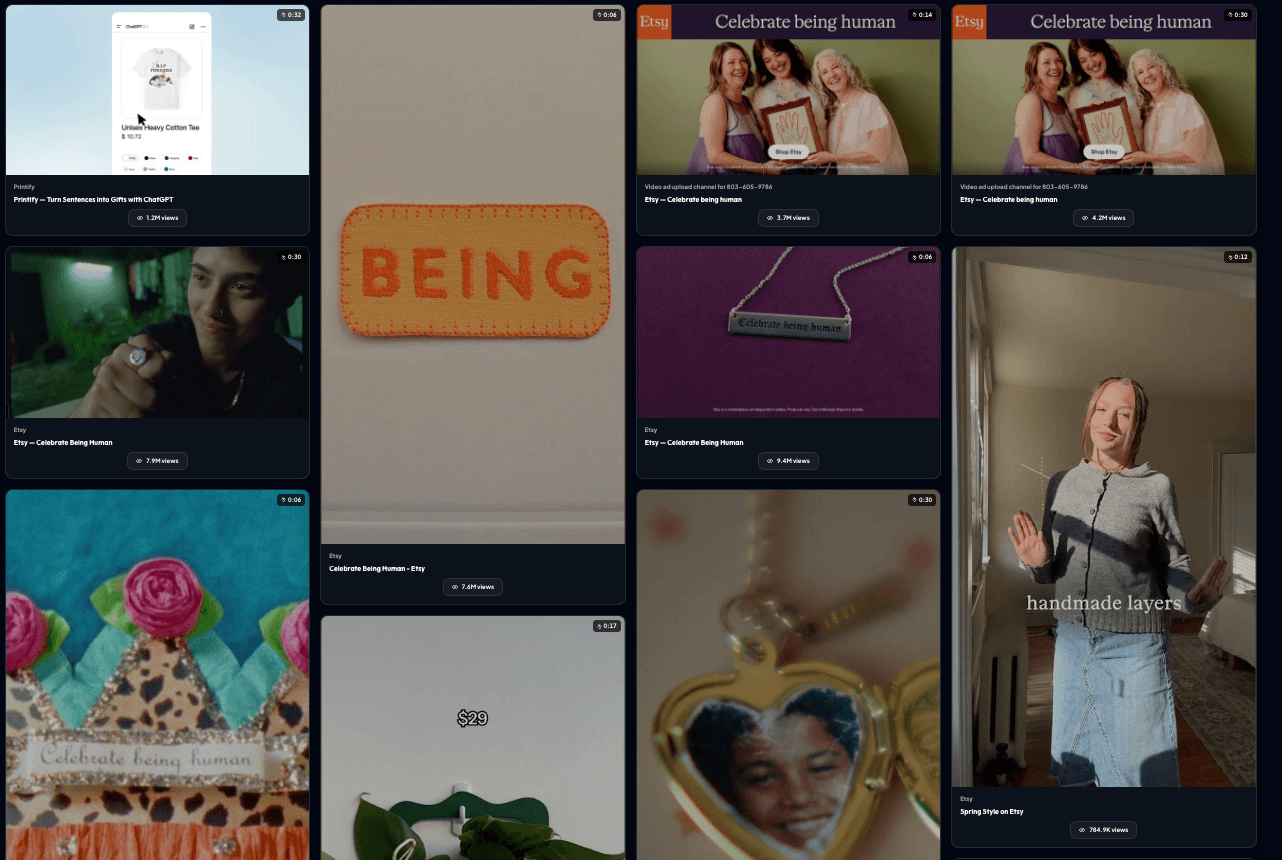
Read the two layers separately or you will draw the wrong conclusion. If you judge the anthem film by the KPIs of the performance baseline, it fails. If you judge the baseline by the ambition of the anthem film, it looks unimaginative. They are different instruments playing in the same orchestra, and the only way to see both from outside the company is a creative-level ad library that lists everything an advertiser has live at once.
Why none of this shows up in Similarweb traffic or Google Trends
Neither instrument can detect this campaign, and the reason is arithmetic: 23M YouTube views against 416–435M monthly site visits per Similarweb is a rounding error, and Google Trends shows Etsy's search interest moving 3–4% in either direction — normal seasonal breathing for a brand at maximum fame.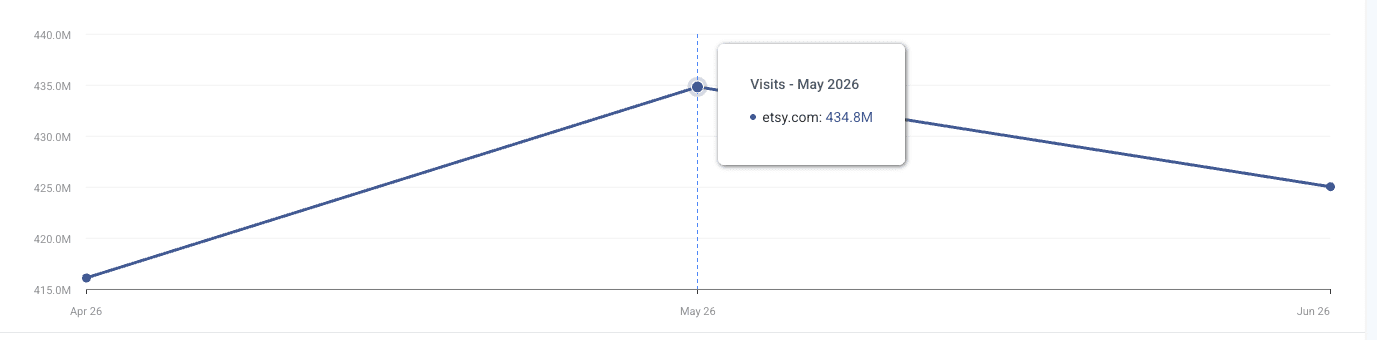
May's +4.5% traffic bump coincides with the campaign but cannot be attributed to it, and no honest analyst would try. Search has the same problem in reverse: a brand at this level of recognition has no search headroom left for an awareness campaign to fill. Almost everyone who would ever search "Etsy" already does.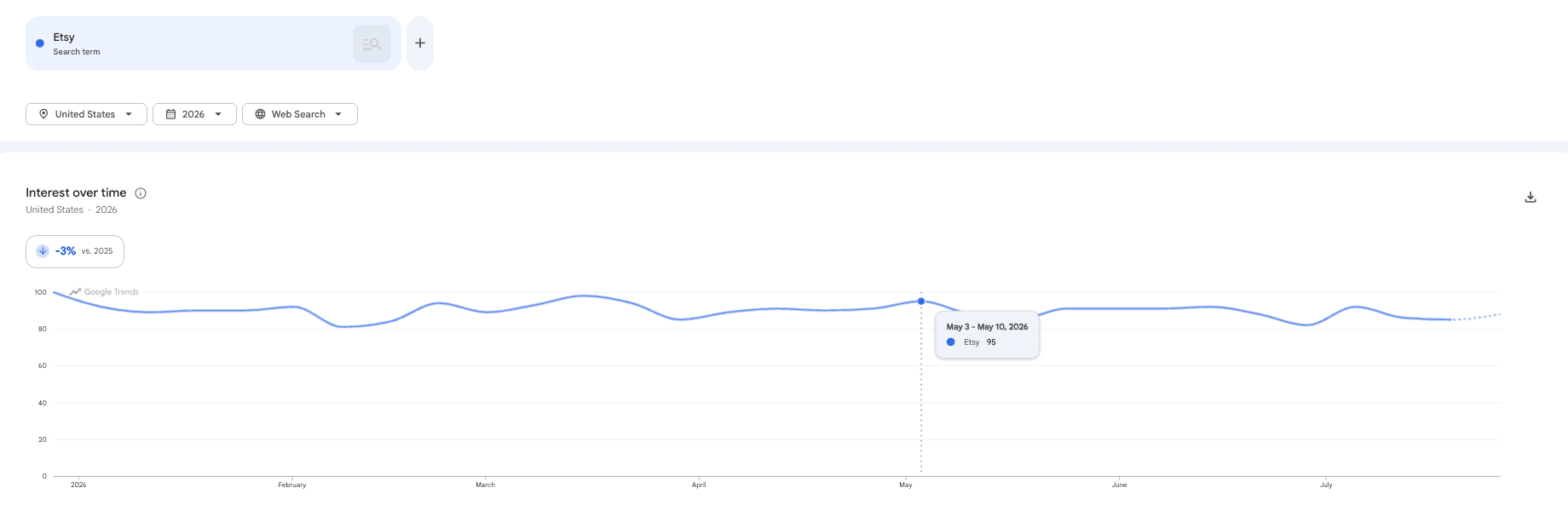
The instruments that do register a phase-three campaign
Brand trackers picked up what web analytics could not: YouGov BrandIndex reporting showed a rise in Etsy's Ad Awareness and Attention scores immediately following the launch.
The audience math explains the creative choice as well. Etsy's own campaign materials note that a large majority of its US customers are women and that a similarly large majority say they are concerned about technology's impact on society. A film about algorithmic sameness is aimed dead-centre at people already uneasy about algorithmic life — which is a targeting decision disguised as a creative decision.
The three-phase brand lifecycle and where Etsy's YouTube ad strategy sits in it
Etsy is a textbook phase-three advertiser, and the tell is the combination of a flat high search plateau — down 3% quarter over quarter, up 4% year over year per Google Trends — with an anthem film that contains no offer, no price and no call to action.
Phase one: a brand advertises features, buys awareness expensively, and every metric moves because the baseline is near zero. Phase two: word of mouth compounds, marketing scales into adjacent audiences, and acquisition efficiency is the scoreboard. Phase three: search interest goes flat at a high plateau, the website is an institution, and advertising stops creating demand at all. It becomes moat maintenance — reminding a drifting audience why you exist, in terms competitors cannot copy.
That last clause is the whole media budget. Amazon can match any feature and Temu any price, but neither can say "human" and be believed. Etsy can, because twenty-one years of marketplace structure back the claim up. Positioning is only defensible when the operational reality behind it would be expensive for a rival to reproduce.
The corollary matters for smaller advertisers: do not copy phase-three creative while you are in phase one. An ad with no product and no offer works for Etsy precisely because 86.6 million people already know exactly what Etsy sells. If they do not know what you sell, an emotional anthem is a very expensive way to stay anonymous.
How to run this teardown on your own competitor with a YouTube ad tracker
You can reproduce every step of this analysis on any advertiser using public data plus a YouTube ad tracker, and the whole sequence takes under an hour once you know the order.
Step one: pull the creative list, not the campaign. Search the advertiser inside a YouTube ads library and export everything live in your window, not just the ad you already noticed. The count itself — Etsy's 67 — is the first insight.
Step two: sort by publish date and compare against press dates. Any creative that predates the official announcement is a pre-seeding signal. Any cluster of same-week publishes is a flight.
Step three: group creatives by duration. Cutdowns of the same film at 15s, 30s and 60s almost always have different jobs. Duration is the cheapest proxy for role in the media plan.
Step four: compute like-to-view for each creative. Compare within the advertiser first, then against other advertisers in the category. The spread tells you the inventory mix.
Step five: read the country lists as a lifecycle stage. A short list of small cheap markets is a test. A coherent regional cluster is a rollout. Two or three sustained markets is focused scale. Fifty-plus countries including premium markets is a global burn. Etsy's US-and-UK pattern here is a focused-scale brand pulse, not a test.
Step six: cross-check against web analytics and search — and expect nothing. For large brands the correct finding is usually "no visible effect," and knowing that in advance stops you from inventing a correlation.
Step seven: write down what you cannot see. Frequency, targeting, view-through conversions, and negotiated rates are all invisible from outside. Naming the gaps is what separates analysis from speculation.
Where this analysis stops working
This method has three concrete failure modes, and Etsy's campaign brushes against two of them — most obviously the fact that the 23M views measured here, per AdSee AI, cover YouTube only.
The first is app-first advertisers. When every creative lands on an app store page, Similarweb and Google Trends see nothing at all, and creative-level ad data becomes the only visible layer of the entire funnel. Nothing in this teardown transfers to a hyper-casual game except the like-rate and lifecycle reads.
The second is multi-channel campaigns. "Celebrate Being Human" runs on broadcast TV, a long CTV roster, Meta and TikTok alongside YouTube. The YouTube slice we can measure is a fraction of the real budget, and treating it as the total would misstate the campaign by an order of magnitude. Every conclusion here is scoped to YouTube deliberately.
The third is attribution itself. Nothing in this analysis proves the campaign sold anything. It shows structure, timing, inventory mix and scale. Whether 23M views moved buyer counts is a question only Etsy's internal cohort data can answer, and even Etsy will struggle to isolate it from the leadership change, the product work, and the seasonal cycle running at the same time.
How we counted: methodology
This teardown rests on two "Celebrate Being Human" cutdowns out of 67 Etsy creatives live in the window, with counters read on July 11, 2026, per the AdSee AI YouTube ads library. Etsy YouTube ad creatives were identified in the AdSee AI YouTube ads library, US placement, Q2 2026 : two "Celebrate Being Human" cutdowns published May 15–16, 2026, out of 67 creatives live from the advertiser in the window. View and like counts are public YouTube counters read on July 11, 2026.
Spend estimates are AdSee AI's, derived from view counts and US CPV benchmarks, presented as ranges with per-creative confidence levels rather than point figures. Website traffic: Similarweb, etsy.com, April–June 2026, read as April 416M, May 434.8M, June 425M and cross-checked against the panel after one raw export row carried a mislabeled month. Search interest: Google Trends, query "Etsy," United States, past three months.
Campaign facts come from Etsy's newsroom announcement of May 26, 2026 and coverage in Campaign, The Drum, LBBOnline and Marketing Brew. Buyer counts and leadership statements come from Etsy's quarterly results and shareholder communications. Brand-lift references come from YouGov BrandIndex reporting for June 2026. Where a figure exists in more than one source, the primary company filing was used.
What to steal from Etsy's YouTube ad strategy
Market to the side of your business that is leaving. Etsy spent two years romancing supply while demand churned, and buyer counts fell two years running per its own results. Whichever side you are not talking to is the side you are losing.
Position where the giant's strength is a weakness. Etsy cannot out-convenience Amazon or out-price Temu, so it reframed their core mechanic — algorithmic efficiency — as the problem. If you cannot win the game, change what the game is about.
Pre-seed the reach channel before the press wave. Per AdSee AI publish dates, Etsy's YouTube flight ran ten days ahead of the official launch, so the coverage landed on a warm audience. This costs nothing extra; it is a scheduling decision.
Split your cutdowns by job, then measure them differently. Etsy's 15-second cut bought frequency and its 30-second cut bought resonance, and their like rates differ by more than 4×. Holding both to one KPI would make one of them look broken.
Grade phase-three campaigns with phase-three instruments. For a brand running 416–435M monthly visits per Similarweb and flat search per Google Trends, traffic and Trends will always read "no effect." Brand trackers, awareness scores and buyer-retention curves are the scoreboard. Google's own creative research makes the same point from the other direction: the metric you optimise decides which creative wins.
FAQ
What is Etsy's "Celebrate Being Human" campaign? A brand campaign launched May 26, 2026 in the US and UK, built around a 60-second film that counts out an average human life — 26,826 days, 76 summers, 15 great loves — and positions Etsy as the place to mark personal moments with human-made things. Per the AdSee AI YouTube ads library, cutdowns went live May 15–16, ten days before the official launch.
How much did Etsy spend on its YouTube marketing campaign? The two "Celebrate Being Human" cutdowns correspond to a combined $466.7K–$1.17M in estimated US media spend at high confidence, according to AdSee AI, for over 23M views recorded by July 11, 2026. That covers YouTube only; the campaign also ran on broadcast TV, CTV, Meta and TikTok, so total campaign spend is substantially higher.
Why is Etsy advertising against Amazon and Temu without naming them? Because Etsy's active buyers declined two years running — down 3.4% to 86.5 million at the end of 2025, per Etsy's Q4 results — as shoppers defaulted to convenience and price. The campaign attacks algorithmic sameness, the shared mechanic of its larger rivals, rather than any named competitor, since Etsy cannot win on speed or price.
How do you find a competitor's YouTube ads? Search the advertiser inside a YouTube ads library such as AdSee AI, then export every creative live in your date window rather than the one ad you already noticed. Sort by publish date, group by duration, and compare view and like counts. This is the same YouTube ads spy workflow used to reconstruct Etsy's flight from public data.
What does the like-to-view ratio tell you about a YouTube ad? It reveals which inventory the money bought. Etsy's 15-second cut recorded about one like per 900,000 views and its 30-second cut about one per 208,000, per AdSee AI — the first is forced in-stream reach, the second is a creative people chose to react to. Content-level rates run orders of magnitude higher.
Is a high like-to-view ratio worth optimising for? Not directly. The ratio is a placement-type signal, not a performance metric: it says nothing about installs, signups, purchases or retention, and it breaks entirely when likes are hidden or when Shorts and in-stream placements are compared side by side. Use it to diagnose inventory mix, per AdSee AI methodology, not to grade campaign success.
Why do brands launch YouTube ads before their official campaign date? To make the press wave land on an audience that already recognises the footage. Etsy published its cutdowns on May 15–16 for a May 26 announcement, per AdSee AI publish dates — a ten-day head start. A YouTube ad tracker exposes this gap because publish dates are public even when media plans are not.
Can you measure a brand campaign's impact with Similarweb or Google Trends? Not for large brands. Etsy runs at 416–435M monthly visits per Similarweb and a flat search plateau per Google Trends, so 23M YouTube views is arithmetically invisible. Brand trackers such as YouGov BrandIndex registered the lift instead. Traffic and search only work as campaign instruments for brands small enough for the delta to exceed the noise.
Data and sources
Ad creatives, publish dates, view and like counts, creative counts and spend estimates — the AdSee AI YouTube ads library. Website traffic — Similarweb (etsy.com). Search interest — Google Trends ("Etsy," US). Campaign details — Etsy newsroom; Campaign; The Drum; LBBOnline; Marketing Brew. Buyer counts and executive statements — Etsy investor relations. Brand-lift data — YouGov BrandIndex. Format research — Journal of Advertising Research, 2025.