VidTao alternative: AdSee vs VidTao

AdSee and VidTao are both YouTube ad intelligence platforms. Both index unlisted ads, estimate spend, and link ads to their landing pages. The real differences are narrower and more specific than most comparison pages suggest: how far back the data goes, and whether you can search what an ad actually says, shows, and displays on screen. This page lays out both — including the cases where VidTao is the better choice.

Quick verdict

Choose VidTao if

You need YouTube ad history going back to 2022, you're working to a tighter budget — their annual plan works out to about $66/month — or you value their community and newsletter around YouTube direct response.

Choose AdSee if

You need to search what's spoken or shown inside ads, you want country-level placement data, or you're researching campaigns running right now rather than historical archives.

Use both if

You're doing deep historical research on a niche. The archives overlap less than you'd expect, and each surfaces creatives the other doesn't.

FeatureVidTaoAdSee
Total video ads19M+16M+
Unlisted adsn/a5M+
Coverage starts20222025
New ads per dayn/a150K+
Spend estimatesYesYes
Ad-to-landing-pageYesYes
Search by landing page domainNoYes
Search by advertiserYesYes
Search by keywordYesYes
Search by spoken wordsNoYesfull transcripts
Search by on-screen visualsNoYesAI descriptions
Search by on-screen textNoYescaptions, offers, prices
Country placement dataNoYes
Find similar adsNoYesby voice or visuals
Free trial24H7 days, no card
Monthly price$87$87 Starter / $149 Pro

The three differences

Search what competitors say

Every ad in AdSee is fully transcribed. Search the exact words spoken — a hook, a claim, a price point, a guarantee — and get every advertiser using it. Keyword and tag search can't reach inside the video; this is the difference between knowing an ad exists and knowing what it argues.
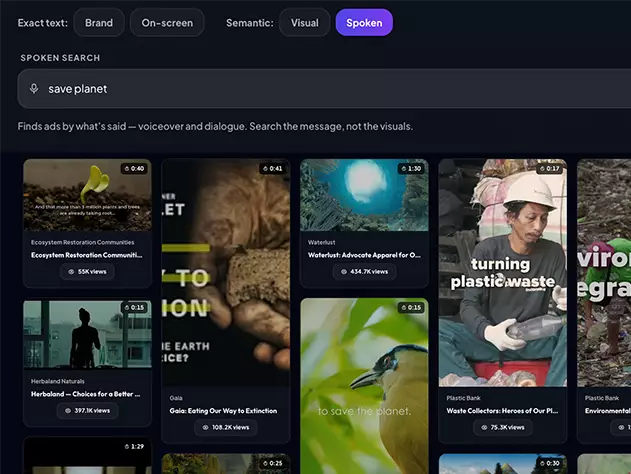
AdSee search results for a spoken phrase

Search what they show

AI generates a description of what happens on screen in every ad. Search in plain language — "man opening a package in a kitchen" — and get the ads containing that footage. No tags, no keywords, no manual watching.
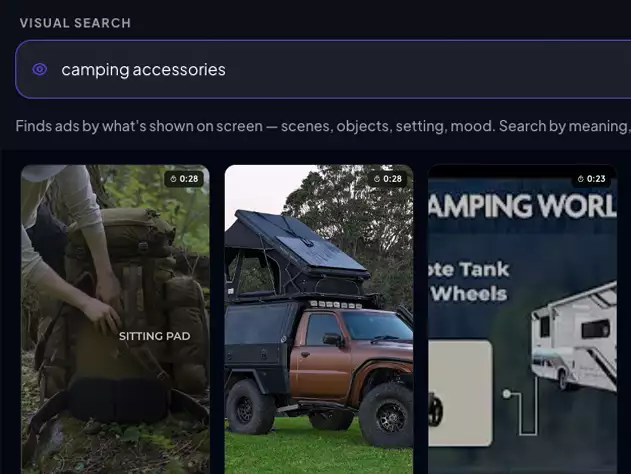
AdSee visual search results

See where ads actually ran

AdSee shows which countries each ad ran in, and lets you filter by market. Useful for separating what a competitor is testing in one region from what they're scaling everywhere. No other YouTube ad tool surfaces this.

Country breakdown for a YouTube ad in AdSee

What both tools do

Where AdSee and VidTao overlap

Unlisted ads

Both index ads uploaded privately and served through paid placements — creatives that never appear on a brand's public channel. AdSee holds 5M+.

Spend estimates

Both estimate spend and impressions per ad. Methodologies differ; neither is exact, and both should be read as ranges rather than figures.

Landing page tracking

Both link ads to the pages they drive to, so creative and funnel can be judged together.

Frequently Asked Questions

For most workflows, yes — AdSee covers unlisted ads, spend estimates, and ad-to-landing-page tracking, and adds transcript, visual, and placement search. The one thing it can't replace is depth of history: AdSee's coverage starts in 2025, so if you're studying how a niche's messaging evolved since 2022, VidTao has data AdSee doesn't.
Yes. Send us proof of an active monthly VidTao subscription and we'll match the remaining days on your Pro plan, free. If you have 22 days left, you get 22 days of AdSee Pro — no card, no commitment. A screenshot showing the subscription dates is enough; we don't need billing details or amounts. Annual VidTao plans aren't covered, but write to us anyway and we'll work something out.
VidTao reports 19M+ video ads against AdSee's 16M+ — a gap of roughly 15%, and it comes down to time. VidTao has been collecting since 2022; AdSee's coverage starts in 2025. The more useful question is what those archives contain: a creative that stopped running three years ago says little about what converts today. AdSee adds 150K+ ads daily, so coverage of active campaigns keeps deepening, and 5M+ of the index is unlisted ads that never appear on a brand's public channel.
Yes. AdSee reads the text shown in every ad — captions, price points, offer terms, disclaimers, and end-card copy — and makes it searchable. A lot of what an ad actually promises is never spoken aloud: a "50% off" burned into the frame, a guarantee in fine print, a URL on the end card. Searching the transcript alone misses all of it. VidTao doesn't index on-screen text at all.
Yes. Enter a domain and AdSee returns every YouTube ad pointing to it. Both platforms show you the landing page behind an ad, but only AdSee lets you search in the other direction — starting from a funnel and working back to the creatives feeding it. That matters when a competitor runs several brands, or when an affiliate offer is promoted by dozens of different advertisers you'd never connect by name.
VidTao searches advertiser names, keywords, and metadata. It doesn't index the spoken transcript or generate descriptions of on-screen visuals, so searching for a specific hook, claim, or visual scene isn't possible there. That's the main structural difference between the two platforms.
Yes. Unlisted ads are uploaded privately and served through paid placements — they never appear on a brand's public channel or in YouTube search. Both platforms index them.
Neither platform has access to advertiser billing data — both infer spend from observable signals. Treat the figures as ranges for comparing ads against each other rather than as exact numbers. AdSee's methodology is published in full.
VidTao. Their monthly plan is $87 and their annual works out to roughly $66/month for the full feature set. AdSee starts at $87/month and the full-feature Pro tier is $149. If price is the deciding factor, VidTao wins — the case for AdSee rests on capabilities their platform doesn't have.
Depends on the work. If advertiser and keyword search covers your workflow, VidTao is the pragmatic choice on price alone. If you write creative — hooks, scripts, angles — then searching what competitors actually say and show is a different kind of tool, and that's what AdSee is for.
Fair question. AdSee launched in 2025 and doesn't have VidTao's track record. What it does have is a published spend methodology, a database that updates daily, and a free trial that requires no card — so you can verify the data against ads you already know before paying anything.
Yes, and for deep niche research it's worth it. The archives overlap less than you'd expect: different collection methods surface different creatives, and the two tools answer different questions.
No. There's no import path between the platforms. Saved lists and swipe files have to be rebuilt.