
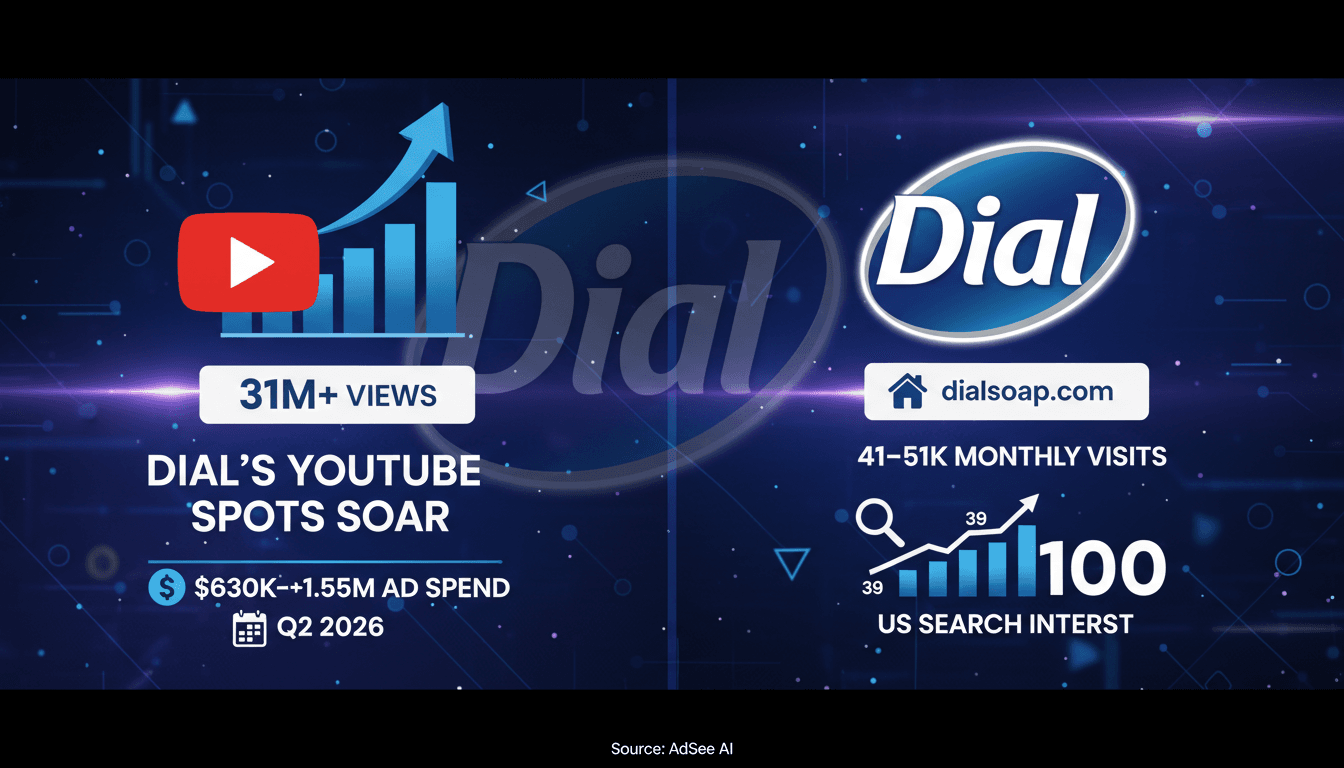
Here's a curve every legacy brand should study.
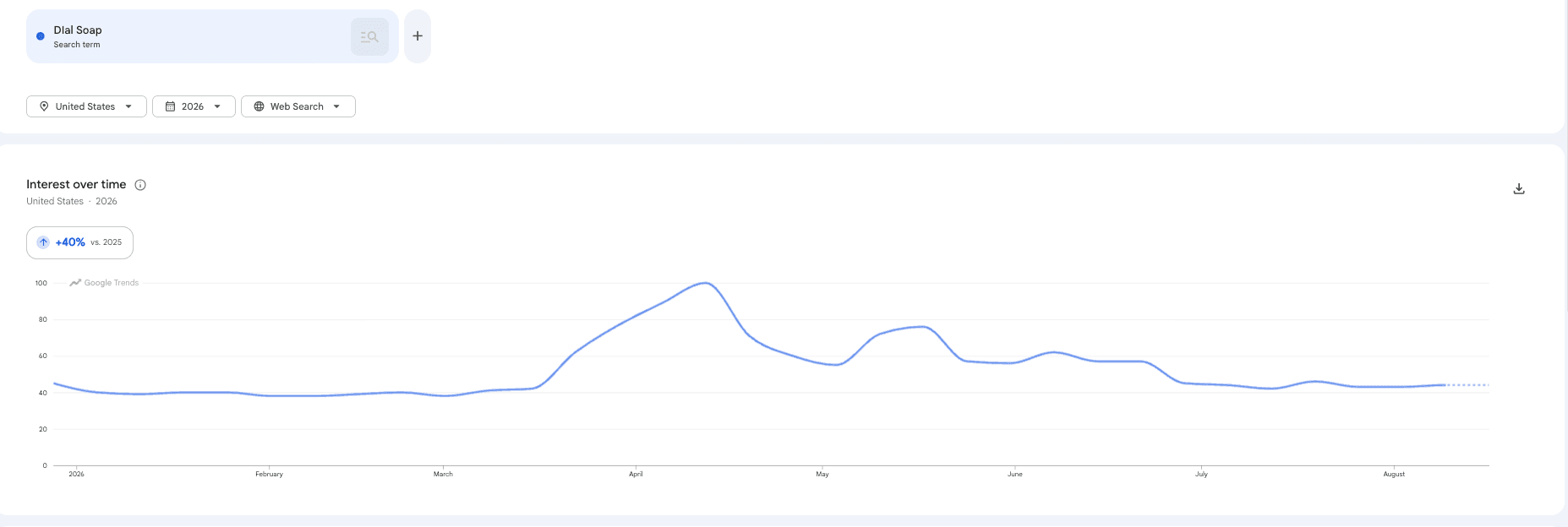
For more than a year, US search interest in "Dial Soap" lay flat — Google Trends shows the query stuck between 38 and 44, week after week, the signature of a brand people know completely and think about never. A bar of soap in the mental pantry.
Then, in the week of March 22, 2026, the line woke up: 62. A week later, 78. By the week of April 12 — 100, the query's annual peak, with overall 2026 interest running 50% above last year.
What does a 78-year-old soap brand have to do to double its search interest in three weeks?
Apparently: show a dog drinking from a toilet.
The Dial campaign: two 15-second ads, two invisible villains, zero CTA
Dial built its entire Q2 2026 US flight on two 15-second YouTube spots that together collected over 31M views — 22.4M on the hero and 9M on the companion, per the AdSee AI YouTube ads library, counters read July 4, 2026. Both creatives sell the same single idea: the germs you can't see inside the moments you love most.
Neither ad contains a discount, a promo code, a "click below," or a jingle about freshness. No CTA at all, per AdSee AI's creative data. The ask is a question — aren't you glad you use Dial — which does two jobs at once: it reassures current users they made the right choice, and it plants a doubt in everyone else.
The hero: the dog that drinks from the toilet, 22.4M views
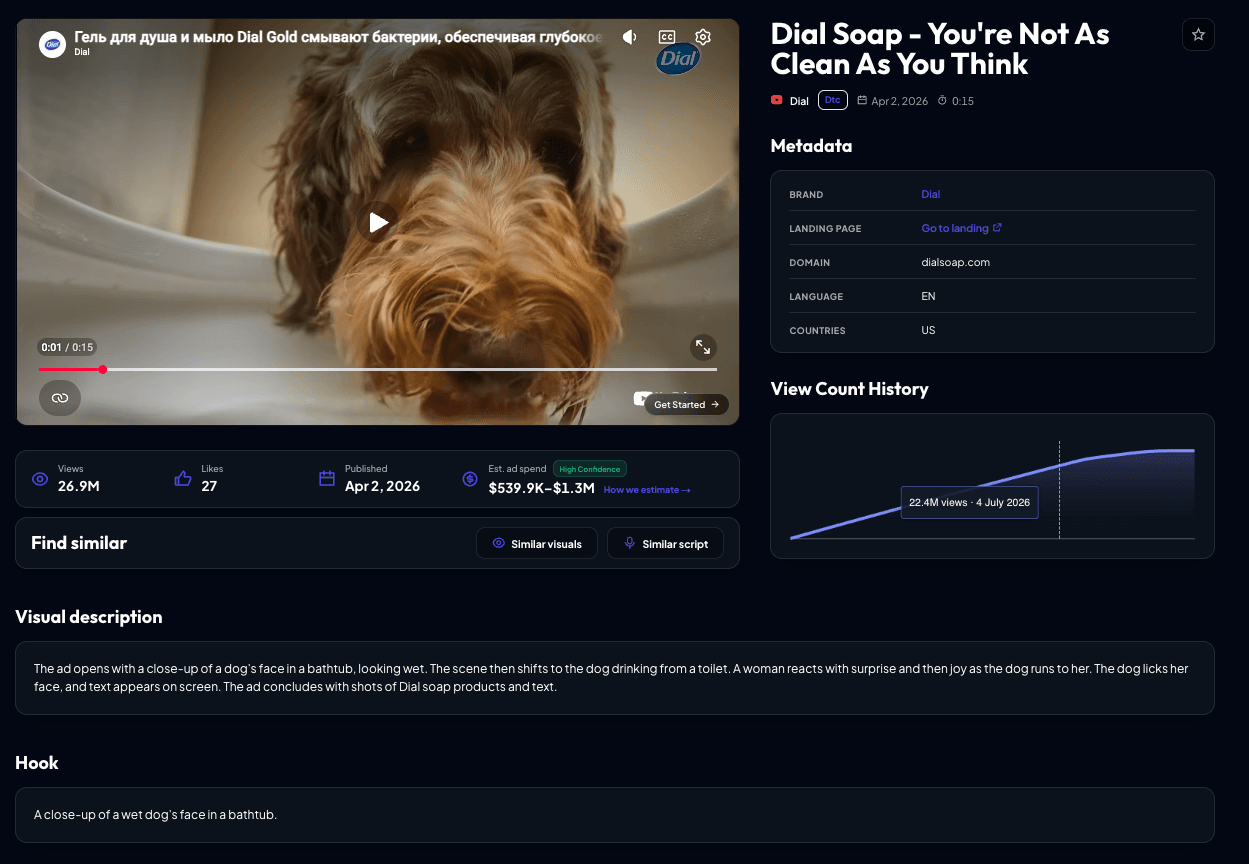
On April 2, 2026, Dial published "You're Not As Clean As You Think." The creative, per the AdSee AI breakdown: a wet dog in a bathtub; the same dog drinking from the toilet; the dog joyfully licking its owner's face; the line lands — you're not as clean as you think... aren't you glad you use Dial. End card: product lineup and the claim "#1 Antibacterial Soap." By July 4, the spot had accumulated 22.4M views on an estimated $448.5K–$1.1M in media spend, high confidence, US-only, per AdSee AI.
The companion: the crumb-covered remote, 9M views
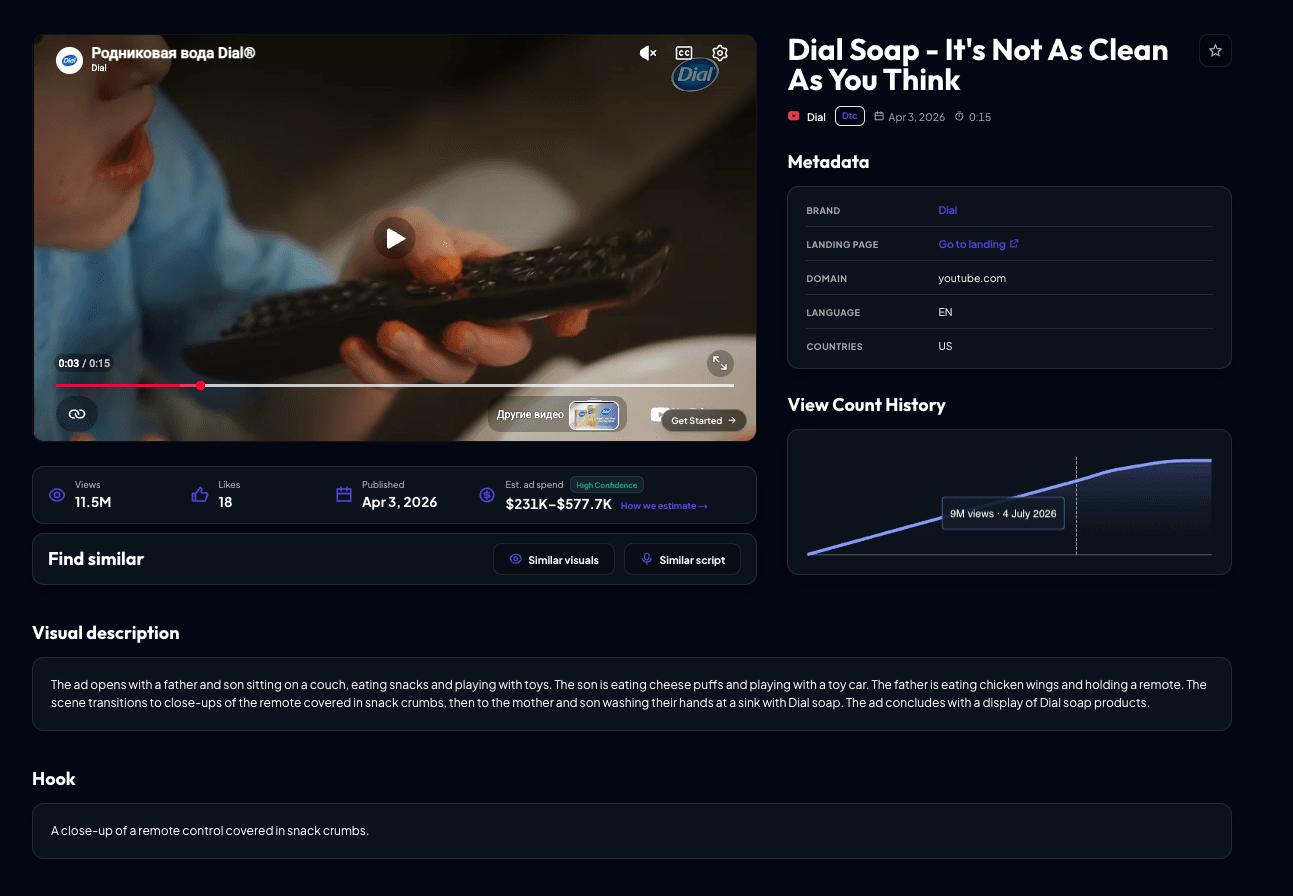
One day later, April 3, the second spot: a dad and son on the couch, chicken wings and cheese puffs, a close-up of a remote control coated in snack crumbs, then hands being washed with Dial. Per AdSee AI, the companion reached 9M views on an estimated $181.2K–$453.1K, high confidence, also US-only and also exactly 15 seconds.
The rest of Dial's eight-creative fleet
The two flagship spots are two of 8 ads the advertiser had live in the window, per AdSee AI. Our export covers the two flagships in full; what the fleet count itself tells you is discipline. A brand running eight creatives could have run eight messages — a scent story here, a moisturizing claim there. Dial pointed its two biggest media commitments, a combined seven-figure-capable flight, at one message and one villain. When you see a multi-creative fleet where all the visible spend concentrates on a single idea, you're looking at a brand that finished its strategy argument before the shoot, not after.
What Dial is actually selling (hint: not soap)
Dial sells protection from invisible everyday germs, not a bar of soap, and the creative structure proves it: both 15-second spots stage a threat you can't see — a dog's tongue, a crumb-coated remote — and position the product as the tool that removes it, per AdSee AI's creative breakdown. That's a story choice, and it's the whole case.
Walk down the soap aisle of most brands' advertising and you'll find the same three stories: the beautiful packaging, the delightful scent, the spa-like moment of me-time in the shower. Notice who the hero of those stories is: the product. Its design. Its fragrance. Its aesthetic.
Dial made the opposite choice.
The customer is the hero, the germ is the villain
In these ads, the customer is the hero — specifically, a millennial with a dog or a kid, someone whose daily life is full of love that happens to be covered in germs. The villain isn't a competing soap. The villain is invisible: the bacteria on the tongue that licks your face, the crumbs on the remote everyone touches. And the brand appears only as the guide — the tool the hero uses to win.
This is the structure Google's own creative research keeps arriving at from the data side. Suzana Apelbaum, head of creative and innovation at Google Media Lab, said it plainly in Think with Google's creative experiment learnings: "to break through on any platform, being relevant is key." Relevance here isn't demographic targeting — it's staging the ad inside a moment the viewer already lives daily. Every dog owner has been licked. Every parent has touched that remote.
The three layers of the problem the campaign solves
Look at the three layers of the problem this campaign addresses. The external problem: germs on your skin. The internal problem: that quiet, nagging question — am I actually clean? Is my family actually protected? The philosophical problem: taking care of the people (and creatures) you love shouldn't come with hidden risks. Ads that sell packaging solve none of these. Ads that sell protection solve all three.
This is functionality-first positioning, and the timing is cultural, not accidental. In an era of overconsumption fatigue, buyers have started grading products on the result they deliver, not the shelf appeal they project. A pretty bottle is a cost. Removing germs is an outcome. Dial — a brand built on antibacterial positioning since 1948, per its Wikipedia entity history — leaned into the one story competitors selling "freshness" can't copy without admitting they were selling the wrong thing.
One message, one villain, one product, one destination
Even the landing page follows the discipline: per AdSee AI, the ad links not to the brand homepage but directly to a single product page — the gold antibacterial bar. One message, one villain, one product, one destination. If you confuse, you lose; Dial doesn't confuse.
Compare that with the default behavior of most consumer brands, which route ad clicks to a homepage carrying every product line, a store locator, a careers link, and three rotating banners. Each additional choice on the landing page is a place for the doubt the ad planted to dissipate. Dial's funnel has exactly one next step, which matters double for a product that mostly converts offline: the click isn't the sale, it's the rehearsal of the shelf decision.
The search curve: how a YouTube flight coincided with a 39-to-100 Trends breakout
"Dial Soap" search interest broke out of a year-long 38–44 plateau to its annual peak of 100 in the week of April 12, 2026, directly overlapping the campaign window, per Google Trends weekly data for the US. That's the scoreboard for this campaign — not clicks, not likes. But the timing deserves an honest read, so let's give it one.
The honest read on timing: YouTube joined a fire already lit
The curve starts moving in the week of March 22 — before the YouTube flight published on April 2–3. The campaign was almost certainly already live on other channels; YouTube joined mid-ascent and rode the wave to the April 12 peak of 100. So we won't claim YouTube alone lit the fire. What the data does show: the brand's biggest search wave in over a year coincides exactly with this campaign window, a second wave follows in mid-May (back up to 77), and the whole quarter holds at 55–77 against a 39-point baseline.
Why doubts get googled and packaging doesn't
Compare this to a pattern we've documented before: pure memory-refresh campaigns — snack-brand bumpers bought for frequency — leave search untouched. Dial's campaign moved search. Why the difference? Because this message is a claim about YOU, not about the product. "You're not as clean as you think" is a doubt, and doubts get googled. A campaign built on a question sends people to find the answer; a campaign built on a package shot doesn't send them anywhere until they're at the shelf.
That's worth writing down: if you want search lift from video, advertise a problem, not a product.
Why dialsoap.com traffic barely moved — and why that was the plan
Dialsoap.com registered 42.7K visits in April, 50.7K in May (+19%), and 41.4K in June, per Similarweb — a rounding error against a campaign delivering roughly 240K hero-ad views per day, and exactly what a shelf-first strategy predicts.
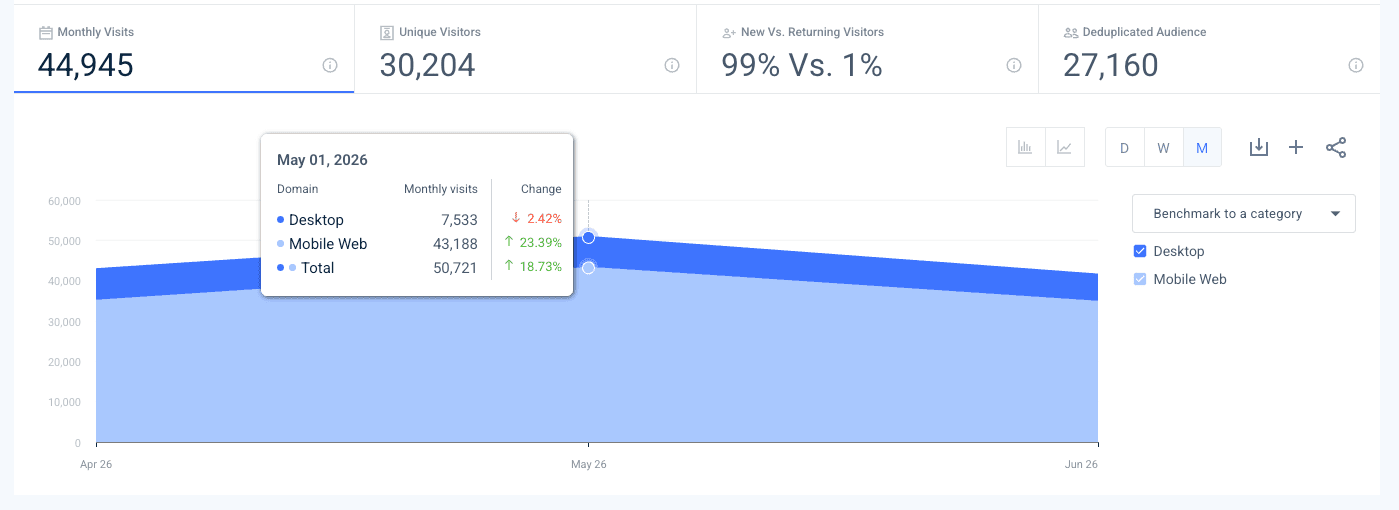
Hold those numbers against the media: the hero ad accumulated five times the website's monthly audience, every single day. The site is a brochure; the sale happens at Target and Kroger, next to the competing bars. Which is exactly why the campaign optimizes for the two things that survive the trip to the store — the doubt ("am I clean?") and the answer (the gold bar) — rather than for clicks that a shelf-sold product can't use.
There's a structural lesson here for anyone auditing competitors with web analytics alone: for retail-converting brands, Similarweb will tell you almost nothing about campaign scale. The 31M+ combined views documented in the AdSee AI YouTube ads library are invisible in the traffic chart. Creative-level ad intelligence is the only layer where this campaign is measurable at all.
The like-to-view ratio: what 27 likes on 22.4M views actually diagnose
The hero ad's 27 likes against 22.4M views — one like per roughly 830K views, derived from the AdSee AI counts — is not a failed creative; it's the fingerprint of a forced-instream reach buy. The companion shows the same signature: 18 likes on 9M views, about one per 500K. Nobody chose these ads. They played, they planted the question, they left. For this strategy, that's not a bug; that's the spec.
The mechanism: like-to-view ratio works as a public lie detector for how a creative was delivered. Content-level rates — one like per roughly 80–400 views — indicate chosen viewing: discovery placements, fandom, native formats people actively watch. Rates near one per 100K views and beyond — the band where both Dial creatives sit, per AdSee AI — indicate forced instream reach, where the view is bought, not chosen. A 2025 study in the Journal of Advertising Research examined how skippable and non-skippable YouTube formats differ in perceived intrusiveness — the format you buy shapes how the audience receives you, and the like counter is where that reception becomes publicly visible.
Where the like-rate diagnostic lies
The metric has failure modes worth naming before you build decisions on it. It breaks when a channel disables likes; it skews low on content watched heavily by kids, who rarely log in to engage; it stops being comparable when you mix formats — a Shorts placement and a 15-second instream spot have structurally different engagement baselines; and it says nothing about the outcome that pays the bills — shelf sales in Dial's case, installs and retention in an app advertiser's. Use it to read the buy type, never to grade the creative's business result.
How to run this teardown yourself with a YouTube ads library
You can reproduce every step of this analysis on any advertiser in about an hour, using a YouTube ad tracker plus two free public sources. Here's the sequence we followed:
- Pull the advertiser's active creatives from the AdSee AI YouTube ads library: publish dates, view and like counts, countries, landing URLs, and spend estimates per creative.
- Read the geography. A US-only list like Dial's means single-market focus and high-confidence spend math; a scatter of small cheap markets means you've caught a test, not a launch.
- Compute like-to-view per creative to identify the buy type — chosen viewing versus forced reach — before you judge any creative's "performance."
- Overlay Google Trends for the brand query across the campaign window, watching for the curve starting before your earliest ad publish date, which flags other channels in play.
- Add Similarweb for the landing domain — and when traffic doesn't move, treat that as a finding about the funnel, not a data failure.
- Check where each ad actually lands. A single product page versus a homepage tells you whether the brand finished its message discipline.
Steps 1 and 3 are the ones a web-analytics-only stack cannot do at all, which is the practical argument for having a creative-intelligence layer in a competitive research workflow.
Where the problem-first playbook stops working
Problem-first, no-CTA advertising is not a universal upgrade, and three concrete boundaries show where it fails. Naming them matters more than another paragraph of praise.
First: it requires distribution the viewer can't avoid. The doubt-planting mechanic works because forced instream guarantees the question gets asked — 31M+ documented views across the two Dial spots, per AdSee AI. A startup buying skippable views at content-level engagement rates would watch the same creative get skipped at second five, before the reveal lands.
Second: it requires a shelf to convert on. Dial's funnel ends at Target and Kroger, so a campaign that produces zero measurable clicks is still doing its job. A DTC brand running the same clickless strategy would be spending against a funnel with no next step.
Third: the category's claims environment is constrained, and the story has to respect that. The FDA's 2016 final rule removed 19 active ingredients, including triclosan, from over-the-counter consumer antibacterial washes, and the agency's 2024 consumer update states plainly that washing with plain soap and water remains the baseline it recommends. "It's simple, and it works," said Theresa Michele, M.D., of the FDA's Division of Nonprescription Drug Products. That regulatory reality is precisely why the campaign sells a feeling of protection and a question about the viewer, rather than a clinical superiority claim — and it's the boundary any marketer borrowing this playbook in a regulated category needs to map before writing the script. Emotional truth travels where hard claims can't; the flip side is that the emotional claim has to stand on its own, because the hard claim isn't coming to save it.
How we counted (methodology)
Sample: Dial YouTube ad creatives with US placement in Q2 2026, identified via a YouTube ad tracker (the AdSee AI ads library): the hero published April 2, 2026 and the companion April 3, 2026, out of 8 creatives live from the advertiser in the window; view and like counts from public YouTube counters as of July 4, 2026. Spend estimates are AdSee AI's, derived from views and US CPV benchmarks ($0.02–0.05 per view), shown as ranges with high confidence for single-market campaigns. Cross-checked against the raw JSON export: hero at 22,427,994 views and $448.6K–$1.12M estimated spend. Website traffic: Similarweb, dialsoap.com, April–June 2026. Search interest: Google Trends weekly series, "Dial Soap", United States, 2026, exported to CSV (baseline 38–44 through mid-March; 62 the week of March 22; 100 the week of April 12; second wave to 77 in mid-May). Regulatory context: FDA public documents and consumer updates, linked in the sources block.
What to steal for your next campaign
Make the customer the hero and the problem the villain. Dial's villain is invisible germs hiding inside moments of love — a dog's kiss, a kid's snack. Find the villain in your customer's ordinary day, and your product stops being a package and starts being a tool.
Sell the outcome, not the object. In a market tired of overconsumption, function beats aesthetics. If your product genuinely does something — protects, saves, prevents — advertise the doing, and let competitors fight over the prettiest bottle.
Advertise a problem if you want search lift. Doubts get googled; packaging doesn't. A claim aimed at the viewer ("you're not as clean as you think") converts video reach into verification searches in a way product-beauty ads never will.
Match the buy type to the mechanic. Doubt-planting needs forced reach; a skippable buy would cut the same creative off before the reveal. Read your own like-to-view ratios the way we read Dial's, and confirm the delivery you're paying for is the delivery the script assumes.
If you want to improve YouTube ads that sell shelf products, stop grading them on clicks. Grade the pair that matters: did search interest move, and did the message survive to the store? Dial's 27 likes are irrelevant; the 100 on the Trends chart is the scoreboard.
FAQ
What is Dial's "You're Not As Clean As You Think" campaign? A US YouTube campaign launched April 2–3, 2026, built on two 15-second spots — a dog that drinks from the toilet then licks its owner, and a snack-crumbs-covered remote — positioning Dial antibacterial soap as protection from invisible everyday germs. Per AdSee AI, the two creatives collected 22.4M and 9M views respectively by early July 2026.
How much did Dial spend on the campaign? According to AdSee AI estimates, the hero ad corresponds to $448.5K–$1.1M in media spend and the companion to $181.2K–$453.1K, both with high confidence as single-market US campaigns — a combined flight of over 31M views across two of the brand's 8 active creatives.
Did the Dial campaign affect search interest? Google Trends shows "Dial Soap" search interest breaking out of a year-long 38–44 plateau to a peak of 100 in the week of April 12, 2026, directly overlapping the campaign window, with 2026 interest running 50% above 2025. The curve began rising the week of March 22, suggesting the campaign was live on other channels before the YouTube flight documented by AdSee AI joined on April 2–3.
Why do the Dial ads have so few likes? Because they're forced-instream reach buys: per AdSee AI, 27 likes on 22.4M views (one per 830K) and 18 on 9M. The campaign's job is planting a doubt that resurfaces at the store shelf, not earning engagement — a deliberate strategy for a product that converts in retail, where dialsoap.com's 41–51K monthly visits (per Similarweb) play no meaningful funnel role.
How do you find a competitor's YouTube ads? Use a YouTube ads spy tool that indexes creatives at the ad level. The AdSee AI YouTube ads library surfaces an advertiser's active and past creatives with publish dates, view and like counts, target countries, landing URLs, and estimated spend — the dataset this Dial teardown was built on, and one that web analytics platforms cannot see.
What makes a YouTube ad effective without a call to action? A CTA-free ad works when the conversion happens somewhere the click can't reach — in Dial's case, the retail shelf. Per AdSee AI, neither Dial spot carries a CTA; both plant a doubt ("you're not as clean as you think") designed to resurface at the point of purchase, which Google Trends data suggests converted reach into search instead of clicks.
Is a high like count worth optimizing for in YouTube advertising? Not directly. Like-to-view ratio diagnoses how an ad was delivered — chosen viewing versus forced instream reach — not whether it worked commercially. Dial's hero earned one like per 830K views, per AdSee AI, and still coincided with the brand's biggest search breakout in over a year, per Google Trends. Optimize the metric your funnel actually pays on.
Does YouTube advertising work for products sold in retail stores? Yes, but the scoreboard changes. Dial's campaign generated over 31M views, per AdSee AI, while dialsoap.com stayed at 41–51K monthly visits, per Similarweb — the sale happens at the shelf, so search lift and message recall replace clicks as success metrics. Grade retail campaigns on brand-query movement in Google Trends, not on site traffic.
Data and sources
Ad creatives, publish dates, view and like counts, creative count, landing pages, and spend estimates — the AdSee AI YouTube ads library. Website traffic — Similarweb (dialsoap.com). Search interest — Google Trends ("Dial Soap", US, 2026, weekly CSV export). Brand claim ("#1 Antibacterial Soap") — the campaign's own end card. Creative relevance research — Think with Google, "Our video ad creative experiment learnings" (business.google.com/us/think/search-and-video/video-ad-creative-experiments/). Format intrusiveness research — Journal of Advertising Research, 2025 (tandfonline.com/doi/full/10.1080/00218499.2025.2464276). Regulatory context — U.S. FDA, "Skip the Antibacterial Soap; Use Plain Soap and Water" (fda.gov/consumers/consumer-updates/skip-antibacterial-soap-use-plain-soap-and-water). Brand entity history — Wikipedia, "Dial (soap)" (en.wikipedia.org/wiki/Dial_(soap)).