
Ten FIFA World Cup 2026 ads from the AdSee AI YouTube ads library collected 325.3M views and just 204 likes between them. That is one like for every 1.6M views. On most platforms, a number like that would mean the campaign failed. On YouTube, it usually means the opposite: the brand paid for reach, and the reach was delivered.
The ten advertisers are Aramco, AXE, Clear Men, ViX, ZURU Ballers, Coca-Cola, Deliveroo, Powerade, Lay's and McDonald's UK. Their ads look very different. One shows oil tankers and data screens. Another shows a man wrapped in gold foil on a plane. A third is a six-second video call with football legends. But when you put the ten ads side by side, the same decisions appear again and again: when to launch, how long to run, which markets to buy and where to send the click.
This article breaks down those decisions with the numbers behind them. It also shows how you can run the same teardown on your own competitors before the next big tournament, and where this kind of analysis stops being reliable.
The 10 World Cup ads in this YouTube ad library sample
The sample covers 10 YouTube ads from 10 brands, all tied to the 2026 FIFA World Cup and all published between February 27 and June 17, 2026, per AdSee AI. We picked the highest-view creative per brand and left out duplicates, so one advertiser cannot dominate the set.
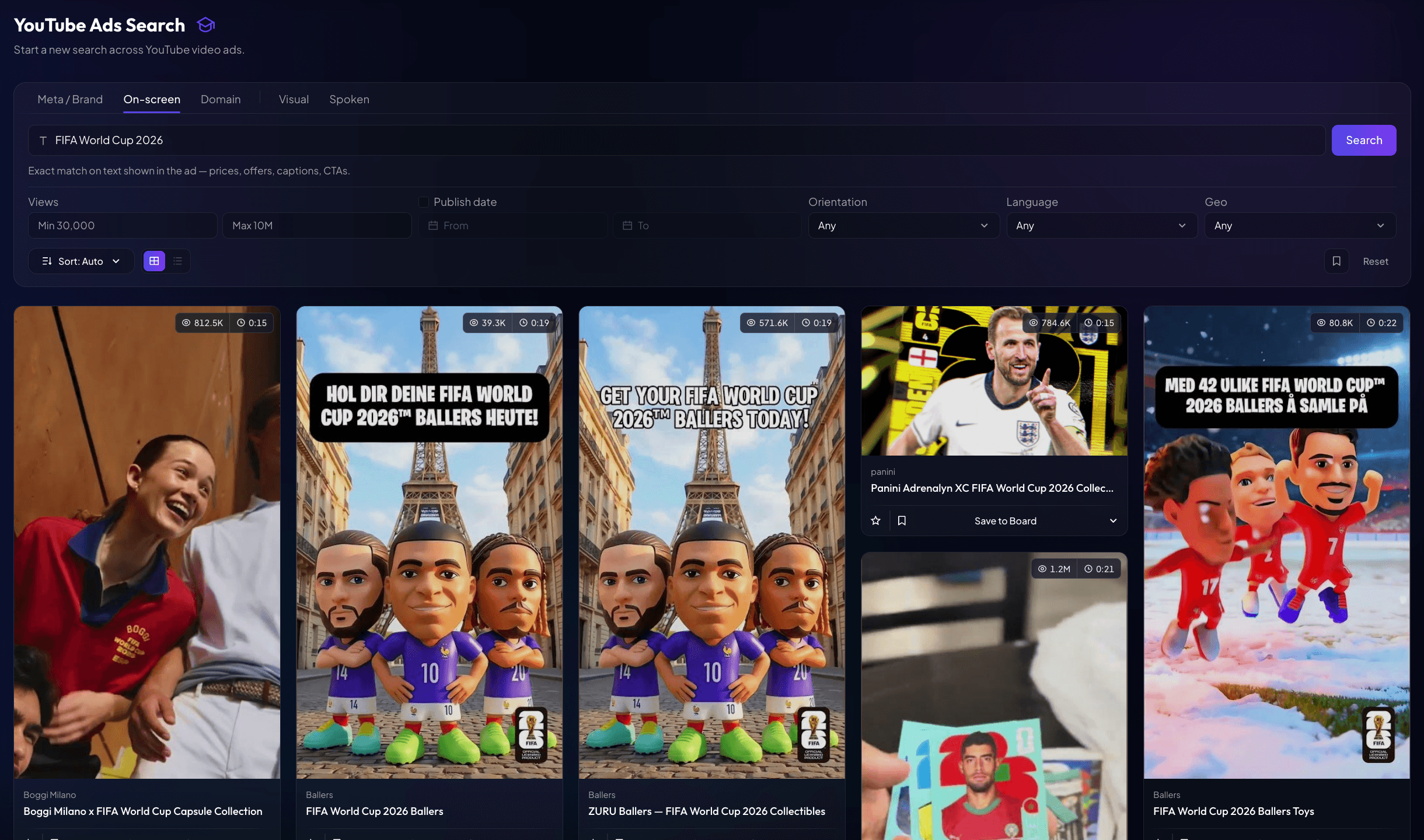
Here is the full set, with view and like counters read on October 4, 2026:
| Brand | Market | Language | Length | Views | Likes | Published |
|---|---|---|---|---|---|---|
| Aramco | 8 markets, US to Japan | English | 15s | 81.6M | 5 | May 3 |
| AXE México | Mexico | Spanish | 15s | 52.4M | 152 | April 8 |
| Clear Men | Brazil | Portuguese | 10s | 48.7M | 7 | June 17 |
| ViX | Mexico | Spanish | 15s | 43.3M | 1 | May 26 |
| ZURU Ballers | Mexico, Spain | Spanish | 13s | 27.0M | 0 | February 27 |
| Coca-Cola | Brazil | Portuguese | 15s | 21.7M | 30 | May 22 |
| Deliveroo | UK (per file name) | English | 13s | 17.4M | 9 | June 1 |
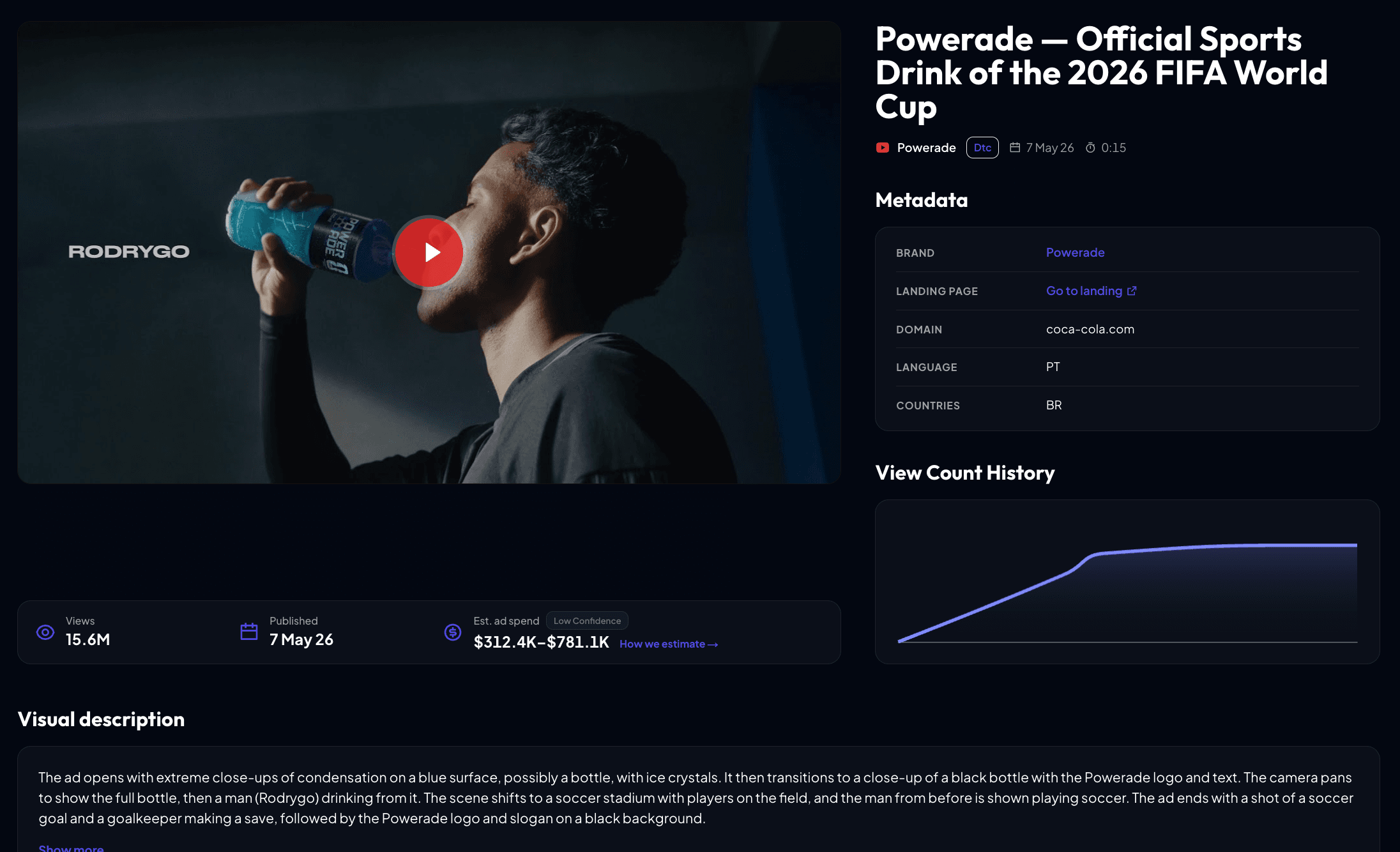
| Powerade | Brazil | Portuguese | 15s | 15.6M | 0 | May 6 |
| Lay's Polska | Poland | Polish | 6s | 10.9M | 0 | May 8 |
| McDonald's UK | UK (per channel) | English | 10s | 6.3M | 0 | June 2 |
Two things stand out before any analysis. First, Aramco alone holds about a quarter of all views: 81.6M of 325.3M. Second, the biggest audiences are not in the host countries you might expect. Mexico is a host, and three of the ads target it. But Brazil, which is not a host, gets three ads too.
Why 325M views produced only 204 likes
These World Cup ads got so few likes because almost all of their views were bought as in-stream reach, not chosen by viewers: across the sample, AdSee AI counts one like per 1.6M views. A person who sees an in-stream ad came to YouTube to watch something else. They did not search for the ad, and most of them will not react to it.
The numbers are extreme even for paid video. Four of the ten ads have zero likes. ViX has one like on 43.3M views, and Aramco has five likes on 81.6M views, per AdSee AI.
How the like-to-view ratio works on YouTube
The like-to-view ratio is a simple signal: it shows whether people chose to watch. In earlier AdSee AI teardowns, formats that people watch by choice, such as discovery placements, fan content and native-looking videos, ran at roughly one like per 80 to 400 views. Forced in-stream reach usually sits at one like per 100K views or worse.
Every ad in this World Cup sample sits in the second group. Even the "best" one is far away from content-level engagement. That tells you how each brand bought its media, not whether the creative was good.
Where AXE's 152 likes fit
AXE México collected 152 of the 204 likes, or 75% of all likes in the sample, from 52.4M views, per AdSee AI. That is one like per about 345K views. It is the highest rate in the set, and it is still roughly a thousand times weaker than content-level engagement.
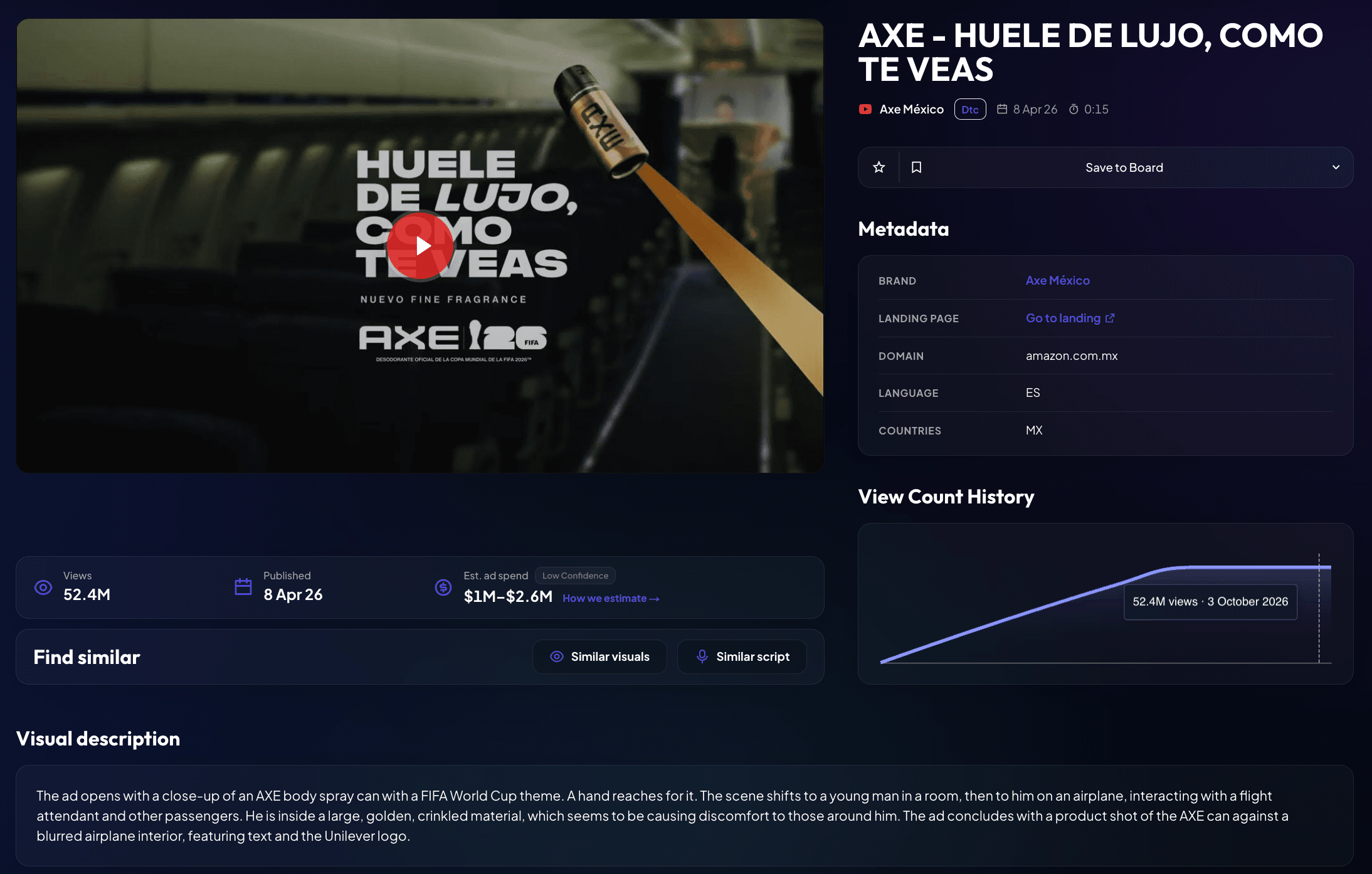
The ad itself helps explain the small difference. A young man boards a plane wrapped in crinkly gold foil and annoys everyone around him. The joke is physical and easy to follow without sound. AXE was the only ad in the set with a clear comic idea, and it got slightly more reaction. But "slightly more" is the honest summary. Nobody in this sample earned likes at scale.
Timing: 9 of 10 World Cup ads went live before the June 11 kickoff
Nine of the ten ads were published before the opening match on June 11, 2026, according to AdSee AI publish dates. The tournament itself ran from June 11 to July 19 in Canada, Mexico and the United States, as the 2026 FIFA World Cup entry on Wikipedia records. So the advertising window opened weeks or even months before the first whistle.
The only ad that launched during the tournament is Clear Men, published on June 17. Every other brand wanted to be in front of fans while they were still building excitement, buying merchandise and planning where to watch.
ZURU Ballers started in February
ZURU Ballers published its ad on February 27, 2026, more than three months before kickoff, per AdSee AI. That is the earliest date in the sample by almost six weeks.
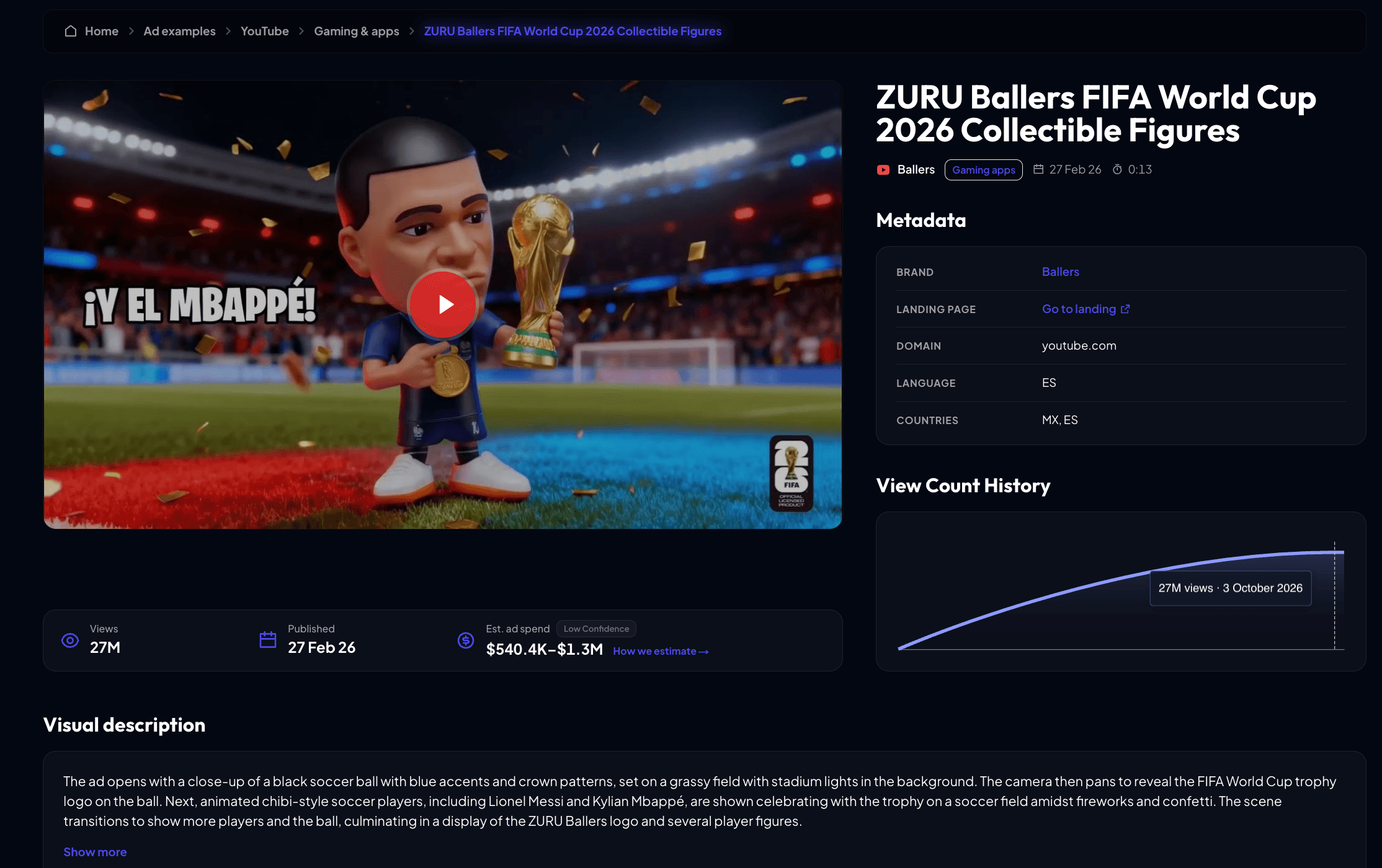
The early start makes sense for the product. ZURU sells collectible figures of football players, and the ad's title asks viewers to find the "super rare" Messi and Mbappé figures. Collections take time. A child who starts collecting in March has three months to complete the set before the tournament. A collectible launched in June would miss most of that buying cycle.
Seven ads launched in 31 days
Seven of the ten ads went live between May 3 and June 2, a 31-day window, per AdSee AI: Aramco, Powerade, Lay's, Coca-Cola, ViX, Deliveroo and McDonald's UK. This is the main pre-tournament push.
The pattern matters if you are planning around a big event. The real competition for attention starts about five weeks before the event, not on the day itself. By kickoff, most of these campaigns had already been running for weeks and had collected most of their reach.
Length: every ad is 15 seconds or shorter
All ten World Cup ads run 15 seconds or less, and the average length is 12.7 seconds, according to AdSee AI. Five ads use the full 15 seconds, two run 13 seconds, two run 10 seconds, and one runs just 6.
Nobody in this set tried a long story. There is no 60-second brand film, no mini-documentary and no founder talking to camera. Each ad carries one idea, one football moment and one product.
Lay's did it in a 6-second bumper
Lay's Polska ran the shortest ad in the sample: a 6-second bumper with 10.9M views in Poland, per AdSee AI. A man eats chips during a video call with football legends. AdSee AI's visual description names David Beckham, Thierry Henry and Lionel Messi on the call.
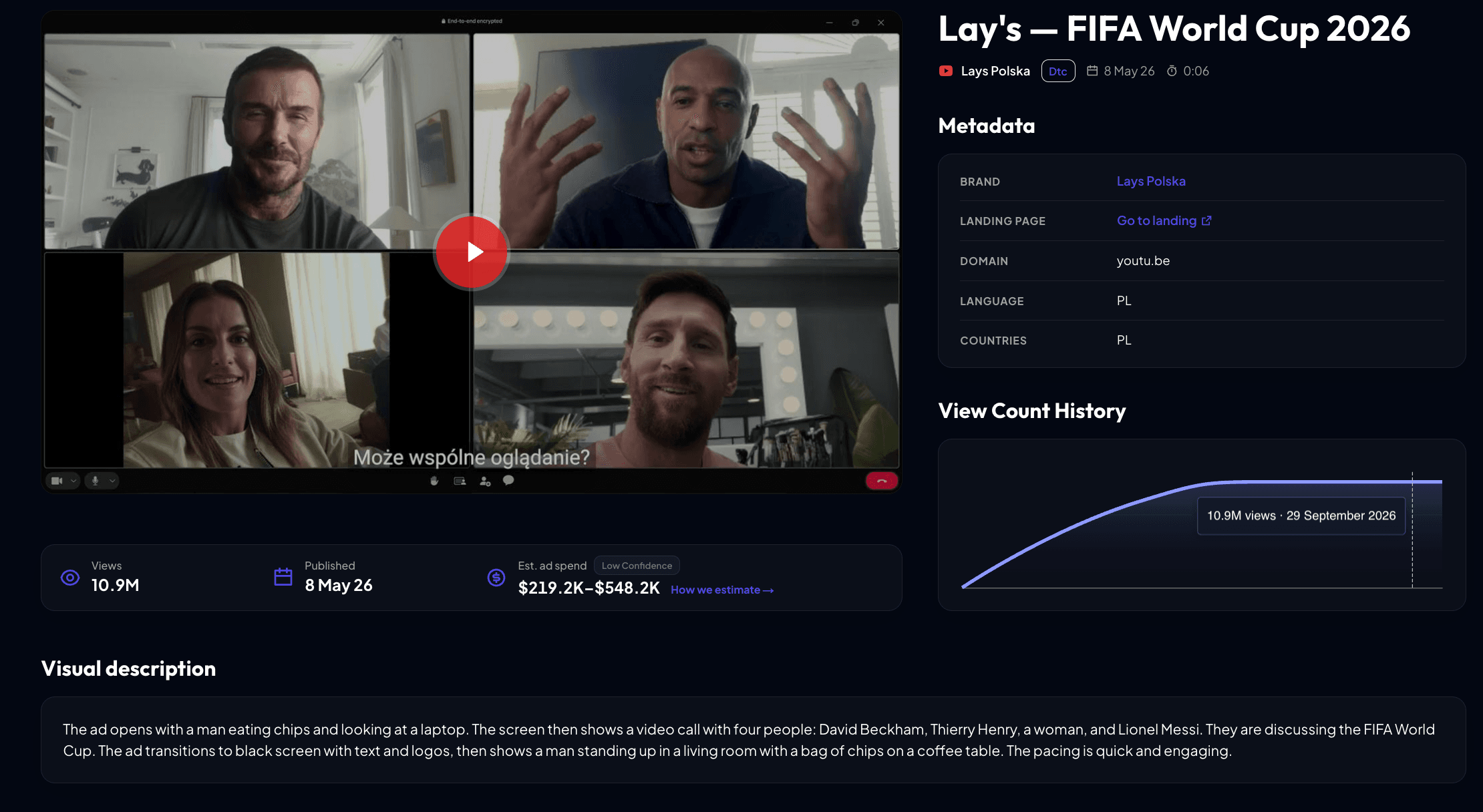
Six seconds is the format limit. Google's video ad formats guide describes bumper ads as non-skippable ads lasting 5 to 6 seconds. That leaves room for one gag and one product shot. Lay's used famous faces so the gag would land in under two seconds, and put the bag of chips on the table so the product never leaves the screen.
Why under 30 seconds changes what you pay
Short ads also change the economics of skippable in-stream buying. Google Ads Help explains that viewers can skip after 5 seconds, and that the advertiser pays when someone watches 30 seconds, or the whole ad if it is shorter than 30 seconds.
For a 15-second ad, that means every paid view is a complete view. The brand never pays for half a message. That is a strong reason to keep tournament ads short: you pay only for people who saw the logo, the product and the end card.
Format: horizontal in-stream, and a CTV signal from Aramco
All ten ads in this sample are horizontal, built for the classic in-stream slot rather than for Shorts, per AdSee AI records checked against the video frames. This includes Aramco, even though its AdSee AI metadata labels it as portrait. The frame on the card is clearly 16:9, which we cover in the limitations section below.
The choice of horizontal fits the event. People watch football on big screens: TVs at home, screens in bars, laptops at work. A horizontal ad matches the screen where the match is playing.
Research supports staying with skippable in-stream for this kind of reach. A 2025 study in the Journal of Advertising Research by Davtyan, Tashchian and Thomas found that skippable ads are perceived as less intrusive than non-skippable ones, while non-skippable ads are stronger for brand recall. A short skippable ad tries to get both: it is easy to accept, and it is short enough that most viewers see the brand before they can skip.
Aramco bought reach in 8 markets, including connected TV
Aramco ran the most global ad in the set: 81.6M views across 8 markets, from the United States to Pakistan, India, South Korea, Singapore, Hong Kong, the Philippines and Japan, per AdSee AI. It is also the only ad here with a high-confidence spend estimate: $1.6M to $4.0M.
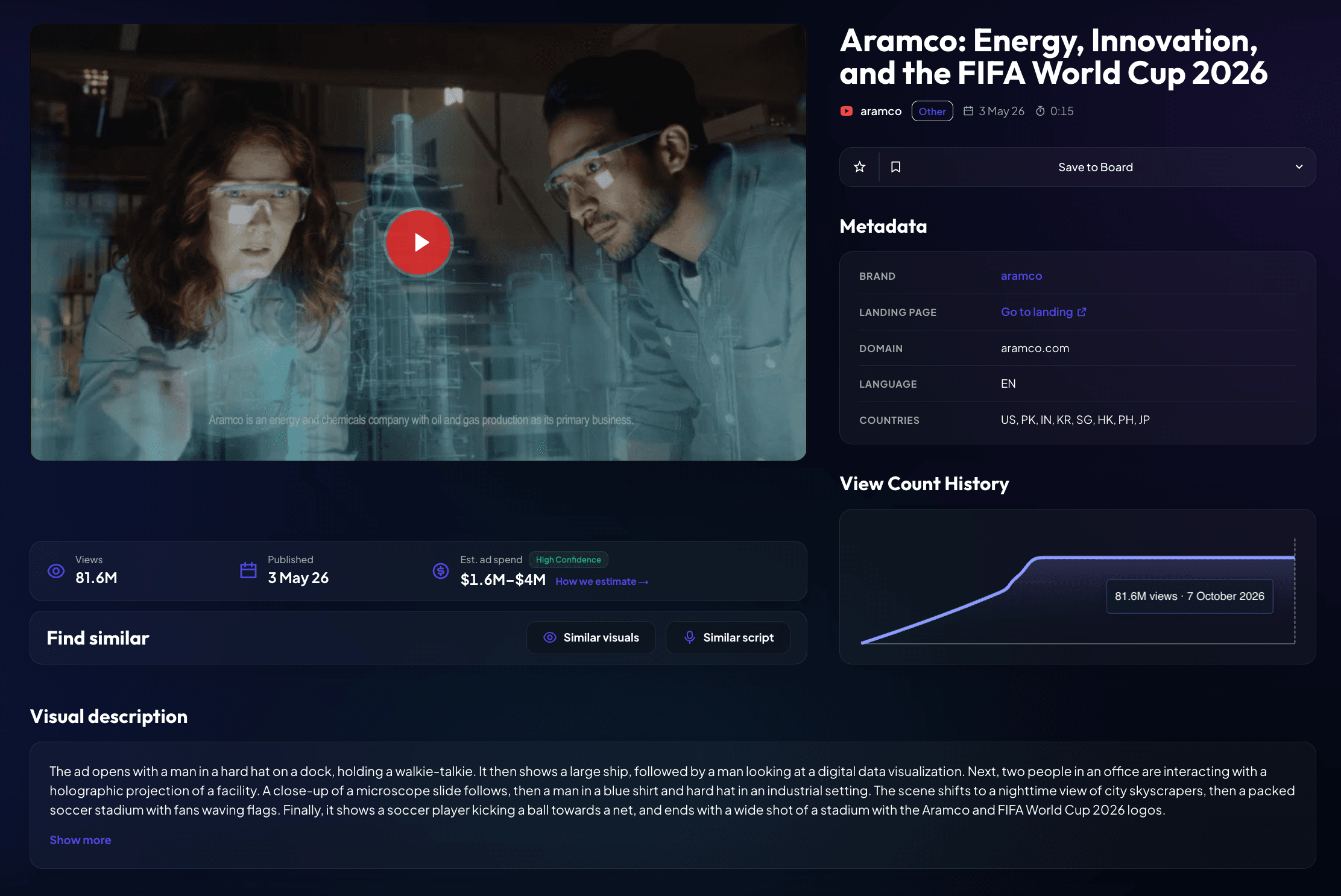
The landing page link reveals more. Its UTM parameters include "ctv-youtube" as the source and "ctv" as the medium, per the landing URL stored in AdSee AI. In plain words, at least part of this campaign was bought as connected TV, meaning YouTube watched on a television. That explains both the horizontal frame and the five likes: almost nobody presses "like" with a TV remote.
The creative logic behind Aramco's football ad
Aramco's ad is not really about football. It opens with a man in a hard hat on a dock, then shows a ship, data screens and a laboratory. Only near the end do we see a packed stadium and a player kicking the ball. Football is the reward at the end, not the story. For an energy company, the World Cup is a reason to be seen by a huge audience, and the ad uses that audience to talk about technology.
Geography: 6 of 10 World Cup ads are Mexico or Brazil plays
Six of the ten ads target Mexico or Brazil, and together they account for 208.9M views, or 64% of the sample, per AdSee AI. Three ads run in Mexico (AXE, ViX and ZURU Ballers, which adds Spain). Three run in Brazil (Clear Men, Coca-Cola and Powerade).
The World Cup is a global event, but the ad buying behind it is mostly local. Each brand picked one country, one language and one cultural angle, then spent heavily there.
Reading country lists as campaign lifecycle stages
A country list in a YouTube ad tracker is not just a targeting setting. It often shows where a creative sits in its life. Small, cheap markets usually mean a test. A regional cluster means a rollout. Two or three big markets sustained over time mean focused scale. Fifty or more countries, including expensive ones, mean a proven creative running on a global budget.
In this sample, six ads are single-market buys, one runs in two related markets (ZURU in Mexico and Spain), and one runs across eight (Aramco). There is no ad in the "test" stage. These are finished creatives, launched at full scale in their chosen market. For tournament advertising, that makes sense: there is no time to test in June.
Coca-Cola and Powerade: one company, two jobs in Brazil
Coca-Cola and Powerade both target Brazil, both send clicks to coca-cola.com, and both use Portuguese, per AdSee AI. Powerade is a Coca-Cola brand, so the same company runs two ads in the same market with different goals.
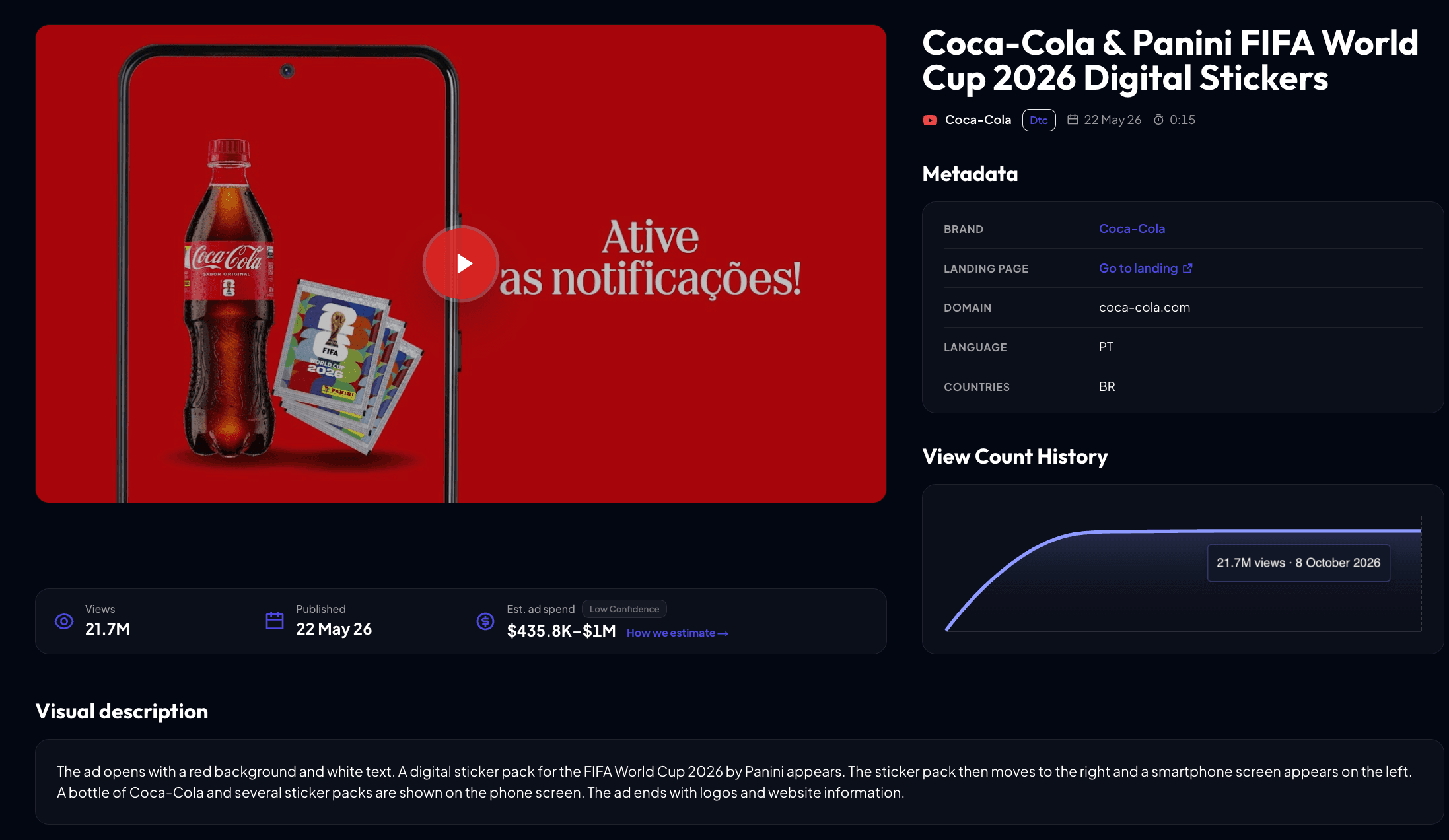
Coca-Cola's ad opens with an offer written on screen: sign up and get a free pack of digital Panini stickers. There is no player and no stadium. It is the only ad in the set whose hook is the call to action. Powerade's ad does the opposite. It opens with ice crystals on a bottle, then shows Brazilian player Rodrygo drinking, playing and watching a goalkeeper make a save, per AdSee AI's visual description. Coca-Cola sells a game for fans. Powerade sells performance for players. The company splits the audience and gives each brand one clear job.
Landing pages: where the click goes in a YouTube marketing campaign
Only four of the ten ads send viewers to the brand's own website, according to the landing pages stored in AdSee AI: Aramco, ViX, Coca-Cola and Powerade. Two send clicks to Amazon, two send them to other YouTube pages, and two have no landing page recorded.
The landing page is one of the most useful fields in any YouTube marketing campaign teardown. It tells you what the brand wants to happen after the view, which is often more revealing than the ad itself.
Unilever's Amazon route
AXE and Clear Men, both Unilever brands, send YouTube clicks to Amazon stores instead of their own sites, per AdSee AI: amazon.com.mx for AXE in Mexico and amazon.com.br for Clear Men in Brazil. Together these two ads hold 101.1M views, or 31% of the sample.
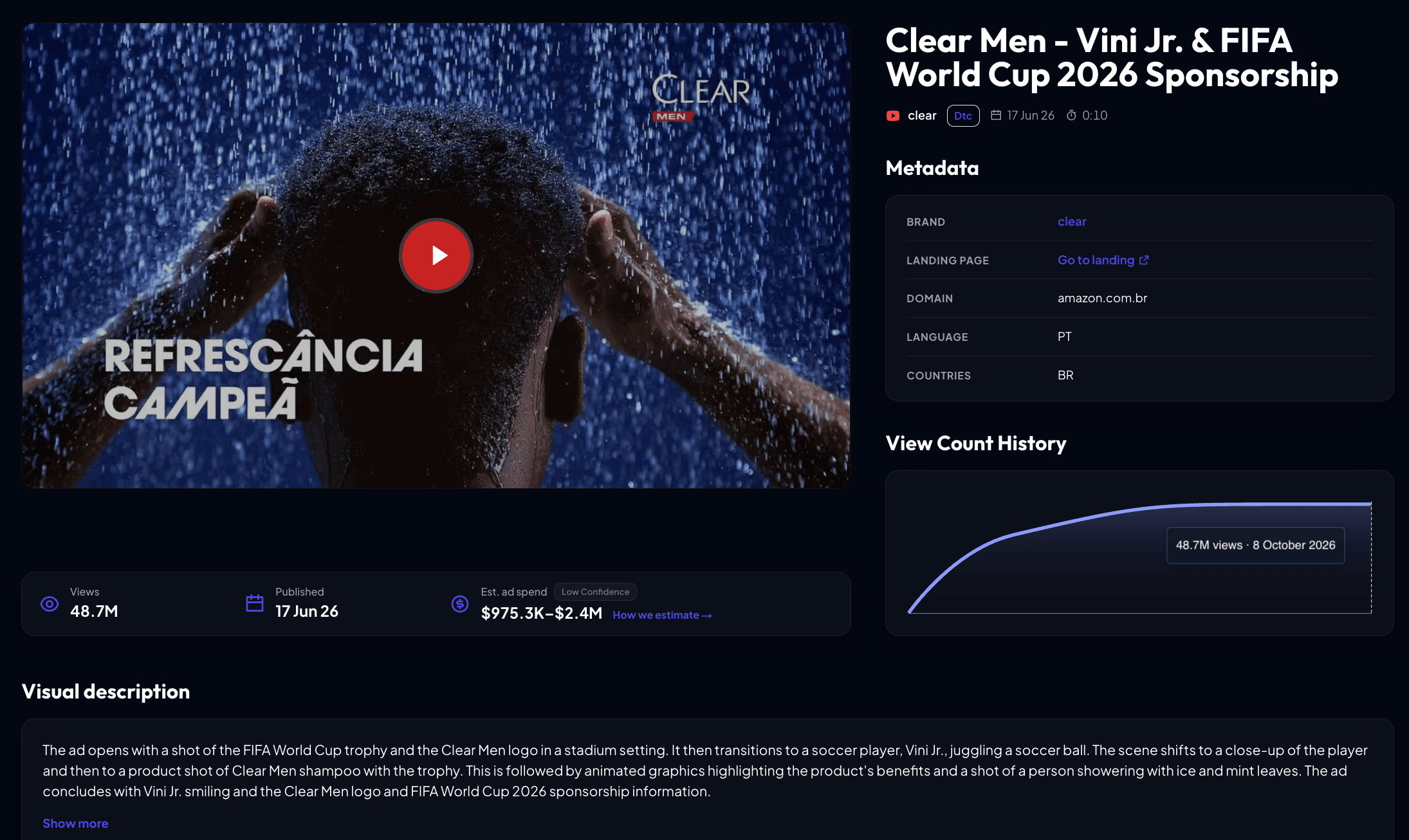
For a personal care product, this is a logical choice. A person who wants a new deodorant or shampoo does not need a brand website. They need a place to buy it with one click. Unilever uses YouTube for reach and lets Amazon handle the sale. The Clear Men link even carries the tag "Always on Copa FIFA" in its channel parameter, which suggests a steady campaign rather than a single burst.
ZURU and Lay's keep the viewer on YouTube
ZURU Ballers sends clicks to its own YouTube channel, and Lay's Polska sends them to another YouTube video, per AdSee AI. Neither brand asks the viewer to leave the platform. For a toy and a snack, the goal is not an immediate purchase online. It is to keep the brand in the viewer's head until the next trip to the shop.
Creative patterns: stars, collectibles and the nervous fan
The ten ads use three repeating creative ideas, per AdSee AI's visual descriptions: real football stars, collectible products and the fan's own emotions. Most brands pick one of these, and a few combine two.
Real stars appear in four ads. Clear Men uses Vini Jr., who appears in the ad's title. Powerade shows Rodrygo. Lay's shows Beckham, Henry and Messi on a video call. ZURU uses cartoon figures of Messi and Mbappé.
Collectibles appear in three. ZURU sells the figures themselves. Coca-Cola gives away digital Panini stickers. McDonald's UK ends its ad on a meal with a collectible cup printed with famous players. In all three, the merchandise is part of the product, not decoration.
The fan's emotions drive two ads. Deliveroo shows a sweaty forehead, socks and slides, and a phone screen reading "RIDER ARRIVED", then pizza on the table. It sells the stress and joy of watching a match, not football itself. ViX shows fans waving flags because ViX is not a sponsor selling a product: it is a streaming service selling the broadcast.
Suzana Apelbaum of Google's Media Lab described this shift in a Think with Google article on creative experiments: on any platform, "being relevant is key — regardless of the platform's scale." The World Cup gives every brand huge scale. The ads in this sample that stand out are the ones that tie the event to something the viewer already cares about: a collection, a snack during the match, the minutes before the delivery arrives.
What the file names reveal about each campaign
Original file names and links show how a brand planned its media, and AdSee AI stores both for every ad: in this sample, four of them name the market, format or length directly. They also reveal creative choices that the ads never say out loud.
Deliveroo's original title is "UK | Q2'26 | World Cup | Lo-Fi | Hero | 16x9 | 13s". In one line, it tells you the market, the quarter, the theme, the production style, the ad's role, the aspect ratio and the length. "Lo-Fi" is especially useful: it confirms that Deliveroo chose a simple, phone-style look on purpose.
ViX's original title includes the words "Sin precio", Spanish for "no price". So the streaming service deliberately ran a version without a price, probably to test brand interest before a pricing message. Coca-Cola's file name confirms the format: "YT_15s_1920x1080_16x9". And the Clear Men link includes "skipinstr", which points to skippable in-stream as the buying format.
If you study competitors regularly, read these fields every time. They are free information about a media plan that the brand would never publish.
Estimated spend: $6.5M to $16.2M across 10 ads
AdSee AI estimates that the ten ads cost between $6.5M and $16.2M in total, based on 325.3M views multiplied by a cost-per-view range of $0.02 to $0.05. This is a rough estimate, not an invoice, and it should be read as a range.
The method is simple. For each ad, AdSee AI multiplies views by $0.02 at the low end and $0.05 at the high end. Aramco, with 81.6M views, lands at $1.6M to $4.0M. McDonald's UK, with 6.3M views, lands at $126.5K to $316.3K, per AdSee AI.
There is an important caveat. That cost-per-view range reflects expensive markets like the United States. Six of these ads run in Mexico and Brazil, where views usually cost less. So the real total is probably closer to the bottom of the range, and AdSee AI marks nine of the ten estimates as low confidence for that reason. Only Aramco, which runs in the US and other premium markets, gets a high-confidence label.
How to run this teardown with a YouTube ad tracker
You can repeat this analysis for any event or competitor in about an hour if you use a YouTube ad tracker that stores dates, countries and landing pages, as AdSee AI does for every ad in its library. Here is the process we used for this article.
- Search by theme, not only by brand. Search the event name in on-screen text, in spoken words and in visual descriptions. Different search types find different ads, so run all three.
- Sort by views and set a date filter. Start from about four months before the event. This catches early launches like ZURU's February ad.
- Keep one ad per brand. Pick the highest-view creative and note the rest. This stops one big advertiser from controlling your conclusions.
- Record the same fields for every ad. Publish date, length, orientation, countries, language, landing page, views and likes.
- Read the country list as a lifecycle stage. Is the ad a test, a rollout or a full-scale burn?
- Open the landing link and the file name. UTM tags and file names often reveal the format, market and campaign type.
- Check orientation and celebrity names by eye. Open the video. Metadata can be wrong, as Aramco's was.
The whole process works with any YouTube ads spy tool that shows these fields. We used AdSee AI because it stores the original file names and full landing URLs, which made the CTV and Amazon findings possible.
Where this analysis stops working
This teardown of 10 World Cup ads in AdSee AI describes what the brands did, not whether it worked, and that limit matters. Here are the specific places where the data can mislead you.
Likes say nothing about sales. A 15-second ad with zero likes may still have sold millions of bags of chips. The like-to-view ratio only tells you how the media was bought. It cannot measure brand lift, store visits or revenue.
Metadata can be wrong. AdSee AI labels Aramco's ad as portrait, but the frame on the card is 16:9. The Clear Men link includes "9x16" in its creative name, while the ad is stored as horizontal. Automatic labels are a starting point. Always check orientation by watching the video.
Spend is an estimate. AdSee AI's $6.5M to $16.2M range is views multiplied by a cost-per-view assumption. Real prices depend on the market, the targeting, the format and the deal each brand negotiated.
Two ads have no country data. Deliveroo and McDonald's UK have empty country fields in AdSee AI. We call them UK campaigns because of the file name and the channel name, not because of targeting data.
Ten ads is a small sample. These patterns describe these ten brands. A different set, such as betting brands or sportswear, could look very different. Treat the findings as hypotheses to test, not as rules.
What to steal for your next tournament campaign
You can apply the main lessons from these ten ads without a sponsor's budget. Here are four that work at any size.
Start before the event. Most of these ads launched three to five weeks before kickoff, and one launched three months early. If your product needs time to buy or collect, start even earlier.
Keep it under 15 seconds. On skippable in-stream, a short ad means every paid view is a complete view. One idea, one moment, one product.
Buy one market well. Six of the ten brands chose a single country and language. A local ad with a local star beats a generic global message.
Decide where the click goes. Own site, Amazon or YouTube: each choice serves a different goal. Pick the one that matches how your customer actually buys.
How we counted
The sample includes ten YouTube ads tied to the 2026 FIFA World Cup, found in the AdSee AI YouTube ads library through on-screen text, spoken word and visual searches for World Cup themes. We kept the highest-view creative per brand and excluded FIFA's own promotional videos and duplicate creatives from the same brands, such as additional Aramco and ViX cuts.
View and like counters were read on October 4, 2026. Publish dates, lengths, countries, languages and landing pages come from AdSee AI ad records. Tournament dates come from Wikipedia. Spend estimates use AdSee AI's method of views multiplied by $0.02 to $0.05 per view, with the confidence level AdSee AI assigns. Celebrity names come from AdSee AI's visual descriptions and ad titles. View counts are shown in the same format as the AdSee AI interface, for example 81.6M.
Format rules come from Google Ads Help. Research on how viewers perceive skippable and non-skippable ads comes from a 2025 study in the Journal of Advertising Research.
FAQ
These are the questions marketers most often ask about World Cup advertising on YouTube, answered with AdSee AI data from this sample.
What were the most viewed FIFA World Cup 2026 ads on YouTube?
Per AdSee AI, the most viewed World Cup 2026 ads in our sample were Aramco with 81.6M views, AXE México with 52.4M, Clear Men with 48.7M and ViX with 43.3M. All four ran 15 seconds or less. Aramco was the only one running across several countries; the other three targeted a single market, Mexico or Brazil.
Why do YouTube ads get so few likes?
Most YouTube ad views come from in-stream placements, where people see the ad while waiting for another video, so they rarely react to it. In AdSee AI data, ten World Cup 2026 ads got one like per 1.6M views. Formats that people choose to watch usually reach about one like per 80 to 400 views.
When should brands launch ads for a big sporting event?
Most brands should launch three to five weeks before the event starts. Per AdSee AI, nine of ten World Cup 2026 ads went live before the June 11 kickoff, and seven launched between May 3 and June 2. Products that people collect or plan ahead, like ZURU Ballers figures, started as early as February.
How long should a YouTube ad for a sports event be?
Fifteen seconds or less works well for big events. All ten World Cup 2026 ads in the AdSee AI sample ran 15 seconds or shorter, with an average of 12.7 seconds. On skippable in-stream, Google charges for a complete view when an ad is under 30 seconds, so a short ad never pays for half a message.
How much did World Cup 2026 YouTube ads cost?
AdSee AI estimates that ten World Cup 2026 ads cost between $6.5M and $16.2M in total, based on 325.3M views at $0.02 to $0.05 per view. The real figure is probably near the lower end, because six of the ads ran in Mexico and Brazil, where views usually cost less than in the United States.
How do I find a competitor's YouTube ads?
Use a YouTube ad tracker that searches on-screen text, spoken words and visuals, not just brand names. In the AdSee AI YouTube ads library, you can filter by date and country, sort by views, and open each ad's record to see its publish date, length, countries, language and landing page, including UTM tags that show the buying format.
Is a high like count worth optimizing for in YouTube ads?
Not directly. Likes mostly show how the media was bought, not whether the ad worked. In AdSee AI data, AXE México earned 152 likes on 52.4M views, the best rate among ten World Cup ads, yet that is still one like per 345K views. Brand lift, search lift and sales are better measures of success.
Why do some brands send YouTube ad clicks to Amazon?
Brands with everyday products often send clicks to Amazon because the customer wants to buy, not read about the brand. Per AdSee AI, Unilever's AXE in Mexico and Clear Men in Brazil both linked their World Cup 2026 ads to Amazon stores. Together the two ads collected 101.1M views, about 31% of the sample.
Data and sources
- AdSee AI YouTube ads library: ad records for all ten ads, including views, likes, publish dates, lengths, countries, languages, landing pages, original file names and spend estimates. Counters read on October 4, 2026.
- 2026 FIFA World Cup, Wikipedia: tournament dates and host countries.
- About video ad formats, Google Ads Help: skippable in-stream and bumper ad rules.
- Davtyan, Tashchian and Thomas, Journal of Advertising Research, 2025: a comparison of skippable ads, non-skippable ads and brand placements on YouTube.
- Think with Google, video ad creative experiments: Suzana Apelbaum on relevance and scale.
- Unilever, Wikipedia: parent company of AXE.