
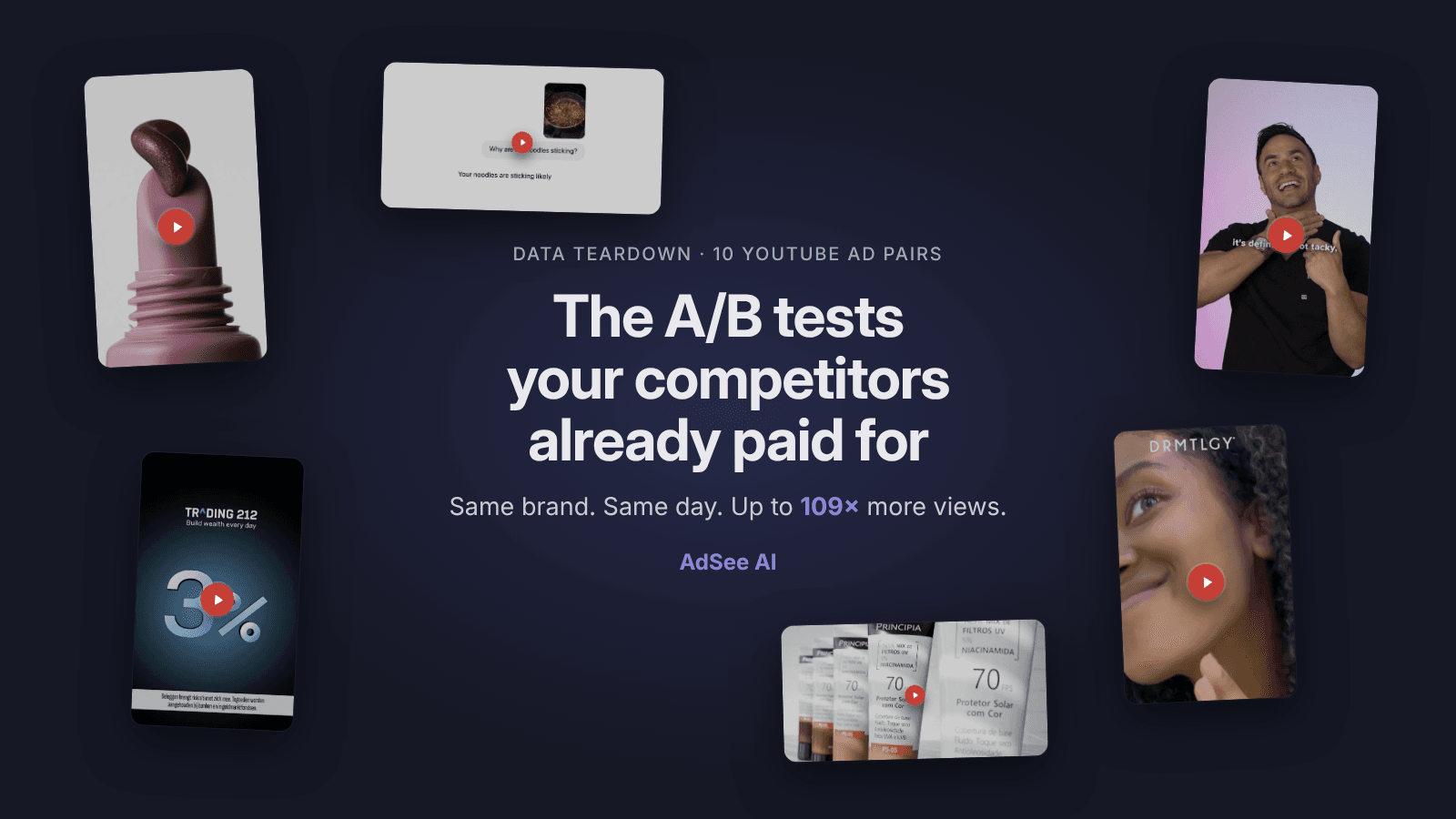
You cannot see a competitor's ROAS, but you can see where they stopped spending. When a brand publishes two versions of the same ad and one gets 100 times more views, the brand has made a decision with its budget. It ran a test, picked a winner and moved the money.
We looked for these decisions in the AdSee AI YouTube ads library and found 10 pairs from Banamex, Trading 212, ChatGPT, Codex, rhode, DRMTLGY and Principia. In every pair, one ad got between 24 and 1,829 times more views than its sibling, per AdSee AI. The winners collected 3.14B views together. The losers collected 8.56M, per AdSee AI.
This article goes through all 10 pairs and asks one question each time: what is the single thing that differs between the winner and the loser? The answers cover length, format, the first frame, the main claim, words on screen and localization. At the end, you will find a step-by-step method for finding the same pairs among your own competitors, and an honest list of the places where this method can mislead you.
The 10 ad pairs in this YouTube ads library sample
The sample covers 10 pairs of YouTube ads from 7 brands, all published in 2026, with view counters read on October 4, 2026, per AdSee AI. Five pairs are same-day twins: same brand, same publish date, same market. One pair comes from the same shoot. Four pairs compare ads from the same brand across different months.
Here is the full set:
| Brand | Market | Winner | Views | Loser | Views | Gap | Type |
|---|---|---|---|---|---|---|---|
| Banamex | Mexico | 6s bumper | 573.7M | 16s cut | 5.27M | 109x | Same day |
| Trading 212 | Netherlands | 6s, format A | 3.90M | 6s, format B | 50.8K | 77x | Same day |
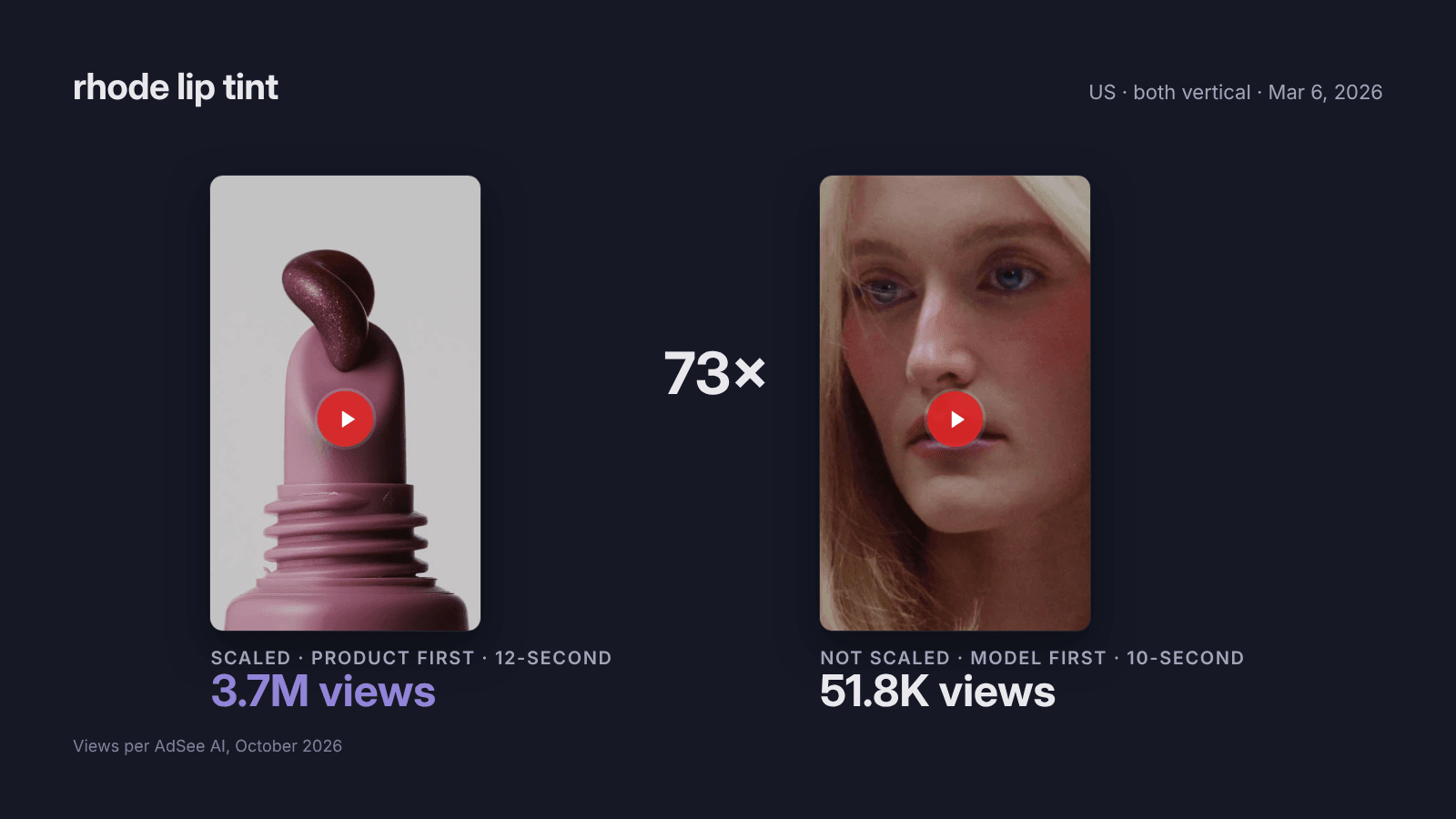
| rhode | US | Lip tint, gloss first | 3.77M | Lip tint, model first | 51.8K | 73x | Same day |
| rhode | US | Pimple patches | 2.90M | Eye patches | 61.3K | 47x | Same day |
| DRMTLGY | US | "Two products" | 4.50M | "No foundation" | 96.9K | 46x | Same day |
| ChatGPT | France + others | 30s training cut | 2.34M | 15s nutrition cut | 58.5K | 40x | Same shoot |
| DRMTLGY | US | Dermatologists | 3.91M | "Viral TikTok" | 54.9K | 71x | Cross-time |
| Codex | Global | 20s text motion | 2.40M | Engineers on camera | 99.5K | 24x | Cross-time |
| Principia | Brazil | 6s bumper | 285.9M | 30s review | 1.58M | 181x | Cross-time |
| ChatGPT | 72 countries | Noodles, 14s | 2.26B | Bobblehead, 8 versions | 1.24M | 1,829x | Cross-time |
The median gap across all 10 pairs is 72x. Among the five same-day twins, the gap runs from 46x to 109x. None of these numbers is close. When a brand spends 50 to 100 times more on one version, it is not an accident of the auction. It is a choice.
Why a view gap is the closest thing to a public A/B test
A view gap between two sibling ads is the best public signal of a brand's own A/B test result, because paid YouTube views mostly follow budget, and budget follows performance, as the AdSee AI data in this sample shows. Across the 10 pairs in this AdSee AI sample, the median winner got 72 times the views of its sibling.
An A/B test, as the Wikipedia entry on A/B testing explains, is "a randomized experiment that usually involves two variants." Advertisers run them inside Google Ads all the time. Google's video experiments help page describes the setup: you choose one ad as the control, and Google creates a treatment arm to compare against it. The results stay private. What stays public is what happens next: the winning version keeps getting budget, and the losing one stops.
How budget turns into views
On YouTube, paid views come from paid placements. If a brand cuts the budget on one version, its view counter almost stops. If it moves that budget to the other version, that counter keeps growing for weeks or months. So two ads that start on the same day in the same market, and end up 50 times apart, tell you where the money went.
Google's own data shows why brands bother. According to Think with Google's guide to creative best practices, advertisers who successfully used Video Experiments saw 60% higher ad recall from the better-performing creative. A 60% difference is worth a test, and it is worth moving the budget once the test is done.
What the gap can and cannot tell you
The gap tells you which version the brand chose to scale. It does not tell you why, and it does not tell you how much revenue each version made. A loser can also be a test that was stopped early for reasons that have nothing to do with performance: a legal change, a product that sold out, a new campaign. That is why this article prefers same-day twins, and why every pair is labeled with its type in the table above.
Length: Banamex's 6-second bumper beat its 16-second twin by 109x
Banamex published two versions of the same ad on February 20, 2026, and the 6-second bumper got 573.7M views while the 16-second cut got 5.27M, a 109x gap, per AdSee AI. Both ran in Mexico and used the same tagline. The only clear difference was length.
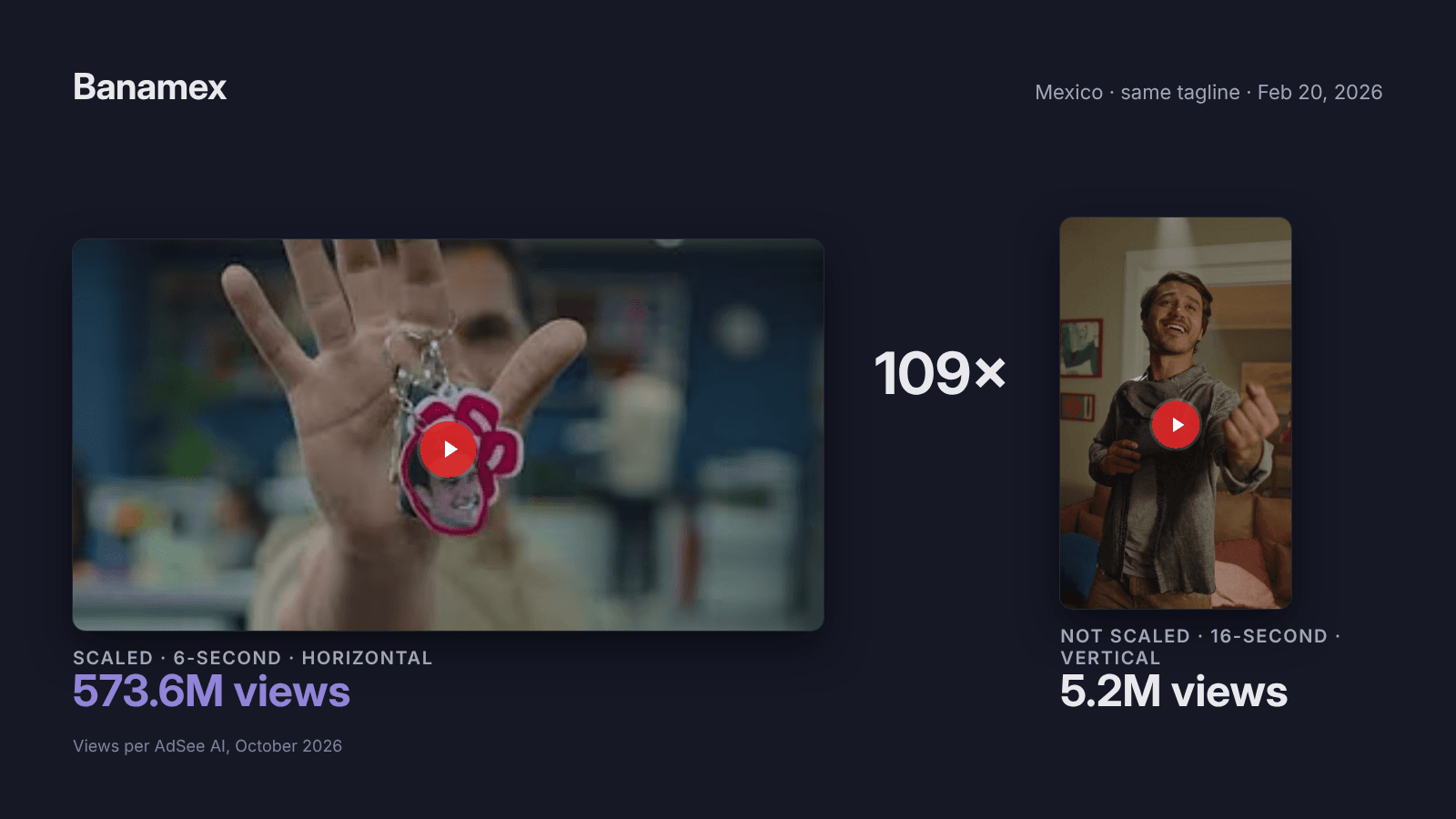
Banamex is one of Mexico's largest banks, and it clearly treated YouTube as a reach channel. A 6-second bumper is the cheapest way to put a brand in front of millions of people. Google's guide to video ad formats describes bumper ads as non-skippable ads of 5 to 6 seconds. Nobody can skip them, and nobody has to wait long.
The 16-second version got 11 times more likes
Here is the twist: viewers liked the losing version more. The 16-second cut got 3,459 likes, and the 6-second bumper got 301, per AdSee AI. That is 11.5 times more likes on an ad with 109 times fewer views.
If Banamex had chosen the winner by likes, it would have picked the 16-second version. It did not. The bank picked the version that delivered reach at the lowest cost, and that was the bumper. Likes measure how much people enjoyed the ad. They do not measure how efficiently the ad reached people, and that was the job of this campaign.
ChatGPT in France: here, the longer cut won
ChatGPT shows that shorter does not always win. The brand ran two cuts from the same shoot with the same runner: a 30-second "training plan" version got 2.34M views across 26 countries, and a 15-second "running nutrition" version got 58.5K views across 5 countries, per AdSee AI. That is a 40x gap in favor of the longer ad.
The country lists also differ, so this is not a perfectly clean test. But it is still a useful warning. "Shorter is better" is a hypothesis to test, not a rule. A training plan is a story with steps, and steps need time. A nutrition tip may simply be a weaker idea, whatever the length.
Format: Trading 212 got a 77x gap from aspect ratio alone
Trading 212 published two 6-second ads on February 9, 2026, with the same "3% interest" text, in the same market, the Netherlands, and one got 3.90M views while the other got 50.8K, a 77x gap, per AdSee AI. The only difference was the aspect ratio of the video.
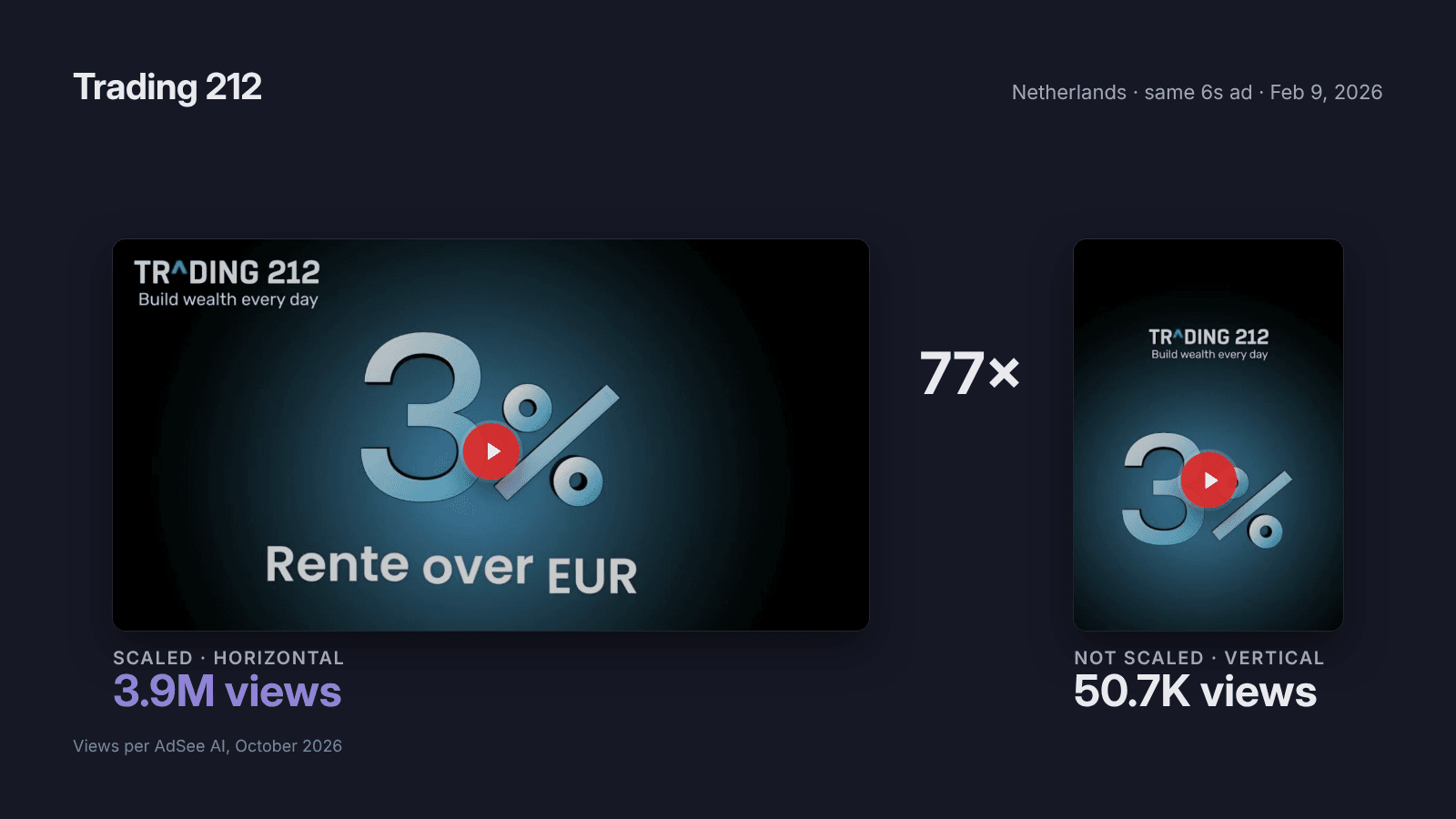
Trading 212 is a European investment app, and this is about as clean a test as public data allows. Same message, same length, same day, same country. The orientation and resolution data for this pair is mixed up in the file names, so we will not say which format won. But the lesson does not depend on that detail.
Why one format can win by 77x
YouTube places ads in many different spaces: horizontal players on TV and desktop, vertical feeds on phones, and everything in between. An ad built for one shape can look awkward or get fewer placements in another. When you upload both versions, the auction tests them for you. One format can end up with almost all the impressions because it fits the places where the audience actually is.
The practical lesson is simple: always ship both formats. It costs one extra export, and in this case the difference was 77 times the reach.
First frame: rhode won two same-day tests by showing the product
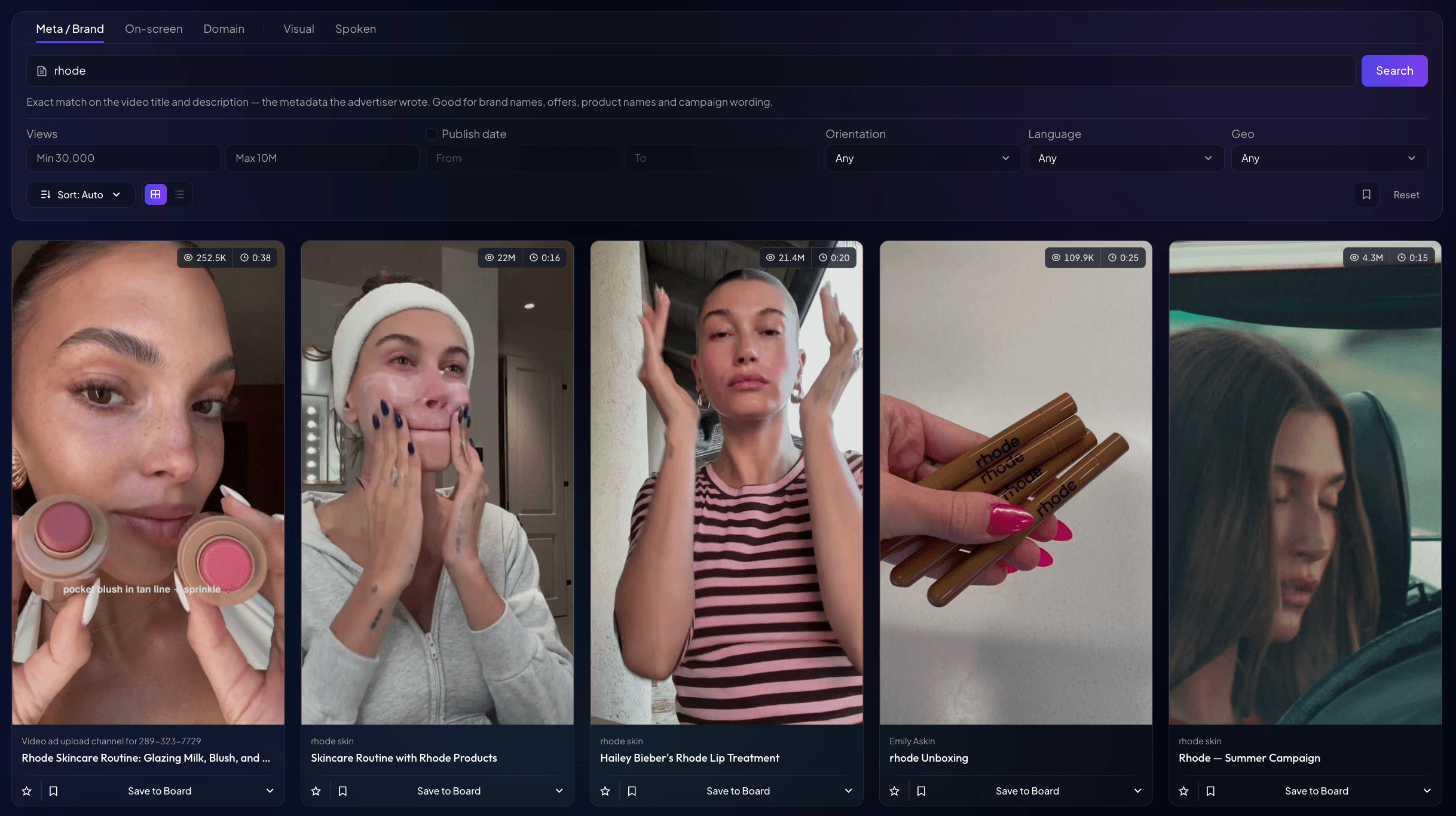
rhode ran two same-day tests in the US in spring 2026, and in both the winning version opened on the product itself: 3.77M views against 51.8K on March 6, and 2.90M against 61.3K on April 22, per AdSee AI. The gaps were 73x and 47x.
rhode is a skincare and beauty brand founded by Hailey Bieber in 2022. Both tests follow the same rule, and they are worth reading together.
March 6: gloss beat the face
On March 6, rhode published two lip tint ads for the US. The winner opened with gloss being squeezed from the applicator, and it got 3.77M views, per AdSee AI. The loser opened with a model and slow close-ups, and it got 51.8K, per AdSee AI.
For a beauty brand built around a famous founder, you might expect the face to win. It did not. The texture of the product did the work in the first second. People who buy lip gloss want to see what it looks like on the brush, not only on a face.
April 22: the thing beat the box
On April 22, rhode published two ads from the same file series, both about patches. The pimple patches ad opened on pouches spilling playful stickers and got 2.90M views, per AdSee AI. The eye patches ad opened on the box pattern and got 61.3K, per AdSee AI.
Both are packaging shots, in a sense. But one shows the product coming out and doing something, and the other shows a printed box. Packaging is not the product. Show the thing.
The claim: DRMTLGY's "two products" line beat a generic promise by 46x
DRMTLGY published two 15-second ads for the US on June 2, 2026, and the one that opened with "My routine is literally just two products" got 4.6M views, while the one that opened with "You don't need foundation every day to look put together" got 96.9K, a 46x gap, per AdSee AI.
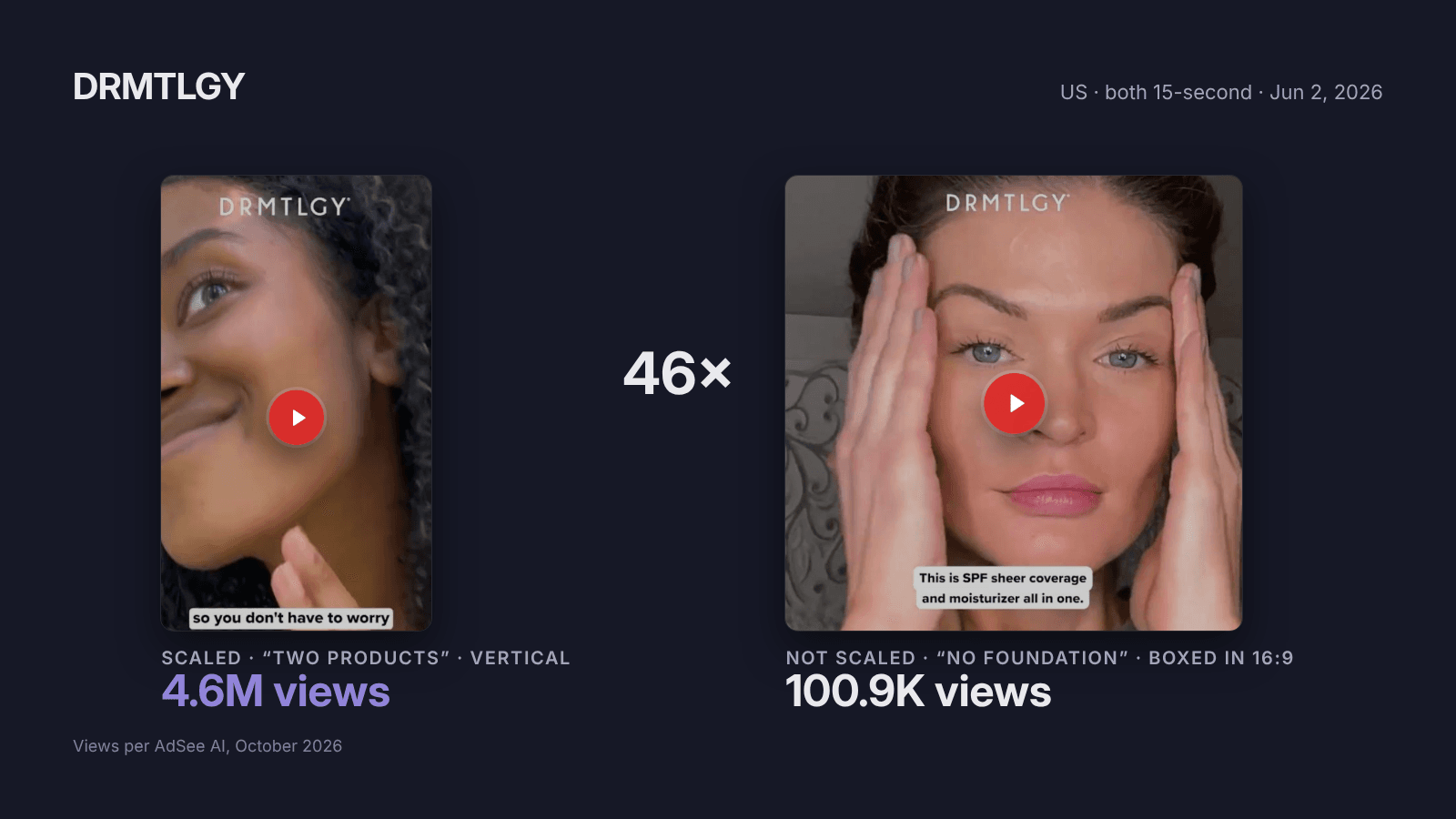
The winner also showed the two products in a box in the first frame. The loser opened on a face. So this pair tests two things at once: the claim and the first frame. Both point in the same direction.
Why a number beats a promise
"Two products" is specific. The viewer can picture it immediately and check it against their own routine. "You don't need foundation every day" is a promise that many brands could make. It does not name a number, a product or a result. In a skippable ad, the viewer decides in about five seconds, and a specific claim gives them something concrete to decide on.
Dermatologists beat "viral on TikTok"
DRMTLGY ran a second, slower test on its retinol body lotion. On January 30, the brand published six ads for the product, and all of them stayed under 230K views, per AdSee AI. One of them opened with a girl waving in a warehouse and called it a "viral TikTok product". It got 54.9K views, per AdSee AI.
On March 20, the brand published a 47-second ad with two dermatologists on a plain background. It opened on a patient's complaint that their hands and arms were "giving away my age". That ad got 3.91M views and 5,517 likes, one like per about 708 views, per AdSee AI.
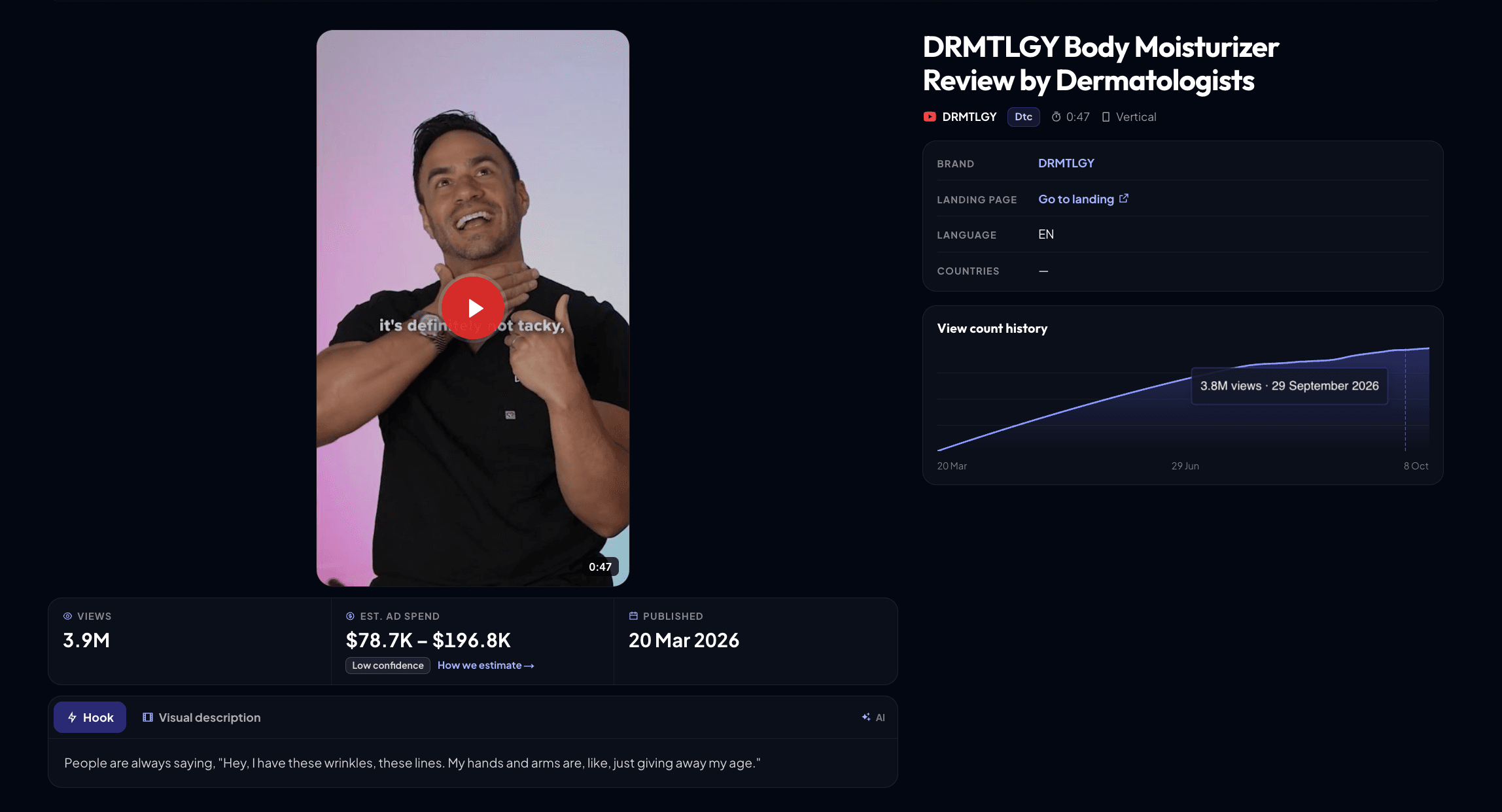
The like rate is unusual for a paid ad. People watched it with real attention. "Viral on TikTok" is a claim about other people's opinions. Two dermatologists explaining a real problem are proof. For a skincare product, proof won by 71 times.
Words on screen: Codex grew 24x when engineers left the frame
OpenAI's Codex ads grew from 45K–99K views each in February to 2.40M views in May, when the brand switched from engineers talking on camera to a 20-second motion piece with text on screen, per AdSee AI. The best February ad got 99.5K views, so the gap is 24x.
This is a cross-time pair, so other things changed too: the season, the product's popularity and probably the budget. But one detail in the data stands out. One of the February files is literally named "NoCaption", per AdSee AI. That suggests at least one of the talking-head ads ran without captions.
Many YouTube ads are watched on phones, in public places and with the sound low. An engineer explaining a product to camera loses most of their message if the viewer cannot hear them. A motion piece with the message written on screen works in both cases. Google's ABCD framework asks advertisers to "draw attention from the beginning." Text on screen is one of the most reliable ways to do that without sound.
Localization: ChatGPT's bobblehead ad in 7 languages got 1.24M views in total
ChatGPT's "turn me into a soccer bobblehead" ad ran in 8 versions and 7 languages around the World Cup, and all 8 together got 1.24M views, per AdSee AI. ChatGPT's 14-second noodle ad, a single creative, got 2.26B views across 72 countries.
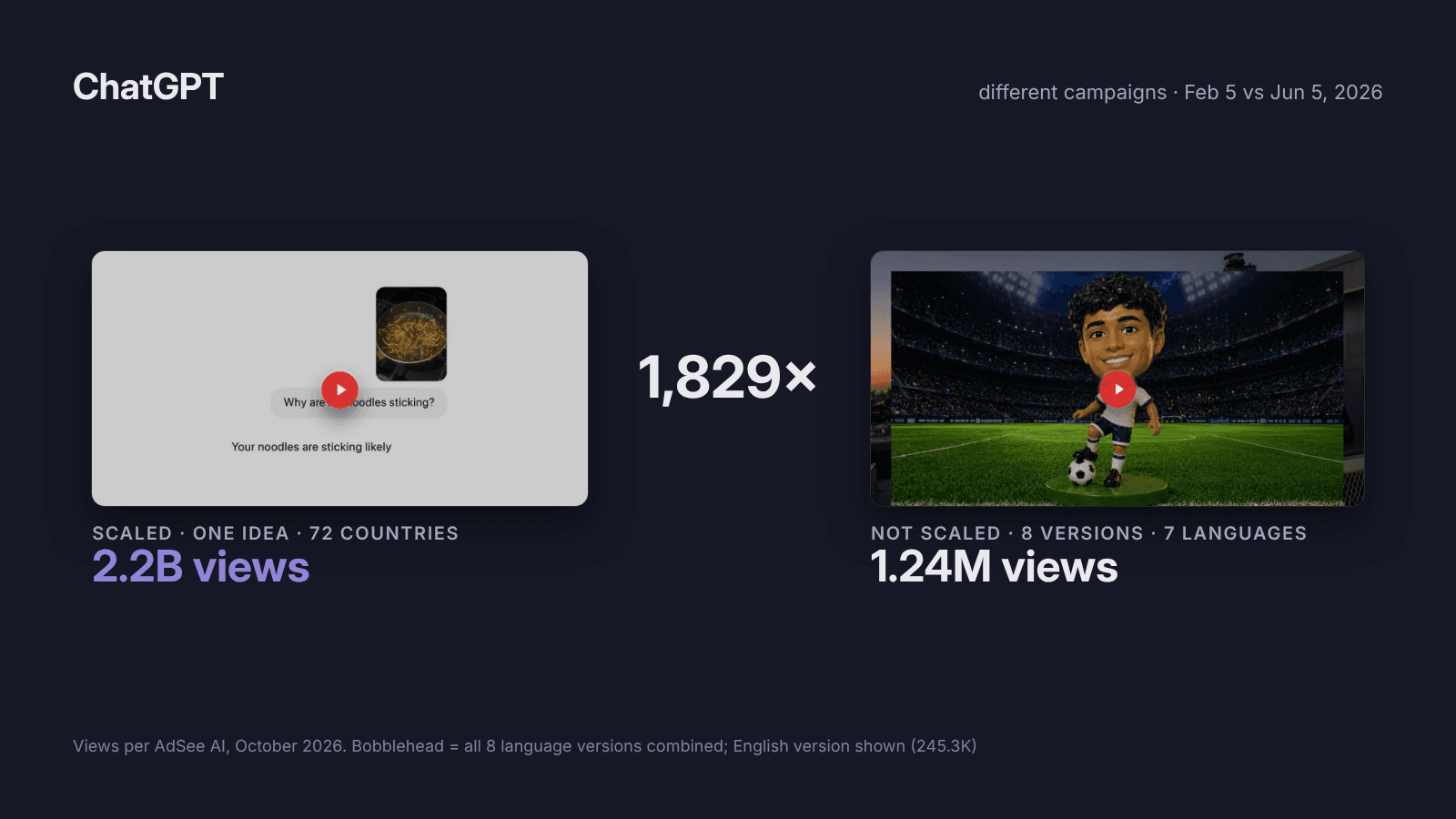
That is a 1,829x gap between the two ideas, and it is the most extreme pair in this sample. It is also the least clean, because the two ads ran at different times and for different goals. Still, the contrast is useful.
One problem, solved, versus a trend
The noodle ad opens on burnt, sticky noodles and one question: "Why are my noodles sticking?" There are no product features and no talk about AI. It shows one everyday problem and solves it. It ran in 72 countries, per AdSee AI, and collected only 160 likes, which is normal for pure paid reach.
The bobblehead ad rode a trend: using ChatGPT to turn yourself into a toy football player during the World Cup. The brand localized it into 7 languages before the idea had proven itself in one market. On average, each of the 8 versions got about 154K views (1.24M divided by 8).
The lesson is about order. Validate an idea in one market first. If it wins there, translate it. Translating a weak idea multiplies production costs, not results.
Format loyalty: Principia's 30-second review ad came in 181x below its best bumper
Principia, a Brazilian skincare brand, published 27 YouTube ads in 2026 that together collected 4.19B views, and 20 of them passed 100M views each, per AdSee AI. Its top 6-second bumpers got between 127M and 286M views each. In June, the brand tried a 30-second "review" ad, and it got 1.58M views, per AdSee AI.
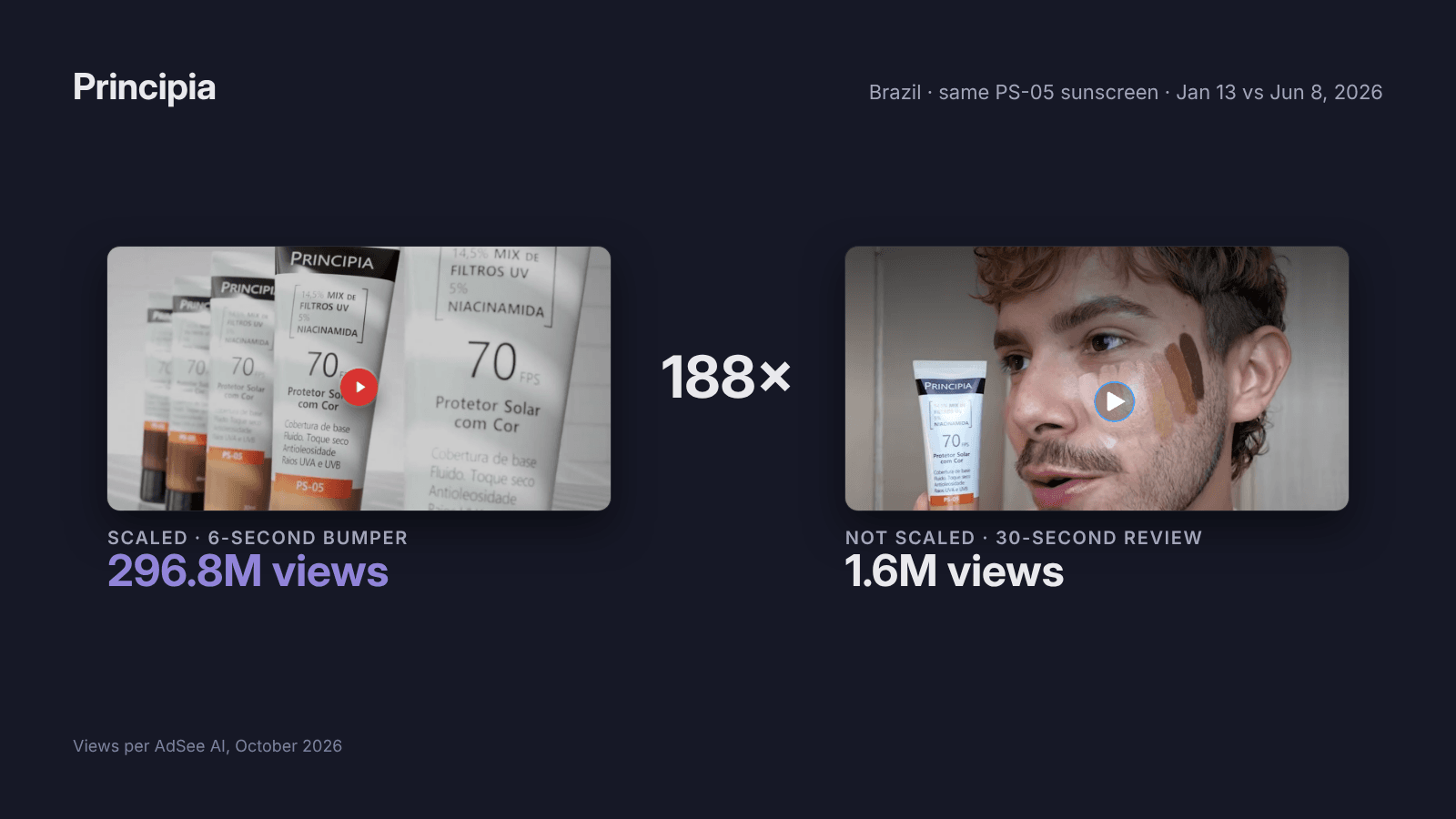
1.58M views is a big number for most brands. For Principia, it is between 80 and 181 times below its own bumpers. The brand had already found a format that worked at huge scale, tried something different and, based on the view counts, did not scale the experiment.
A wall of small ads
Principia does not build one great hero ad. It builds many short ones and lets the best of them take the budget. This is a different strategy from a big launch film, and it is common in markets where reach is cheap and the product is simple to understand. When a format keeps winning, testing a new one is smart. Abandoning the winner because a longer, more "complete" ad feels better is not.
Likes versus budget: what the winners really optimize for
Likes did not predict the winner in any of the 10 AdSee AI pairs. In the clearest example, Banamex's losing 16-second cut got 3,459 likes, 11.5 times more than the winning bumper's 301, per AdSee AI. The brand still put its budget behind the bumper.
On paid in-stream placements, most viewers did not choose to watch the ad. They came to watch something else. In earlier AdSee AI teardowns, ads that people watch by choice reached one like per roughly 80 to 400 views, while forced in-stream reach usually sits at one like per 100K views or worse. ChatGPT's noodle ad, at 160 likes on 2.26B views, sits deep in the second group.
So when you look at a competitor's ads, do not use likes to guess which version worked. Use the view gap between siblings. It shows what the brand actually did with its money.
What the losing cuts cost: about $171K to $428K across all 10 pairs
Using AdSee AI's estimate method of $0.02 to $0.05 per view, the 10 losing ads in this sample cost between $171K and $428K in total, while the winners collected 3.14B views. These are rough estimates at US-level prices, so real costs in Mexico, Brazil or the Netherlands are probably lower.
The point is the ratio. Using the same method, Banamex spent an estimated $105K to $263K on the 16-second cut that lost, and an estimated $11.5M to $28.7M on the bumper that won. Testing was cheap compared to scaling. For most same-day pairs, the losing version cost only a few thousand dollars before the brand moved on.
This is the main reason competitor tests are so valuable to study. Each losing ad is a lesson that someone else paid for. You get the result without the cost.
Patterns across the 10 winners
The 10 winners in this sample share four patterns, per AdSee AI data and the visual descriptions of each ad. None of them is a universal rule, but together they make a strong starting checklist for effective YouTube ads.
The product or the problem appears in the first frame. rhode's gloss, DRMTLGY's two products, ChatGPT's burnt noodles. The winners do not open on a logo or a slow mood shot.
The claim is specific. "Two products" beat "you don't need foundation". A dermatologist beat "viral on TikTok". A specific claim can be checked; a generic one can be ignored.
The message survives without sound. Codex grew when the words moved onto the screen. Bumpers like Banamex's and Principia's work in 6 seconds with almost no dialogue.
Brands test before they scale. Five of the ten pairs were published on the same day. Brands like rhode and DRMTLGY clearly ship several versions at once and let the auction decide.
There is one pattern that does not hold: length. Banamex's shorter ad won, and ChatGPT's longer ad in France won. Length depends on the idea, not on a rule.
How to find these pairs with a YouTube ads spy tool
You can find sibling pairs among your own competitors in about an hour with any YouTube ads spy tool that shows publish dates, countries and view counts; in AdSee AI, this method surfaced 10 pairs from 7 brands. Here are the steps.
- Pull every ad from one brand. Search by brand name and set a date filter for the last six to twelve months.
- Sort by publish date. Group ads that were published on the same day or in the same week.
- Check the market. Keep pairs that ran in the same country or the same set of countries. Different markets make the comparison weaker.
- Look for gaps of 20x or more. Smaller gaps can be noise. Large gaps are decisions.
- Write down the one thing that differs. Length, format, first frame, claim, presenter, language. If more than one thing differs, note all of them.
- Open both videos. Metadata can be wrong. Watch the first five seconds of each ad yourself.
- Build a swipe file. Save the winners and losers side by side on a board, so your team can see the pattern before the next brief.
This method works best for brands that publish many ads. A brand with three ads a year will not give you enough pairs to learn from. If you want to improve YouTube ads in your own account, the same logic applies: always ship at least two versions, and change only one thing between them.
Where this analysis stops working
A view gap in AdSee AI data shows what a brand chose to scale, not why, and 4 of the 10 pairs here compare different months, which makes them weaker evidence. Here are the specific places where this method can mislead you.
Views are not conversions. A loser with 50K views, like several in this sample, might have converted better per view than the winner. We cannot see sales, sign-ups or app installs. The brand can.
Budget can move for non-creative reasons. A product can sell out, a promotion can end, or a legal team can stop a claim. A stopped ad is not always a failed ad.
Targeting can differ. In the ChatGPT France pair, the winner ran in 26 countries and the loser in 5. Part of that gap comes from targeting, not creative.
Metadata can be wrong. In the Trading 212 pair, the orientation and resolution in the file names do not match the stored data, which is why we do not name the winning format. Always open the videos.
Cross-time pairs are weaker. Four of the ten pairs compare ads from different months. Seasons, budgets and product popularity all change. Treat those pairs as hints, and the five same-day twins as the stronger evidence.
Ten pairs is a small sample. These patterns describe these seven brands in 2026. Test them on your own audience before you treat them as rules.
What to steal for your next creative test
You can use these lessons without a big budget. Here are five that work at any size.
Ship two versions on the same day. Change one thing: the first frame, the claim or the format. Let YouTube's auction pick the winner.
Put the product in the first second. Show the gloss, the box, the problem. Save the logo for the end.
Make the claim specific. Use a number, a name or a visible result. "Two products" works better than "look put together".
Write the message on screen. Assume many viewers will not hear the ad. Captions and on-screen text protect your message.
Do not judge by likes. Judge by what you do with your budget, and watch what your competitors do with theirs.
How we counted
The sample includes 10 pairs of YouTube ads from Banamex, Trading 212, ChatGPT, Codex, rhode, DRMTLGY and Principia, all published in 2026 and found in the AdSee AI YouTube ads library through brand-name searches sorted by views and by publish date. We selected pairs where the same brand published two versions with one clear difference, and we labeled each pair as same day, same shoot or cross-time.
View and like counters were read on October 4, 2026. Publish dates, lengths, countries, languages and visual descriptions come from AdSee AI ad records. Gaps are the winner's views divided by the loser's views. For Principia, the gap range compares the 30-second ad with the brand's bumpers that passed 100M views in AdSee AI. For ChatGPT's bobblehead, the loser's views are the sum of 8 language versions. Spend estimates use AdSee AI's method of views multiplied by $0.02 to $0.05 per view.
Format rules come from Google Ads Help. The video experiments statistic comes from Think with Google. Research on how viewers perceive skippable and non-skippable ads comes from a 2025 study in the Journal of Advertising Research, which found that skippable ads are perceived as less intrusive, while non-skippable ads are stronger for brand recall. That trade-off helps explain why Banamex and Principia put their reach budgets behind non-skippable bumpers.
FAQ
These are the questions marketers most often ask about competitor ad tests on YouTube, answered with AdSee AI data from this sample.
How can I see which YouTube ads a competitor stopped scaling?
Compare sibling ads from the same brand, published on the same day in the same market. In AdSee AI data, five same-day pairs from Banamex, Trading 212, rhode and DRMTLGY showed gaps of 46x to 109x in views. The version with far fewer views is usually the one the brand stopped funding after its own test.
What makes YouTube ads effective, based on competitor tests?
In 10 sibling pairs from the AdSee AI library, the winners usually showed the product or problem in the first frame, used a specific claim like "two products", and kept the message readable without sound. Length was not a rule: Banamex's 6-second bumper won, but ChatGPT's 30-second cut beat its 15-second sibling by 40x.
Are shorter YouTube ads always better?
No. In AdSee AI data, Banamex's 6-second bumper beat its 16-second twin by 109x, but ChatGPT's 30-second training-plan cut beat its 15-second nutrition cut by 40x. Short ads are cheaper for reach. Ideas with steps, like a training plan, may need more time. Test both lengths before you choose.
Does aspect ratio matter for YouTube ads?
It can matter a lot. Trading 212 ran two 6-second ads with the same text, on the same day, in the Netherlands, and one format got 3.90M views while the other got 50.8K, a 77x gap, per AdSee AI. Uploading both horizontal and vertical versions lets YouTube's auction choose the placement that fits.
How do I spy on YouTube ads from competitors?
Use a YouTube ads library that shows each ad's publish date, countries, length and views. In AdSee AI, you can search by brand, sort by date, group ads published on the same day, and compare their view counts. A gap of 20x or more between siblings usually shows which version the brand decided to scale.
Do likes show which YouTube ad worked better?
Not directly. Banamex's losing 16-second ad got 3,459 likes, 11.5 times more than the winning bumper's 301, per AdSee AI, yet the brand scaled the bumper to 573.7M views. On paid placements, likes reflect enjoyment, not efficiency. The view gap between sibling ads is a better signal of the brand's decision.
How much does it cost to test a YouTube ad creative?
Less than scaling it. Using AdSee AI's estimate of $0.02 to $0.05 per view, the 10 losing ads in this sample cost about $171K to $428K in total, while the winners reached 3.14B views. Most same-day losers cost only a few thousand dollars before the brand moved its budget to the winner.
Should I translate a YouTube ad into many languages at once?
Usually not before it wins in one market. ChatGPT's bobblehead ad ran in 8 versions and 7 languages and got 1.24M views in total, per AdSee AI, while its single noodle ad reached 2.26B views in 72 countries. Validate the idea first, then localize the version that already works.
Data and sources
- AdSee AI YouTube ads library: ad records for all 20 ads, including views, likes, publish dates, lengths, countries and visual descriptions. Counters read on October 4, 2026.
- A/B testing, Wikipedia: definition of an A/B test.
- Measure creative impact with Video experiments, Google Ads Help: how video experiments compare a control and a treatment arm.
- About video ad formats, Google Ads Help: bumper ad length and skippable in-stream rules.
- Creative best practices for YouTube ads, Think with Google: the ABCD framework and the 60% ad recall finding for Video Experiments.
- Davtyan, Tashchian and Thomas, Journal of Advertising Research, 2025: skippable ads, non-skippable ads and brand placements on YouTube.
- Banamex, Trading 212 and rhode, Wikipedia: company background.