
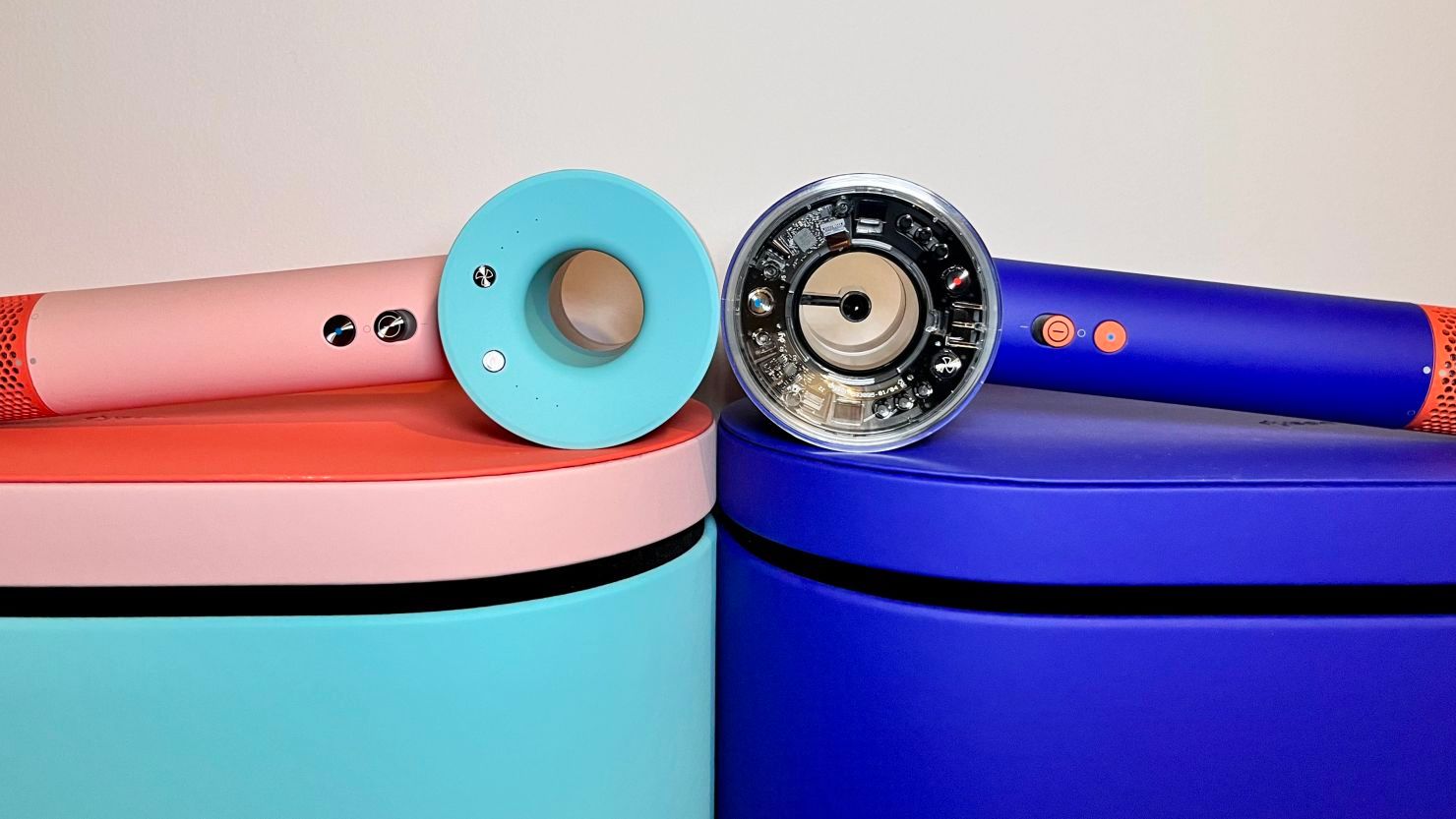
Here's a launch puzzle worth your attention.
In January and February 2026, the search query "Dyson Supersonic Travel" had a volume of exactly zero. Not low — zero. The product didn't exist, so nobody was looking for it.
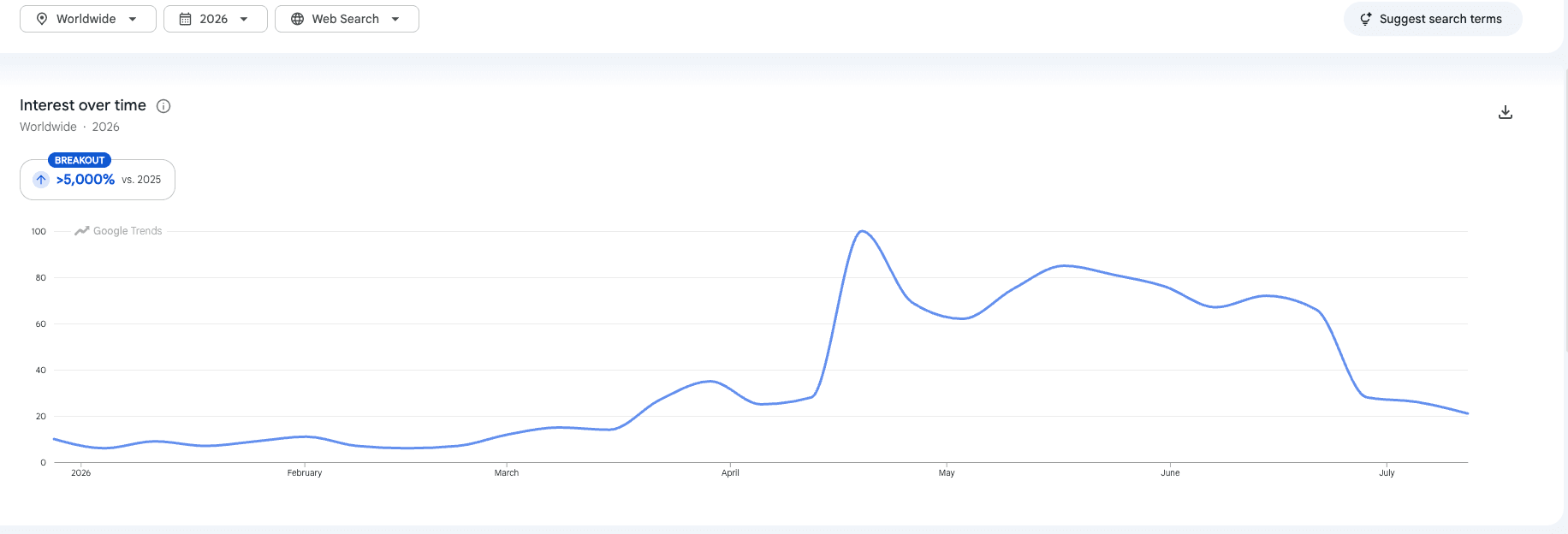
By mid-June, Google Trends had the query at its peak score of 100, wearing the rarest badge Trends gives out: Breakout, up more than 5,000% year over year.
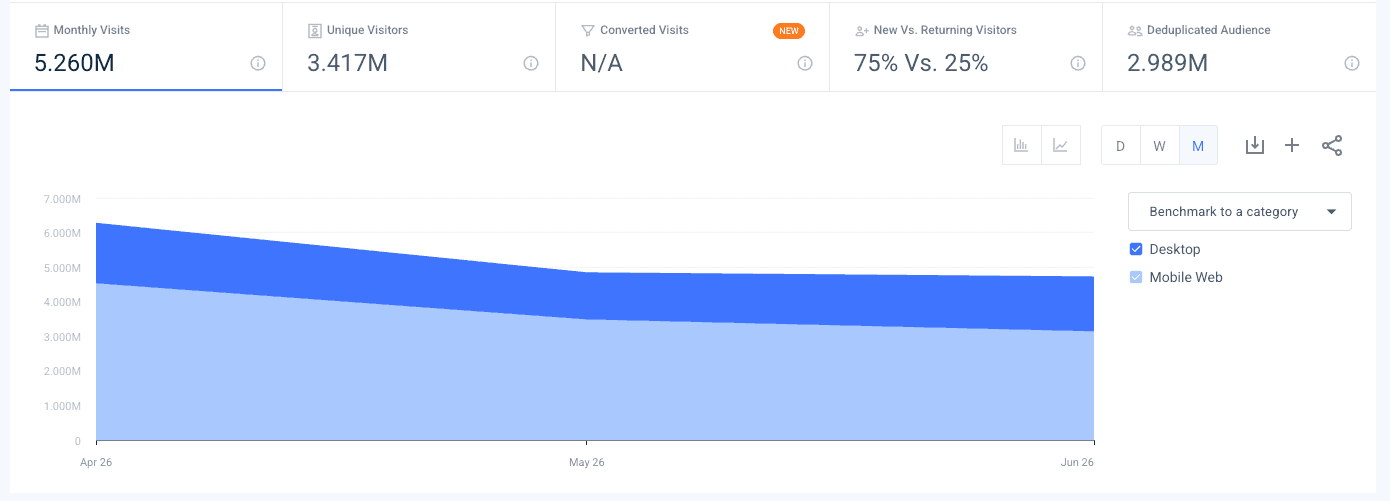
Meanwhile, over the same spring, traffic to dyson.com went down. According to Similarweb, monthly visits slid from about 6M in late April to about 4.7M by late June, averaging 5.26M.
A brand-new search category exploding from nothing, and the brand's own website shrinking while it happens. If that combination looks broken to you, your mental model of a product launch is missing a piece. Let's find it — using the ad-level view that a YouTube ad library gives you and that no press release ever will.
The Dyson Supersonic Travel: the same engine, repositioned against the hotel hair dryer
The Dyson Supersonic Travel, launched on April 21, 2026 at $299.99, is 32% smaller, 25% lighter, and the first Dyson hair tool with universal voltage (100–240V), per Dyson's launch announcement — the same motor and heat-control engineering as the flagship Supersonic, repackaged for a carry-on. CNN Underscored noted the price makes it the most affordable Dyson hair tool ever sold.
Notice what Dyson did NOT do. They didn't build a new technology. The motor logic, the intelligent heat control, even attachment compatibility with the existing Supersonic — all inherited. What changed is the context: the same engineering, repositioned for a person packing a bag. Dyson has run this play across its portfolio for decades — take a proven motor platform and re-context it — but rarely with the positioning this explicit.
And the positioning tell is right in Dyson's own launch materials: in their consumer test, 94% of participants agreed the Supersonic Travel is better than a hotel hair dryer. Read that sentence as a positioning statement, because it is one. The competitive alternative for this product isn't another premium dryer. It's the sad, wall-mounted thing in your hotel bathroom — and years of Reddit threads begging Dyson for a dual-voltage dryer, which CNN Underscored called out as a long-running customer plea, prove the enemy was well chosen.
When you position against a universally hated alternative, you don't have to win a comparison. You just have to exist.
The YouTube ad Dyson ran three weeks before the Supersonic Travel existed
Dyson's US launch ad — a 13-second spot titled "Smaller, Lighter, Still Mighty" — was published on April 1, 2026, three weeks before the product went on sale, and had accumulated 13.5M views by July 8, per AdSee AI. That publish date is the single most important number in this teardown, and it's invisible in every public source except creative-level ad data.
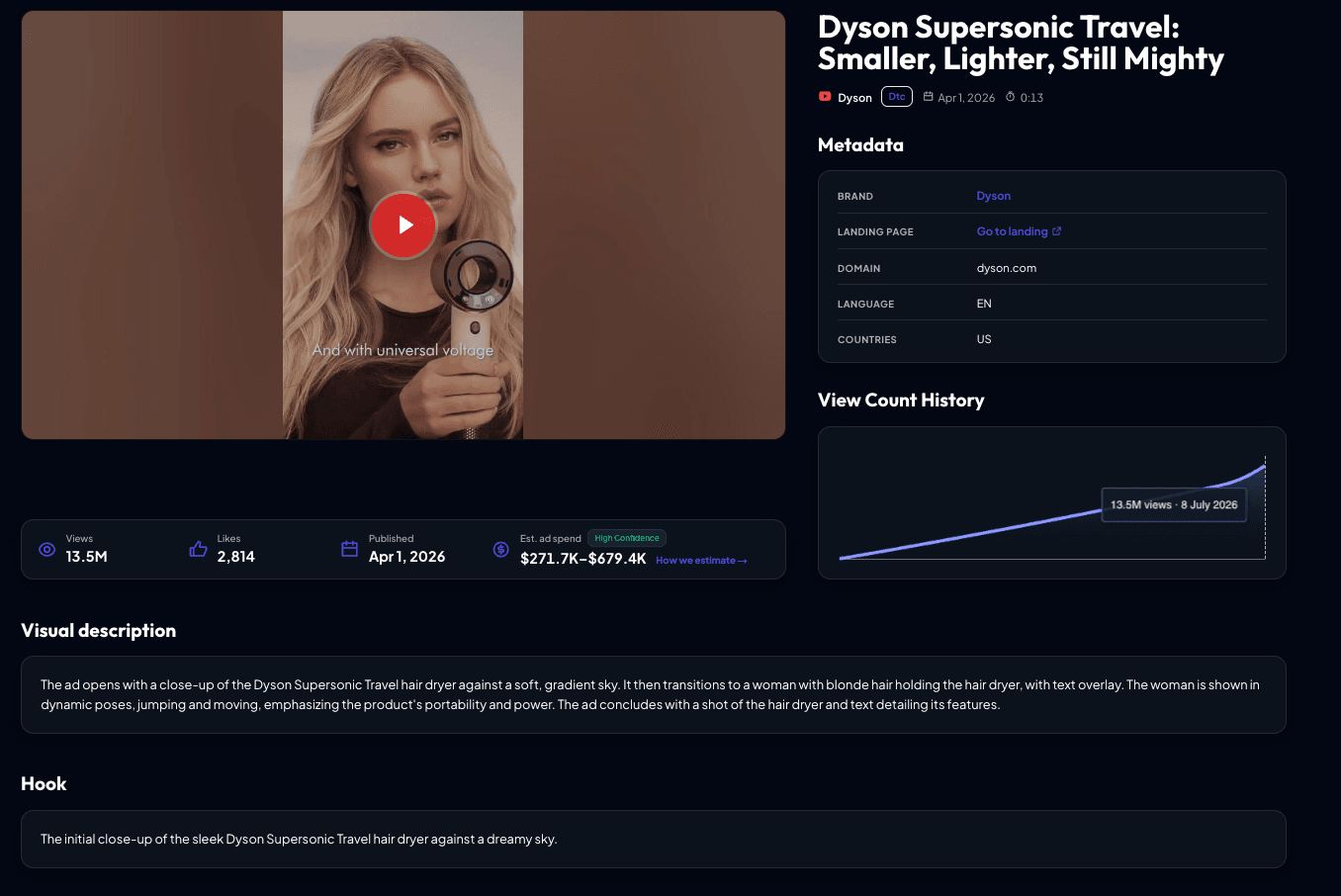
Those 13.5M views ran on an estimated $271.7K–$679.4K in spend (high confidence, per AdSee AI), US-only. And the Google Trends curve responds on cue: the query rises from zero in late March and early April, climbing well before the April 21 press wave from Forbes, CNN, and the beauty media.
This is pre-launch demand seeding. The press coverage makes the story look like it started on launch day. The ad publish date says Dyson spent three weeks warming up a search category that had no supply — so that by the time shelves filled, the query "Dyson Supersonic Travel" already had momentum, owned entirely by one company. You cannot have a competitor in a search category you invented last month.
Where the Supersonic Travel demand went (hint: not to dyson.com)
The launch's demand wave flowed to press, retailers, and creators rather than to the brand's own site — which is why, per Similarweb, dyson.com slid from about 6M to about 4.7M monthly visits over the very quarter the query broke out. The two curves aren't contradicting each other; they're measuring different doors.
A product query is not a brand-site visit. Type "Dyson Supersonic Travel" into Google in May 2026 and look at what wants your click: CNN Underscored's hands-on review, Forbes' launch coverage, beauty-magazine roundups, retailer pages, YouTube reviews. The launch created a demand wave, and the open ecosystem — press, retail, creators — absorbed most of it. That's not leakage; that's how a $299.99 considered purchase gets validated. People don't want the manufacturer's opinion of its own dryer.
Second, honesty about scale: dyson.com is the storefront for the entire portfolio — vacuums, air purifiers, the whole catalog. One hair dryer launch cannot bend that curve, and the spring decline follows the site's ordinary seasonality. Judging this launch by dyson.com's total traffic is the same mistake as judging Coinbase's app campaign by play.google.com's visits: wrong denominator, wrong door.
But the launch does leave a fingerprint in the composition. Per Similarweb, 75% of dyson.com's visitors this quarter were new versus 25% returning — a heavily cold mix for a mature appliance brand, consistent with a wave of first-time visitors arriving to check out one new product.
How Dyson's country-by-country rollout reads in a YouTube ad tracker
Per AdSee AI placement data, Dyson ran the Supersonic Travel campaign as a sequenced relay — the US on April 1, Romania and Austria on April 14–15, Croatia and Greece on April 28–29 — within a fleet of 94+ Dyson ads live in the period. Three details in that country data deserve a closer look, because each one reconstructs a piece of the launch plan that no press release states.
The publish dates map Dyson's stated launch plan, market by market
The dates aren't random. US on April 1, three weeks before launch. Romania and Austria on April 14–15, one week before. Croatia and Greece on April 28–29, one week after. That sequence matches Dyson's own stated plan — select markets first, global rollout in the following eight weeks — and in AdSee AI's country data you can watch the relay happen in near-real time, market by market. If you're using a YouTube ad tracker to size up a competitor's launch, this is the read: publish dates ordered by country are the launch calendar, published involuntarily.
Localization is total: every market gets its own creative, language, and domain
This isn't one global creative sprayed across geos, the way Adidas runs a World Cup spot. Every market gets its own edit, its own language, its own local domain. Premium products with considered purchases localize the landing experience; reach products localize nothing. The degree of localization in a competitor's fleet is itself a signal of how much margin the product carries — nobody cuts five language edits for a $2 impulse purchase.
Greece runs through a distributor, and only the ad data shows it
Greece breaks the pattern in a telling way: the campaign money leads to a distributor's domain (damkalidis.gr), not the brand's. Where Dyson doesn't operate its own market infrastructure, the local partner carries the launch. The distributor layer of a launch is invisible in every analytics tool except creative-level ad data: Similarweb sees a small local site, Trends sees a national query, and only the ad placement record connects the two to Dyson's media budget.
What the like-to-view ratio says about Dyson's youtube video advertising strategy
Dyson's US hero earned roughly one like per 4,800 views — 2,814 likes on 13.5M views, per AdSee AI — which is the signature of purchased instream reach rather than viewing people chose. The European spots run drier still: per AdSee AI like and view counts, Romania sits at one like per 332K views, with Croatia and Greece at effectively zero.
One like per 4,800 views: reading the forced-reach signature
This campaign bought frequency, not fandom — and that's a defensible choice, not a flaw. A 2025 study in the Journal of Advertising Research comparing skippable ads, non-skippable ads, and brand placements found that non-skippable formats deliver the strongest brand recall while being perceived as the most intrusive. Dyson's 13-second instream spot is optimized for exactly that trade: a $299.99 travel appliance doesn't need thumbs-up; it needs the query planted in your head for the next time you pack a carry-on.
Google's own media team has moved past raw frequency as the whole story. "We used to think of social media platforms through a reach and frequency lens," said Suzana Apelbaum, global group marketing specialist for creative and innovation at Google's Media Lab, in Think with Google's creative experiments write-up, describing the shift toward briefing each platform on its own behaviors. Dyson's fleet is a working example: same frequency-buying logic, but a separate localized edit per market rather than one spot everywhere.
For calibration: native-styled mobile game ads in our earlier AdSee AI analyses earn a like per 82–365 views. Put those two ends on a spectrum — "content people chose" to "reach somebody purchased" — and you can place any creative on it using two public numbers.
Where the like-to-view metric lies
The ratio is a lie detector, not a scoreboard, and it fails in specific, predictable ways. First, some advertisers disable likes entirely, which reads as forced reach even when the creative is genuinely loved. Second, the ratio breaks across formats: Shorts, instream, and discovery placements have structurally different engagement baselines, so comparing a Short to a 13-second instream spot tells you about the formats, not the creatives. Third, the metric says nothing about outcomes — recall, consideration, or sales. Dyson's near-zero European like rates coexist with a Breakout search trend, which is the entire point: forced reach can build a query while earning no visible affection at all. Use the ratio to classify how views were acquired, never to grade whether the campaign worked.
How to run this teardown on any competitor with a YouTube ads library
Everything in this analysis comes from four public or subscription data layers, and you can reproduce the workflow on any launch in an afternoon. Here is the sequence we used, step by step.
One: pull the advertiser's creative fleet from the AdSee AI YouTube ads library and sort by publish date. The publish-date column is the launch calendar; look for creatives that predate the product's availability date, because that gap is the pre-launch seeding window.
Two: read each creative's country list as a lifecycle stage. Small, cheap markets mean testing; coherent regional clusters mean rollout; 50+ countries including premium markets mean global burn. Dyson's relay — US, then Romania and Austria, then Croatia and Greece — is a rollout pattern with a pre-launch anchor market.
Three: check the landing domains. A brand domain means owned infrastructure; a distributor or retailer domain maps the markets where the brand outsources its presence. This is the layer, like Greece's damkalidis.gr here, that no other research method surfaces.
Four: overlay Google Trends for the product query and Similarweb for the landing sites. If the Trends curve starts rising at the ad publish date rather than the press date, you're looking at manufactured demand. If site traffic doesn't move, check whether the demand routed to press, retail, and reviews instead — the composition split between new and returning visitors is often the only trace on the brand's own site.
Five: compute like-to-view ratios across the fleet to classify how views were bought, with the failure cases from the previous section in mind. If you spy YouTube ads this way regularly — competitor by competitor, launch by launch — the patterns start repeating fast: pre-launch gaps, distributor domains, localization depth. Each one is a strategy decision the competitor never announced.
Where the pre-launch seeding playbook stops working
Pre-launch demand seeding worked for Dyson because three specific conditions held, and it fails, concretely, when they don't.
It fails for line extensions in contested query space. "Dyson Supersonic Travel" had zero volume and zero competition; Dyson bought an empty category. A brand launching another wireless earbud into "best wireless earbuds" cannot own the query at any spend level — the category term is already an auction, and three weeks of seeding buys three weeks of expensive clicks, not a moat.
It fails for low-consideration products with no validation layer. Dyson's wave was absorbed and amplified by press, reviewers, and retailers, because a $299.99 appliance triggers research behavior. A $15 impulse product has no CNN Underscored review coming; seeded demand with nowhere to validate simply decays. Google's own creative guidance for skippable in-stream formats makes the adjacent point that viewers reject bad or irrelevant ads rather than advertising as such — if the product can't sustain a research journey, no amount of early frequency will build one.
It fails when distribution isn't ready on launch day. Seeding builds a demand curve with a peak; if shelves, listings, or regional distributors aren't live when the curve crests, the brand pays to warm up a query that competitors' retail listings then harvest. Dyson's relay avoided this by sequencing ads one to three weeks around each market's actual availability — the timing discipline is the playbook, not just the head start.
And one measurement honesty note: the alignment between the April 1 ad publish date and the Trends inflection is strong circumstantial evidence, not attribution. Trends cannot separate ad-driven searches from organic word-of-mouth in the same window. We read the sequence — ads first, curve second, press third — as causal because no other stimulus existed before April 21, but a teardown from outside the company can never prove it the way Dyson's own lift studies could.
How we counted (methodology)
Sample: Dyson YouTube ad creatives for the Supersonic Travel identified in the AdSee AI database, published April 2026, treated as one campaign within a ±60-day window around the US hero's publish date; countries, languages, and landing domains from placement data; view and like counts from public YouTube counters as of the dates shown on each creative's view-count history (July 5–8, 2026). Spend estimates are AdSee AI's, derived from views and country-level CPV benchmarks, shown as ranges with per-creative confidence levels; the US hero's $271.7K–$679.4K carries high confidence as a single-market campaign. Website traffic and audience composition: Similarweb, dyson.com, April–June 2026. Search interest: Google Trends, "Dyson Supersonic Travel", United States, 2026. Product and launch facts: Dyson's launch announcement and press coverage (CNN Underscored, Forbes), April 21, 2026. External research cited: Journal of Advertising Research (2025) on YouTube ad formats; Think with Google on video ad creative experiments.
What to steal from Dyson's launch playbook
Position against the alternative people already hate. Dyson's real competitor here is the hotel hair dryer, and their own 94% test stat proves they know it. Find the miserable status quo in your category and aim every claim at it.
Seed the search category before the shelf. Three weeks of pre-launch media turned "Dyson Supersonic Travel" from a zero-volume string into a warm query the brand owns outright. If you're launching something genuinely new, your first ad dollar buys more before availability than after — provided distribution is ready when the curve crests.
Judge a launch by the query, not by your own traffic. The breakout Trends curve is the launch's success metric; the brand-site dip is portfolio seasonality. Pick the metric that lives where your demand actually goes — press, retail, and reviews included.
Read competitor rollouts through ad geography. Publish dates, languages, and landing domains in the ad data reconstruct a launch plan — including which markets run through distributors — better than any press release will.
Classify views before you envy them. A ratio of one like per thousands of views means reach was purchased, not chosen — which is fine for a considered purchase, and a warning if you were planning to copy the creative expecting organic love.
FAQ
When did the Dyson Supersonic Travel launch and how much does it cost? The Dyson Supersonic Travel launched on April 21, 2026 at $299.99, per Dyson's announcement — its first hair tool with universal voltage, 32% smaller and 25% lighter than the full-sized Supersonic. Per AdSee AI, the US YouTube campaign for it began three weeks earlier, on April 1.
How much did Dyson spend advertising the Supersonic Travel? According to AdSee AI estimates, the US hero ad corresponds to $271.7K–$679.4K in media spend (high confidence) for 13.5M views, with additional localized campaigns in markets including Romania ($206.6K–$516.6K), Greece, Croatia, and Austria — a sample of a fleet of 94+ Dyson ads live in the period.
Why is "Dyson Supersonic Travel" a breakout search term in 2026? Google Trends shows the query growing from zero to breakout status (over 5,000% year-over-year growth) between March and June 2026, driven first by Dyson's pre-launch YouTube campaign — which AdSee AI dates to April 1, three weeks before availability — and then by launch press coverage and summer travel season, peaking in mid-June.
Why did dyson.com traffic fall during a successful product launch? Per Similarweb, dyson.com's spring decline (roughly 6M to 4.7M monthly visits) reflects whole-portfolio seasonality, while launch demand flowed to reviews, press, and retail partners. The launch's trace on the site is in composition: 75% of visitors in the period were new, an unusually cold mix for an established appliance brand.
How did Dyson roll out the Supersonic Travel campaign across countries? Per AdSee AI placement data, as a sequenced relay: the US on April 1 (pre-launch), Romania and Austria on April 14–15, then Croatia and Greece on April 28–29 (post-launch), each with a localized creative, local language, and local landing domain — including a distributor-run campaign in Greece landing on damkalidis.gr.
How do you find a competitor's YouTube ads before their product launches? Use a YouTube ads library such as AdSee AI to pull the advertiser's creative fleet and sort by publish date. Creatives published before a product's availability date reveal pre-launch seeding — in Dyson's case, a US ad live on April 1, 2026, three weeks before the Supersonic Travel went on sale.
Is a high like-to-view ratio worth optimizing for in YouTube advertising? Not directly. The ratio classifies how views were acquired — chosen viewing versus purchased instream reach — but says nothing about recall or sales. Per AdSee AI, Dyson's Supersonic Travel ads run near one like per 4,800 views or lower, and the launch still produced a Breakout Google Trends term. Optimize the outcome metric, and read like rates as a diagnostic.
Which YouTube ad formats work best for a product launch campaign? A 2025 Journal of Advertising Research study found non-skippable ads deliver the strongest brand recall but feel the most intrusive, while skippable ads and brand placements read as less invasive. For launches building a new search query — as Dyson did per AdSee AI data — short forced-reach formats fit, because the goal is recall of the product name, not engagement.
Data and sources
Search interest — Google Trends ("Dyson Supersonic Travel", US, 2026). Website traffic and audience composition — Similarweb (dyson.com). Ad creatives, publish dates, countries, languages, landing domains, view and like counts, and spend estimates — the AdSee AI YouTube ads database. Product and launch facts — Dyson newsroom (dyson.com/discover/news/latest/introducing-supersonic-travel), CNN Underscored (cnn.com/cnn-underscored/beauty/dyson-supersonic-travel-launch), Forbes (forbes.com, April 21, 2026). Ad format research — Journal of Advertising Research, 2025. Creative experimentation practices — Think with Google; format guidance — Create with Google, skippable in-stream. Company background — Wikipedia: Dyson.