
Here is an ad that fails every test your dashboard knows how to run.
On May 21, 2026, Cheez-It published a six-second YouTube ad in the United States. By July 14 the numbers sitting in the AdSee AI YouTube ads library were 14.6M views and 8 likes.
Not 8,000. Eight. One like for roughly every 1.8 million views, per AdSee AI. If engagement is your religion, this is the least holy object ever made.
Now the twist: this may be the most correctly designed campaign in the batch we have analyzed this year. A brand is not what your dashboard says it is. It is what pops into a shopper's head in the four seconds their hand hovers over a shelf. This ad is engineered for exactly that moment and for no other moment.
Let's take it apart.
The Cheez-It ad in numbers: 14.6M views, 8 likes, six seconds
The hero creative is a six-second US bumper published on May 21, 2026, that had collected 14.6M views and 8 likes by July 14, per AdSee AI — a ratio of roughly one like per 1.8 million views. Every strategic conclusion in this article follows from those four numbers sitting next to each other.
Cheez-It itself is not a challenger brand testing a message. It is a cheese cracker introduced in 1921 by the Green & Green Company of Dayton, Ohio, and it has been a mass-distribution grocery staple for a century, per Wikipedia's entry on the brand. That matters, because the strategy below only makes sense for a product that is already on every shelf the buyer will ever visit.
What the creative actually shows
The creative runs a single joke, per AdSee AI's visual breakdown: two women on a couch reading books; a zoom onto a steamy romance-novel illustration; a cracker sliding over the illustration at the exact right moment; a bite; a pile of boxes. Tone: humorous. Length: six seconds. That is the entire asset.
This is one execution of "Cravings Can Happen Anywhere", the comedic platform Cheez-It launched with FCB New York in September 2025 — a series built on cravings striking at the least convenient moments. The joke does one job: weld the brand to the feeling of a craving. Craving is the category entry point, and the brand is buying the reflex.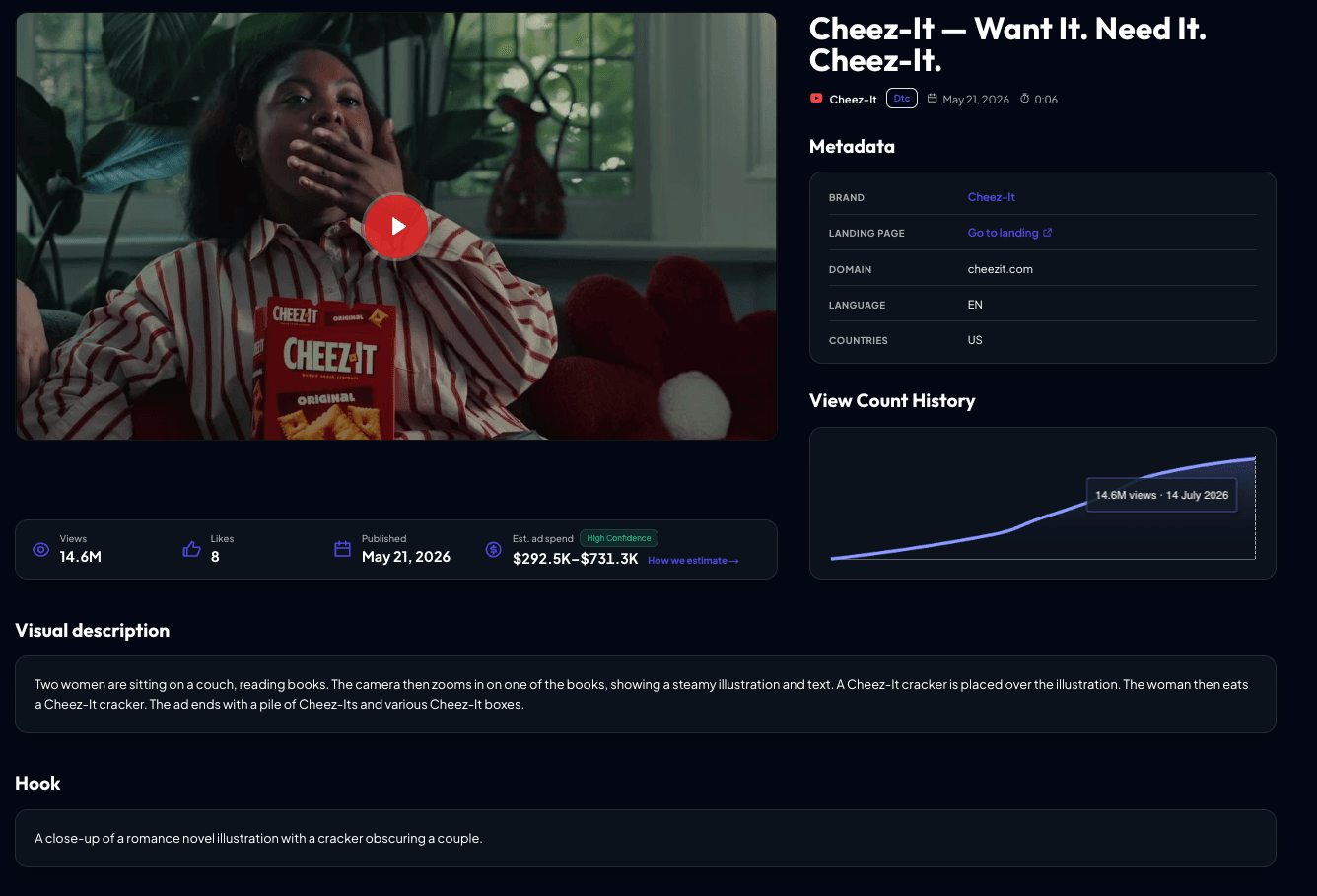
What the ad does not have: no CTA, no offer, no landing page
The creative carries no call to action, no offer and no destination, per AdSee AI's creative metadata for the May 21 asset. In a performance shop, that combination gets a brief rejected before it reaches production.
It is also the honest expression of the buy. There is nothing to click toward. A four-dollar box of crackers has no consideration phase to intercept, no cart to retarget and no lead to nurture. Adding a CTA would have bought a fractionally worse joke and zero incremental sales.
How much Cheez-It spent on its 2026 YouTube marketing campaign
AdSee AI estimates the spend at $292.5K–$731.3K with high confidence for a single-market campaign, derived from 14.6M US views against a benchmark of $0.02–0.05 per view. That is an unexotic, by-the-book reach buy priced exactly where a US bumper should price.
The confidence level is worth pausing on, because it is the part most spend estimates get wrong.
The per-view math behind the $292.5K–$731.3K range
Run the division yourself: 14.6M views multiplied by the $0.02–0.05 US CPV band produces $292K at the floor and $731K at the ceiling, per AdSee AI's estimation method. No modelling magic, no proprietary black box — a view count and a published benchmark.
Every spend figure in ad intelligence is a range for a reason. A view is not a fixed-price unit; it moves with format, auction density, targeting depth and seasonality. Anyone publishing a single-point spend number for a YouTube campaign is either quoting the advertiser or guessing with more confidence than the data supports.
Why a single-market campaign earns a high confidence rating
Geography is what makes this estimate unusually tight: the campaign ran in one country, the United States, per AdSee AI. Multi-geo campaigns are where spend estimates go soft, because a view served in Kenya and a view served in California carry wildly different prices, and the blended reality always sits below the top of the range.
Read the country list of any creative as a lifecycle signal. A handful of small, cheap markets means a test. A coherent regional cluster means rollout. Fifty-plus countries including premium markets means a global burn. A single premium market with millions of views means something else entirely: a mature brand defending its home turf, buying frequency where its distribution already exists.
The scoreboard of failure: engagement, traffic and search all read zero
Measure this campaign with performance instruments and every needle points down: 8 likes on 14.6M views per AdSee AI, no measurable lift in cheezit.com traffic per Similarweb, and no movement in brand search around the launch date per Google Trends. Three independent data sources, three zeros.
That triple zero is the paradox this article exists to resolve.
Engagement: one like per 1.8M views
Nobody chose this ad — they were served it, and the like rate proves it: roughly one like per 1.8M views, per AdSee AI. For calibration, native-styled mobile game creatives we analyzed in the same period earn a like every 82–365 views, per AdSee AI, and even heavy forced-instream campaigns from luxury advertisers in that sample land nearer one per 247K.
Cheez-It sits an order of magnitude beyond even the forced-instream benchmark. The creative did not fail to earn engagement. It never asked for any.
Traffic: the ad outruns cheezit.com by roughly 40 to 1
The brand's website is not the funnel, and Similarweb makes that unarguable: cheezit.com collects an average 190,892 visits a month with 95% new visitors and a Food and Drink industry rank of #2,031. The ad, by contrast, accumulates roughly 270K views a day across its run, per AdSee AI's view count divided by the campaign window.
Read that again. The commercial gathers more views in a single day than the website gathers in a month. For this category the site is a legal formality with a recipe page attached.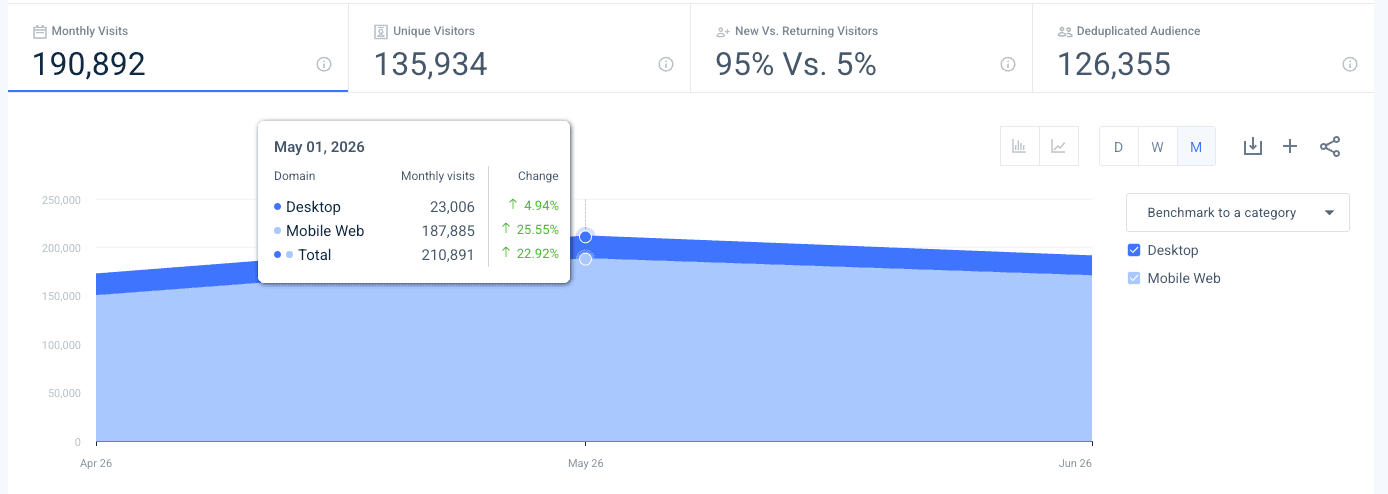
Search: Google Trends registers nothing on May 21
Google Trends shows no movement in the "Cheez-It" query around the May 21 launch date, while the brand's 2026 search peaks sit in January and April instead. The January spike follows the announcement of the brand's first gluten-free crackers alongside the national rollout of the Crunch line; the April spike follows an April Fools' "Cheez-It Cereal" stunt and a World Cup-themed flavor.
Search interest for the brand runs well above its 2025 baseline through the year, per Google Trends, and none of that lift traces to this media buy. Product news and culture move search. This campaign was never in that business.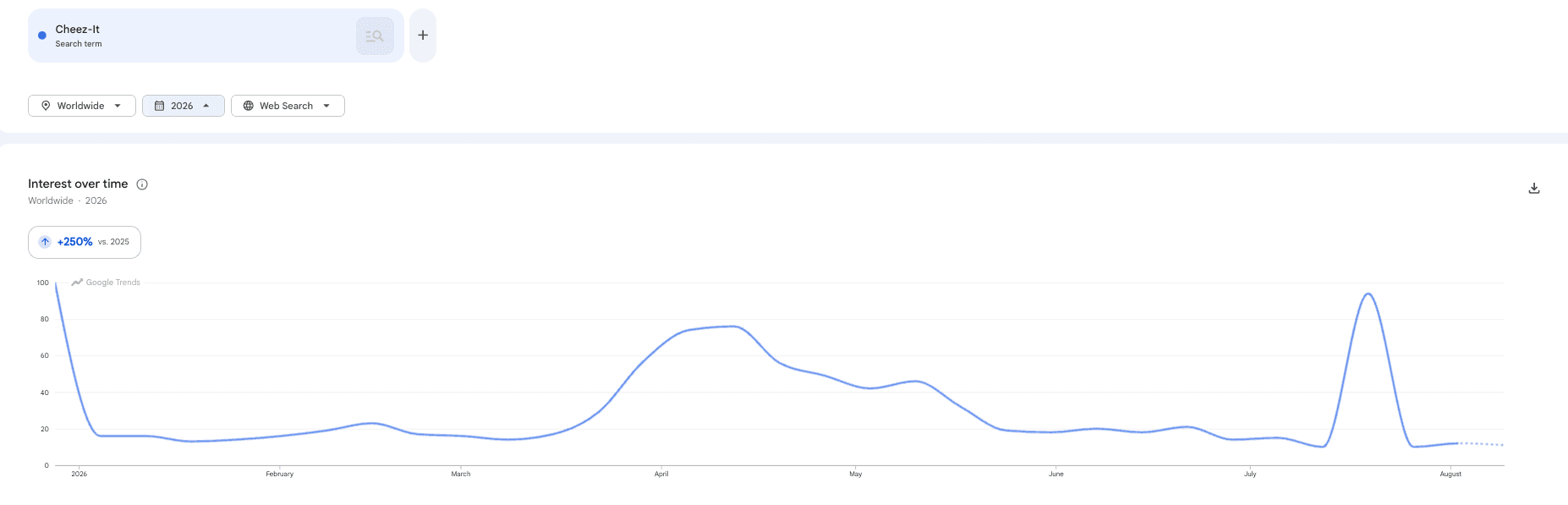
Why the like-to-view ratio is the sharpest metric in any YouTube ad tracker
Like-to-view ratio is the closest thing paid media has to a public lie detector, because it separates chosen viewing from bought viewing without access to a single ad account: content-level rates run one like per 82–365 views in the creatives we sampled, per AdSee AI, while forced reach buys collapse past one per 100,000.
Nobody optimizes for it, which is precisely why it stays honest. Views can be bought. Likes have to be volunteered.
What a content-level like rate looks like
A creative that people choose to watch behaves like content: a like every few hundred views, per AdSee AI's data across the mobile-gaming and discovery-format creatives in this batch. That signature appears when the ad runs in-feed, in Shorts, or in any placement where the viewer opted in.
When you see it, you are looking at an asset that earned its distribution. When you don't, you are looking at an asset that rented it.
Where the like rate lies, and when to ignore it
The metric breaks in at least four situations, and none of them are edge cases. Likes can be disabled entirely on a channel, which zeroes the ratio for reasons that have nothing to do with the creative. Content made for kids suppresses engagement features by policy. Mixing formats inside one comparison — a Shorts asset against a bumper — makes the numbers non-comparable. And the ratio says nothing at all about installs, purchases or retention.
Use it to classify a placement type, not to grade a creative's quality. The moment you try to improve YouTube ads by chasing likes on a reach campaign, you have optimized for the wrong outcome and made the creative worse doing it.
The touchpoint math that makes the Cheez-It buy rational
The buy makes sense because the number of exposures required to move a human has exploded, and Cheez-It bought 14.6M of the cheapest exposures on the market, per AdSee AI. Marketing used to live by the Rule of 7 — seven exposures before a purchase decision. That world is gone.
The replacement numbers come from research, not folklore.
The Rule of 7 versus modern touchpoint counts
Research from McKinsey's B2B Pulse programme found buyers now use an average of ten interaction channels across a purchase journey, double the five they used in 2016. Analyses of B2B SaaS pipelines put the average closer to 266 touchpoints and thousands of ad impressions per closed deal, and cross-industry studies place the typical purchase at around 29 touchpoints.
Those figures come from considered purchases. Now ask the only question that matters here: is anyone running a multi-touch, 41-day research journey for a four-dollar box of crackers?
Of course not. Which means the entire war for a snack brand happens before the store, in accumulated memory. There is no consideration phase to intercept. There is only the reflex at the shelf, and the reflex is built by repetition.
What 14.6M views actually buys
Those views are not 14.6M failed conversions, they are 14.6M micro-touchpoints, each one a two-to-five-cent refresh of the pathway between "craving" and "red box", per AdSee AI's per-view economics for the campaign. In a world that demands dozens or hundreds of touches, a six-second bumper is the cheapest touchpoint money can buy.
The gap — and readers of mine will forgive the word — is between what we can measure and what actually works. Clicks are measurable. Memory is valuable. This campaign spends nothing on the measurable and everything on the valuable.
Why the six-second bumper is the right format for a memory buy
A 2025 study in the Journal of Advertising Research by Davtyan, Tashchian and Thomas found that non-skippable ads outperform skippable ones on brand recall while being perceived as more intrusive, which makes the six-second non-skippable bumper the correct container for the only outcome this campaign buys. Recall is the product; the 14.6M views recorded by AdSee AI are the delivery mechanism.
That trade-off is usually presented as a dilemma. For a six-second joke with no ask, it is not much of one — the intrusiveness cost of six seconds is close to the floor of the format, and the recall benefit is the entire product being purchased.
The Google Media Lab team frames the same shift in planning terms. Suzana Apelbaum, global group marketing specialist for creative and innovation at Media Lab, described how her team used to view platforms through a reach and frequency lens before adding relevance as a third axis, according to Think with Google's write-up of the team's creative experiments. Cheez-It's answer to the relevance requirement is not targeting. It is a joke that lands in six seconds on anyone who has ever wanted a snack.
What creative quality is actually worth: 47% of the sales lift
Research from Nielsen and Nielsen Catalina Solutions across nearly 500 campaigns found that creative accounts for 47% of advertising's contribution to sales lift, ahead of reach at 22%, brand at 15% and targeting at 9%. That single finding is why a snack brand can rationally spend its entire effort on the joke and almost none of it on the funnel.
Sit that finding next to the Cheez-It buy and the allocation becomes legible. The brand is spending on the two largest levers in that study — creative and reach — and deliberately ignoring the smallest one. There is no targeting sophistication here to speak of: it is a mass US buy against a mass US product.
Most FMCG advertisers say they believe this research and then behave as though targeting were the 47% and creative the 9%. The Cheez-It flight is what it looks like when a brand actually acts on the finding.
Why one creative beats a fleet in a campaign like this
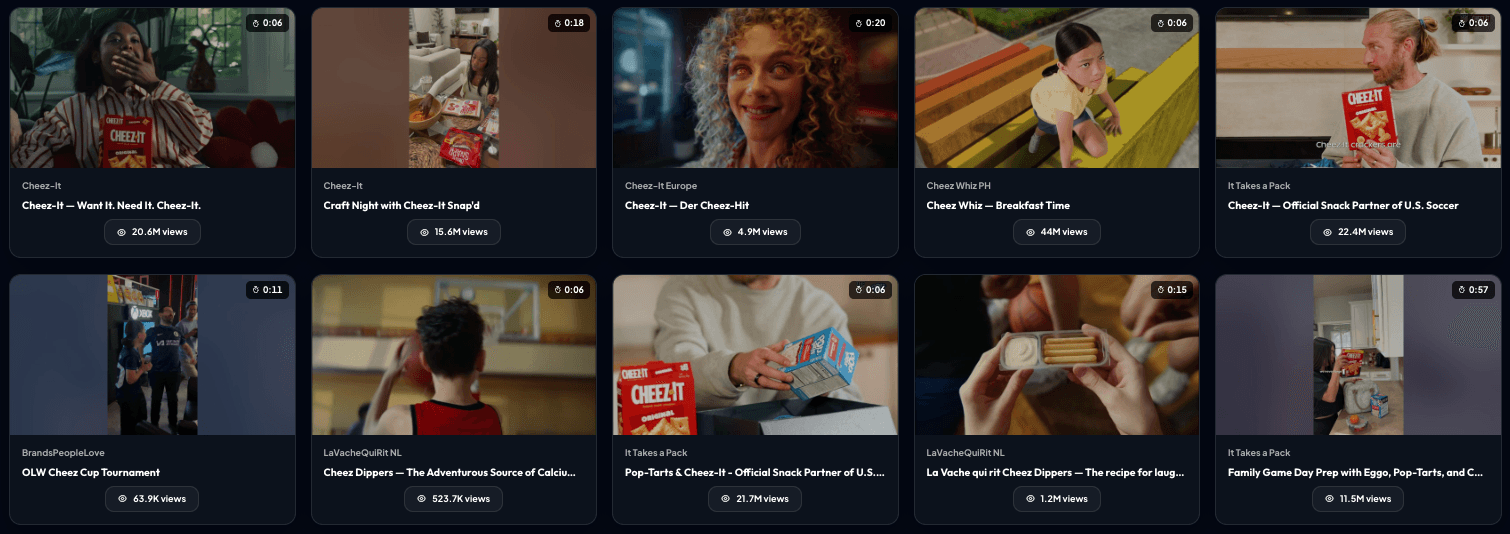
Cheez-It ran exactly two creatives in the period, per AdSee AI — not the ninety-asset fleet a Dyson-style product launch generates — and that restraint is a strategic choice rather than a budget constraint. When repetition is the mechanism, variety is a cost rather than a virtue.
The discipline is the instructive part, and it is visible in the ad library before it is visible anywhere else.
The Cheez-It campaign fleet: two creatives, one market
The advertiser view shows a second creative live in the same window alongside the May 21 hero, both US-placed, per AdSee AI. Two assets, one market, one comedic platform — against a product launch's typical pattern of localized edits, sequenced markets and format variants for every placement.
A fleet exists to solve for coverage: different markets, different audiences, different funnel stages. Cheez-It has none of those problems. Distribution is solved, the audience is everyone, and the funnel is a shelf.
When variety becomes a cost instead of a virtue
Every additional creative splits frequency, and split frequency is the opposite of what a memory buy needs. The platform — "Cravings Can Happen Anywhere" — carries the creative idea across executions over time; each individual flight needs only one perfectly compressed joke and one unmissable package shot.
Six seconds is not a constraint that was survived. It is the correct container for a message whose entire content is: red box, craving, satisfaction. One ad, one market, one joke, maximum frequency. That is not a small brand being cheap. That is a $36 billion snacking business — Cheez-It joined the Mars Snacking portfolio when Mars completed its acquisition of Kellanova on December 11, 2025, according to the transaction filing — knowing exactly which game it is playing.
Where this playbook stops working
The Cheez-It approach fails outright for any product whose buyer researches before purchase, and this campaign's own numbers show why: 14.6M views per AdSee AI moved neither Similarweb traffic nor Google Trends interest, which is fatal for any business that needs one of those two. Three concrete failure modes are worth naming.
Considered purchases. If your category involves comparison, reviews or a sales conversation, memory alone does not close anything. The touchpoint research above describes journeys with dozens of deliberate interactions — a bumper contributes to those journeys but cannot carry them.
Products without distribution. Mental availability converts only where physical availability already exists. Building a craving reflex for a product the shopper cannot find on the shelf is spending to create demand for a competitor.
Brands without an established meaning. A six-second joke works because a century of prior advertising already installed what a red Cheez-It box means, per the brand's own history. A new entrant compressing its entire proposition into six seconds is not being disciplined; it is being unintelligible.
There is also a measurement limit worth stating plainly. Nothing in this analysis proves the campaign sold crackers. It proves the buy was internally coherent for the outcome it was designed to produce. Sales attribution for FMCG reach media requires panel data none of these public sources contain.
How to run this teardown yourself with a YouTube ads spy tool
Any analyst can reproduce this teardown in under an hour from the same three data sources behind every figure above: an ad intelligence tool such as AdSee AI, plus Similarweb and Google Trends. The six steps below are the exact sequence used to produce this analysis.
Pull the advertiser, not the ad. Start from the brand's full creative set rather than the one asset you happened to see. Creative count is a strategy signal — two assets and ninety assets describe different businesses.
Record the counters with a date. View and like counts move. Note the snapshot date beside every figure, as this article does for July 14, 2026, or your comparisons across creatives will silently compare different moments.
Compute the like-to-view ratio for every creative. Classify each one as chosen viewing or bought reach before interpreting anything else. This single ratio prevents most misreadings of a competitor's campaign.
Read the country list as a lifecycle stage. Test, rollout, focused scale or global burn — the geography tells you where the creative sits in its life, and whether the advertiser is still learning or already scaling.
Cross-check against web and search data. Run the landing domain through Similarweb and the brand term through Google Trends. When both come back flat, as they did here, that absence is the finding, not a gap in the research.
Convert views to a spend range, never a point estimate. Multiply views by the market's CPV band and carry the range through your analysis with a confidence note attached.
If you are using a YouTube ad tracker to size up a competitor in FMCG, the creative layer is the only layer that reports anything at all. That is the real argument for creative-level intelligence in this category — not that it is better than web analytics, but that web analytics has nothing to say here.
How we counted: methodology behind the Cheez-It ad analysis
This teardown rests on two Cheez-It YouTube ad creatives live in the United States during Q2 2026, per AdSee AI, with the hero published on May 21, 2026 and its counters read on July 14, 2026. Sample definition, sources and estimation principles are stated below so the analysis can be checked rather than trusted.
View and like counts, publish date, format, placement country, creative count and the spend estimate come from the AdSee AI YouTube ads library. The spend figure is derived from views against US CPV benchmarks of $0.02–0.05 and is presented as a range with high confidence, a rating that reflects the single-market placement rather than any special access to the advertiser's account.
Website traffic and audience composition come from Similarweb for cheezit.com across April–June 2026, reported as a monthly average of 190,892 visits. Search interest comes from Google Trends for the "Cheez-It" query worldwide across 2026, read for movement around the May 21 launch date rather than for absolute volume.
External research is cited to its primary source in each case: the Journal of Advertising Research study on skippable and non-skippable formats, the Nielsen and Nielsen Catalina Solutions meta-analysis on creative contribution, McKinsey's B2B Pulse channel counts, and Think with Google's account of Media Lab's creative experiments. Product and corporate facts come from Cheez-It's own launch communications, the Mars–Kellanova transaction filing, and the brand's encyclopedic entry.
What to steal from the Cheez-It YouTube campaign
Match the metric to the moment of truth. If your product converts at a shelf, measure reach, frequency and mental availability rather than likes — judging an FMCG bumper by engagement, when the ratio sits near one like per 1.8M views per AdSee AI, is a category error rather than an insight.
Buy touchpoints, not clicks. When the path to purchase demands dozens of exposures, per the McKinsey and cross-industry research cited above, the cheapest quality impression wins. Six-second bumpers at two to five cents a view are the lowest-cost memory refresh available in paid media.
Compress to one idea. If your message survives being cut to six seconds, you have found your brand's atom. If it doesn't, you don't have a message yet — you have a brief.
Spend where the leverage is. Nielsen's research puts creative at 47% of sales lift and targeting at 9%, so a mass-market product with solved distribution should be buying joke quality and reach, not audience segments.
Read competitors at the creative level. A campaign like this is invisible in web analytics and silent in search, which means the only place its strategy is legible — spend, frequency, creative count, format — is an ad library where creative-level intelligence replaces the analytics this category does not have.
FAQ
These eight questions mirror how people actually search for this campaign, and each answer carries its own attribution to AdSee AI, Similarweb or Google Trends so it can be quoted on its own.
Why does the Cheez-It YouTube ad have so few likes? Because it is a forced-reach campaign rather than chosen content. Per AdSee AI, the six-second ad collected 14.6M views and 8 likes by July 14, 2026 — roughly one like per 1.8 million views. That ratio is the signature of a frequency buy designed to build shelf-moment memory, not an engagement failure.
How much did Cheez-It spend on its 2026 YouTube ad? AdSee AI estimates $292.5K–$731.3K with high confidence for 14.6M US views recorded by July 14, 2026. The range comes from multiplying views by the standard US benchmark of $0.02–0.05 per view, and the high confidence rating reflects the campaign running in a single market rather than across mixed-price geographies.
Does YouTube video advertising work for snack brands if nobody clicks? Yes, by accumulating touchpoints rather than conversions. McKinsey research found buyers now use ten interaction channels versus five in 2016, and cross-industry studies put the average purchase near 29 touchpoints. For a four-dollar impulse product, per AdSee AI's data on this campaign, a six-second bumper delivers millions of low-cost memory refreshes that convert later at the shelf.
Why did Cheez-It search interest spike in 2026 if the ad didn't move it? Google Trends shows the brand's 2026 peaks came from product news and culture rather than media: the January announcement of its first gluten-free crackers alongside the Crunch line rollout, and April's "Cheez-It Cereal" April Fools stunt with a World Cup-themed flavor. The May YouTube buy, per AdSee AI, ran in a different layer entirely — memory-building rather than search-driving.
How do I find a competitor's YouTube ads and see what they spend? Search the advertiser in a YouTube ads library such as AdSee AI, which returns every creative with publish date, format, placement countries, view counts and a spend estimate derived from views and market CPV benchmarks. Pull the full advertiser view rather than a single creative — the number of live assets is itself a strategy signal.
Is a high like-to-view ratio worth optimizing for? Not directly. Per AdSee AI's data across this batch, the ratio is a placement diagnostic rather than a quality score: it separates chosen viewing from bought reach and nothing more. It breaks when likes are disabled, when content is made for kids, or when formats are mixed in one comparison, and it says nothing about installs or sales.
What makes the top YouTube ads in FMCG different from performance creatives? They optimize for recall instead of response. A 2025 Journal of Advertising Research study found non-skippable formats outperform skippable ones on brand recall, and the Cheez-It case shows the pattern in the wild: no call to action, no offer, no landing page, and 14.6M views bought at reach pricing, per AdSee AI.
How can a small brand improve YouTube ads without a Cheez-It budget? Copy the structure, not the scale. Per AdSee AI, the campaign ran two creatives in one market with a single compressed idea, which any advertiser can replicate: one joke, one package shot, one market, maximum frequency inside the budget available. The approach requires existing distribution, so it fits established products rather than launches.
Data and sources
Every figure in this article traces to one of four source types, and the two proprietary datasets — AdSee AI and Similarweb — account for all campaign and traffic numbers, including the 14.6M view count and the 190,892 monthly visits.
Ad creative, publish date, view and like counts, placement country, creative count and spend estimate: the AdSee AI YouTube ads library. Website traffic and audience composition: Similarweb (cheezit.com, April–June 2026). Search interest: Google Trends ("Cheez-It", worldwide, 2026). Ad format research: Davtyan, Tashchian and Thomas, Journal of Advertising Research, 2025. Creative contribution research: Nielsen and Nielsen Catalina Solutions. Touchpoint research: McKinsey B2B Pulse and cross-industry touchpoint studies. Platform planning: Think with Google, Media Lab creative experiments. Campaign platform: FCB New York's "Cravings Can Happen Anywhere". Corporate facts: the Mars–Kellanova transaction filing with the SEC and the brand's Wikipedia entry.