
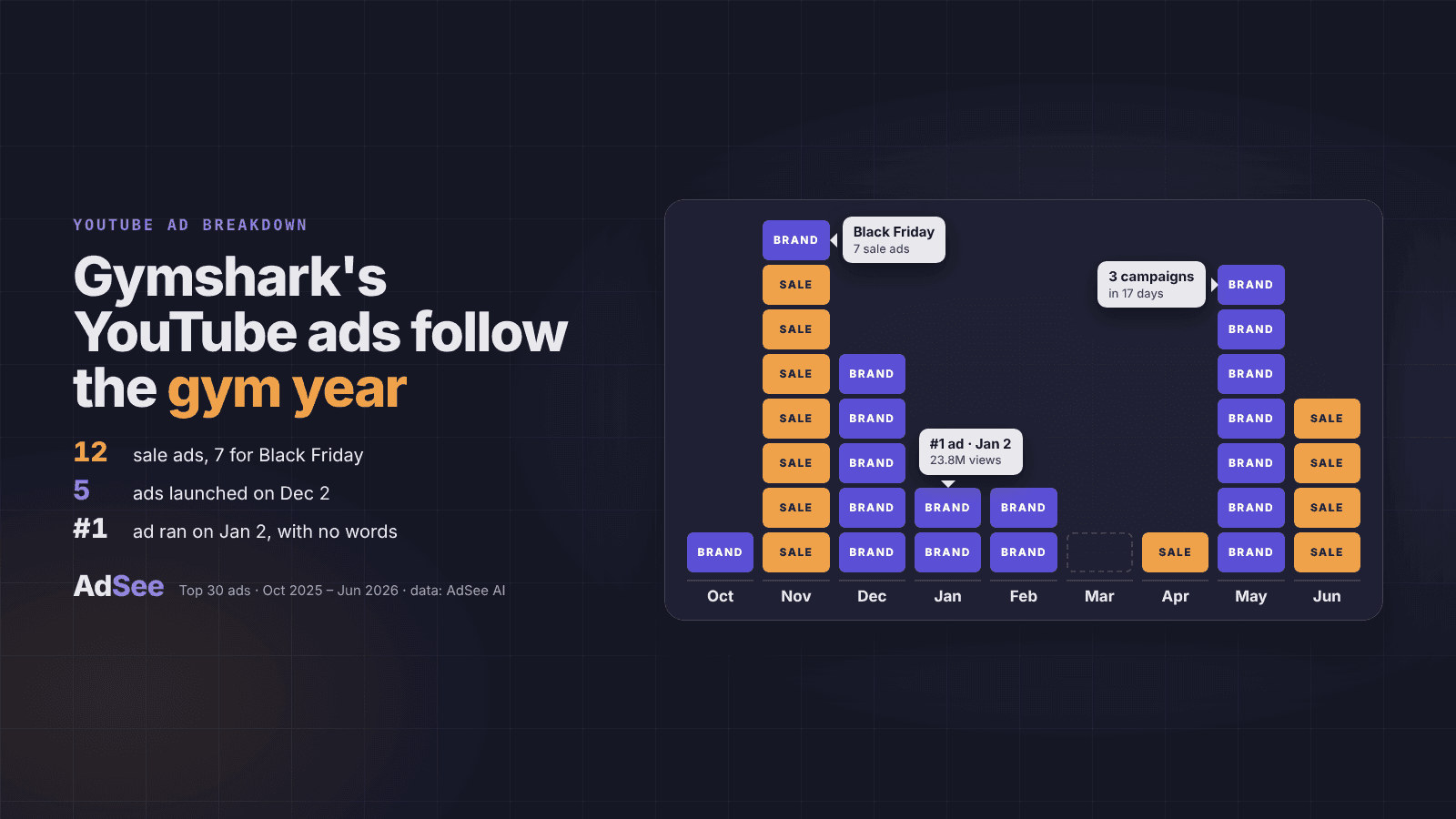
Gymshark's YouTube ads follow the customer's year: of the brand's 30 most-viewed YouTube ads, 12 are sale ads, 5 went live on a single day in December, and the #1 ad launched on January 2, per AdSee AI data pulled on October 27, 2026. The calendar is the strategy. Gymshark spends hardest when people are already thinking about training or shopping, and goes quiet when they aren't.
Gymshark is a British athletic apparel brand founded in 2012 by Ben Francis and Lewis Morgan and headquartered in Solihull. According to Wikipedia, it grew on influencer marketing, and by 2020 it was paying 125 influencers to promote the brand. Statista reports that it operates in over 180 countries and sells mainly online, direct to consumers. Its paid YouTube ads tell a different part of the story: how a creator-first brand buys reach at scale, and when.
Gymshark's top YouTube ads in numbers
Gymshark's top YouTube ad, "Back to Gym", has 23.8M views and an estimated $476K–$1.19M in spend, per AdSee AI, which rates that estimate high confidence. Here is the rest of the top 30 at a glance:
- 12 of 30 are sale ads: Black Friday, a mid-season sale and the summer sale
- 22 of 30 run 15 seconds or less; the shortest runs 5 seconds and the longest 57
- 10 of 30 are vertical, built for Shorts and mobile feeds
- All 30 are in English
- The most-viewed ads ran most often in the US, Canada, the Netherlands, France and the UK, per the Gymshark brand page in AdSee AI
Two notes on reading these numbers. Views on YouTube ads are paid reach: they show where the budget went, not how viral an ad was. Spend is an estimate that AdSee AI derives from views and typical cost-per-view rates, so treat every figure as a range, not a reported number.
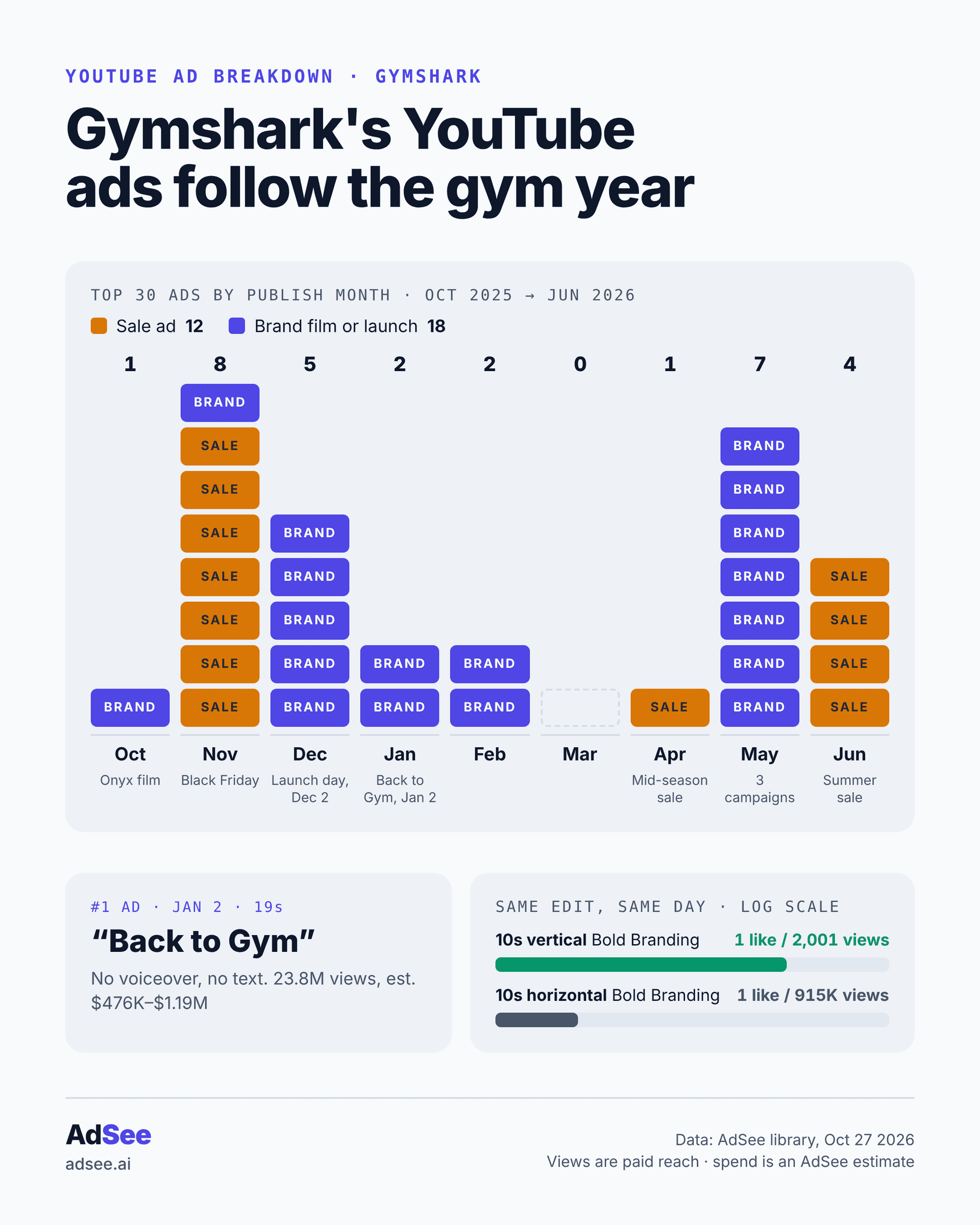 Chart of Gymshark's top 30 YouTube ads by publish month, showing 8 in November, 5 in December and 7 in May, per AdSee AI.
Gymshark's YouTube marketing campaign calendar, month by month
Gymshark's 30 most-viewed YouTube ads cluster in three windows, November, early January and late May to June, per AdSee AI publish dates. Here is the full split:
- October 2025: 1 ad, the 57-second Onyx collection film
- November 2025: 8 ads, 7 of them for Black Friday
- December 2025: 5 ads, all published on December 2
- January 2026: 2 ads, including the #1 ad on January 2
- February 2026: 2 ads
- March 2026: none
- April 2026: 1 ad, a mid-season sale
- May 2026: 7 ads from three campaigns in 17 days
- June 2026: 4 ads for the summer sale, up to 50% off everything
Every peak lines up with a moment in the customer's year rather than only the retail calendar. Black Friday and the summer sale are retail moments. January 2 and the late-May "June Top 30" push are training moments. The sections below take each window in turn.
January 2: "Back to Gym" has no words
Gymshark's most-viewed YouTube ad went live on January 2, 2026, in the US and Canada, and it contains no voiceover and no on-screen text, per AdSee AI's creative analysis. Its original upload title is simply "Back to Gym".
A man with a backpack walks into a gym and hands his training partner a bag. After one cut, both are in Gymshark sets and posing by the squat rack. The end card is the Gymshark logo, and the click goes to the Canadian store's homepage.
The ad doesn't need copy because the date carries the message. Exercise programs are a standard example of a New Year's resolution, as the Wikipedia entry on New Year's resolutions notes, and January 2 is when many people act on one. AdSee AI's analysis scores the hook only 2 out of 5 on its own terms, with no verbal or text hook to stop a skip. The timing does the work the hook doesn't.
 Gymshark Back to Gym YouTube ad with two people in Gymshark workout sets, 23.8M views per AdSee AI.
Black Friday: the teaser sells the date
Gymshark published 7 Black Friday ads between November 5 and November 24, 2025, and the biggest, a 9-second teaser from November 7, reached 16.4M views with an estimated $328K–$819K in spend, per AdSee AI.
A split screen shows "BLACK FRIDAY UP TO 50% OFF EVERYTHING" on one side and a creator in a gym on the other: "Gymshark Black Friday sale coming soon, up to 50% off the website, 16th of November." Then the call to action: "Build your baskets now." The end card says "GET PREPPED", and the click goes to a dedicated Black Friday page.
The teaser sells the date, not the discount. Viewers fill their baskets nine days before the sale opens, so they're ready to buy on day one. The other six Black Friday ads run from 9 to 30 seconds, horizontal and vertical, and carry the same offer.
 Gymshark Black Friday YouTube teaser announcing up to 50% off everything, 16.4M views per AdSee AI.
December 2: Tactical launch day and "We Do Gym"
Five of Gymshark's top 30 YouTube ads went live on December 2, 2025: four vertical cuts of the new Tactical line at 6, 9, 12 and 15 seconds, plus the brand film "We Do Gym", per AdSee AI publish dates. "We Do Gym" got three more cuts the same day.
The 12-second Tactical ad (10.5M views, an estimated $209K–$523K, per AdSee AI) shows a heavy barbell lift with a data overlay: elapsed time 50:01, average heart rate 165 BPM, GPS coordinates and "video shot in Colorado". The tagline: "Performance you can wear anywhere." Its landing URL is tagged tactical_aw25, an autumn-winter 2025 launch.
"We Do Gym" takes the opposite route. Chris Bumstead, who won six consecutive Mr. Olympia Classic Physique titles from 2019 to 2024 and is a part-owner of Gymshark, walks into a mock press conference while a voice says: "We're Gymshark, the gym wear brand. Clue's in the name, no?" The product launch and the brand message ship together, so a viewer who meets Tactical first also learns who makes it.
 Gymshark Tactical YouTube Short with a heart-rate overlay during a barbell lift, 10.5M views per AdSee AI.
May: three campaigns in 17 days
Gymshark published 7 of its top 30 YouTube ads in May 2026, from three separate campaigns, and together they reached 58.5M views, per AdSee AI. The upload titles name all three:
- "Pink Push", May 11: two vertical cuts of 5 and 8 seconds showing women in matching pink sets, linked to a "pink trend" page
- "Bold Branding", May 22: a 10-second locker-room edit, uploaded once as a vertical and once as a horizontal
- "June Top 30", May 28: three horizontal cuts linked to a "must-have" collection; the biggest, a 12-second ad where cloned athletes fill an empty gym on the beat, reached 12.6M views and ran in 39 countries
Read through the country lists and landing pages, the push widens over the month. Pink Push linked to the Australian store and ran in up to five markets. Bold Branding ran in eight or nine markets across North America, Europe and Oceania. The June Top 30 hero cut went to 39 countries. That is the shape of a rollout: a narrow start, then a global push once the creative is ready.
June: the summer sale
Gymshark's summer sale produced 4 of its top 30 YouTube ads, published June 9 to 16, 2026, and the biggest, a 28-second cut uploaded as "Gymshark Summer Sale 2026", reached 6.26M views with an estimated $125K–$313K in spend, per AdSee AI. All four promise up to 50% off everything.
The sale also got local versions outside the top 30: German, Spanish and French cuts published June 12 to 19, and a 12-second Australian cut with "30% OFF EVERYTHING" on screen, linked to au.gymshark.com. The mid-season sale in April follows the same logic on a smaller scale: one 18-second vertical, uploaded as "Gymshark - MSS", linked to the outlet.
Vertical vs horizontal: which Gymshark ads earn likes
Gymshark's "Bold Branding" campaign uploaded the same 10-second locker-room edit twice on May 22, 2026, and the vertical cut earned 3,324 likes while the horizontal cut earned 8, per AdSee AI. That's one like per 2,001 views against one per 915K, from the same campaign on the same day.
The pattern holds across every Gymshark ad we checked:
- Vertical: Pink Push 5s, one like per 896 views; Pink Push 8s, one per 976; mid-season sale 18s, one per 1,187; Tactical 12s, one per 1,767; Bold Branding 10s, one per 2,001
- Horizontal: June Top 30 16s, one per 104K; summer sale 28s, one per 174K; Back to Gym 19s, one per 404K; Bold Branding 10s, one per 915K; June Top 30 12s, one per 1.26M; Black Friday teaser 9s, one per 1.64M; We Do Gym 15s, one per 2.24M
Likes don't decide who sees an ad. They do show which ads people watched as content rather than as an interruption. The Pink Push ad, a 5-second mirror selfie captioned "matching sets >>>", looks like a post from a fitness creator.
That fits what Google found when it tested its own creative. In a Think with Google write-up of those experiments, creator-led skippable ads for the Pixel 7a in Germany reached 49% higher watch time and 128% higher consideration than the control, with a 56% lower cost per lifted user. Billy Corbyn, head of Global Creative Works, said the approach means "making your ad creative look like content." Read the Think with Google experiment write-up.

Gymshark 5-second vertical YouTube ad with two women in matching pink sets, one like per 896 views per AdSee AI.
Where the like-to-view ratio misleads
The like-to-view ratio is a useful signal for Gymshark's ads only within one format, because vertical and horizontal ads are seen in different places, per AdSee AI's placement data. Four limits apply:
- Placement changes the baseline. A Short sits in a feed with a visible like button; an in-stream ad plays before a video the viewer chose. Comparing the two measures the placement as much as the creative.
- Likes are not sales. A Black Friday teaser with one like per 1.64M views, per AdSee AI, can still fill baskets. The ratio says nothing about clicks, orders or returns.
- Small numbers swing. The "We Do Gym" cut has 3 likes. One more like would move its ratio by a third.
- Likes can be hidden or disabled by the advertiser, which makes some ads look worse than they are.
The fair use of the ratio is the Bold Branding pair: same edit, same day, same campaign, different format.
Bumpers and short cuts: 22 of 30 Gymshark ads run 15 seconds or less
Gymshark keeps most of its top YouTube ads short: 22 of the 30 run 15 seconds or less, and two run 6 seconds or less, per AdSee AI. Google Ads Help describes bumper ads as "videos up to 6 seconds long," a format sold for non-skippable reach. See Google Ads Help on video reach campaigns.
Short doesn't mean thin. The 9-second Black Friday teaser carries a date, a discount and an instruction. The 5-second Pink Push ad carries a product, a colour and a caption that does the selling. The 12-second "June Top 30" ad shows a full collection on a dozen athletes without a single cut away from the gym.
The longest ad in the top 30, the 57-second Onyx film from October 2025, plays like a short heist movie: a security breach at HQ, a text from "Ben Francis", athletes told to "suit up". It reached 7.44M views, per AdSee AI. Gymshark uses long creative rarely, and for a collection launch rather than a sale.
What Gymshark's upload titles reveal about the plan
Gymshark's original YouTube upload titles read like an internal campaign brief, per the original-title field AdSee AI stores for each ad. The titles in the top 30 include:
- "Back to Gym"
- "Gymshark - Black Friday 2025"
- "Gymshark - Tactical NPD"
- "Gymshark - Pink Push"
- "Gymshark - Bold Branding"
- "Gymshark - June Top 30"
- "Gymshark - MSS"
- "Gymshark Summer Sale 2026"
NPD is a common retail shorthand for new product development, and MSS matches the mid-season sale the ad promotes. Together with landing URL tags like tactical_aw25, these titles let you rebuild a competitor's media plan: which pushes are sales, which are launches, and which are pure brand.
How to run this teardown on your own competitors
You can repeat this Gymshark analysis on any competitor's top 30 ads in seven steps, using the same YouTube ads library data AdSee AI used here. The steps work with any YouTube ad tracker that shows publish dates and view counts:
- Search the competitor's domain or brand name and sort by views.
- Open the top 30 and note each ad's publish date, length, orientation and countries.
- Group the ads by month. Peaks and gaps show the campaign calendar.
- Mark each ad as sale, launch or brand. Sale ads show the price in the first seconds; launch ads name a product line.
- Read the country lists. A narrow start followed by a wide push usually means a rollout.
- Read the original upload titles and landing URL tags for internal campaign names.
- Compare likes only within one format, and save the ads worth studying to a board.
In AdSee AI, Gymshark already has a brand page with its top ads and markets: Gymshark in the AdSee AI YouTube ads library. The library indexes 16M YouTube ads, including unlisted ones you won't find through YouTube search, and it's free to search.
Where this analysis stops working
This teardown covers Gymshark's 30 most-viewed YouTube ads as of October 27, 2026, per AdSee AI, and that sample has three blind spots:
- Top 30 by views favours big budgets. Smaller tests, local cuts and retargeting ads sit below the cut, so a quiet month in the top 30, like March, doesn't mean Gymshark stopped advertising.
- A publish date is not a run date. YouTube shows when an ad was uploaded, not when it stopped serving, so the calendar above is a launch calendar.
- Spend is modelled. AdSee AI estimates spend from views and typical cost-per-view rates. The ranges are useful for comparing ads with each other, not for reconstructing Gymshark's budget.
None of this changes the main finding. The biggest pushes line up with the customer's year, and that pattern holds whether you rank by views or by estimated spend.
Takeaways from Gymshark's YouTube ads
Gymshark's calendar gives DTC brands five practical takeaways, based on the 30 ads AdSee AI analysed:
- Plan creative around your customer's year: back to the gym in January, summer in June.
- Announce a sale before it opens and ask people to build their baskets.
- Launch a product with several cuts on one day, vertical and horizontal.
- Pair a launch with a brand film so new customers learn who you are.
- Use vertical, creator-style ads for engagement and short horizontal ads for reach.
FAQ
What is Gymshark's most-viewed YouTube ad?
Gymshark's most-viewed YouTube ad is "Back to Gym", a 19-second spot published on January 2, 2026, with 23.8M views and an estimated $476K–$1.19M in spend, per AdSee AI. It has no voiceover and no on-screen text: two people change into Gymshark sets in a gym, and the ad ends on the logo.
What are the top Gymshark YouTube ads right now?
The top YouTube ads from Gymshark, by views in AdSee AI, are "Back to Gym" (23.8M), a Black Friday teaser (16.4M), a "June Top 30" gym clip (12.6M) and a second Black Friday cut (11.5M). Most run 15 seconds or less, and 12 of the top 30 are sale ads.
How often does Gymshark run sale ads on YouTube?
12 of Gymshark's 30 most-viewed YouTube ads are sale ads, per AdSee AI: 7 for Black Friday in November 2025, 4 for the summer sale in June 2026 and 1 for an April mid-season sale. The other 18 are product launches and brand films, such as the Tactical line and "We Do Gym".
How long are Gymshark's YouTube ads?
Gymshark's YouTube ads are mostly short: 22 of the top 30 run 15 seconds or less, per AdSee AI. The shortest is a 5-second vertical from the Pink Push campaign. The longest is the 57-second Onyx collection film from October 2025, which Gymshark used for a launch rather than a sale.
Where does Gymshark advertise on YouTube?
Gymshark's most-viewed YouTube ads run most often in the US, Canada, the Netherlands, France and the UK, per its AdSee AI brand page. All 30 top ads are in English. Some campaigns start narrow, like Pink Push on the Australian store, and the biggest May ad ran in 39 countries.
How can I track Gymshark's YouTube ads?
You can track Gymshark's YouTube ads with any YouTube ad tracker that lists publish dates, views and countries. In AdSee AI, open the Gymshark brand page or search gymshark.com, sort by views and save ads to a board. Google's Ads Transparency Center also lists active ads, without views or spend.
Do likes show which Gymshark ad sells best?
Not directly. Likes show which ads people watched as content, and in AdSee AI data Gymshark's vertical ads earn one like per 896 to 2,001 views while horizontal ads earn one per 104K to 2.2M. But likes don't track clicks or orders, and placement changes the baseline, so compare them only within one format.
Where can I see all Gymshark ads?
You can see Gymshark's top ads, markets and estimated spend on its brand page in the AdSee AI YouTube ads library: adsee.ai/ad-examples/youtube/brands/gymshark. Searching gymshark.com in AdSee AI shows every indexed ad, with filters for country, language, date range and orientation.