
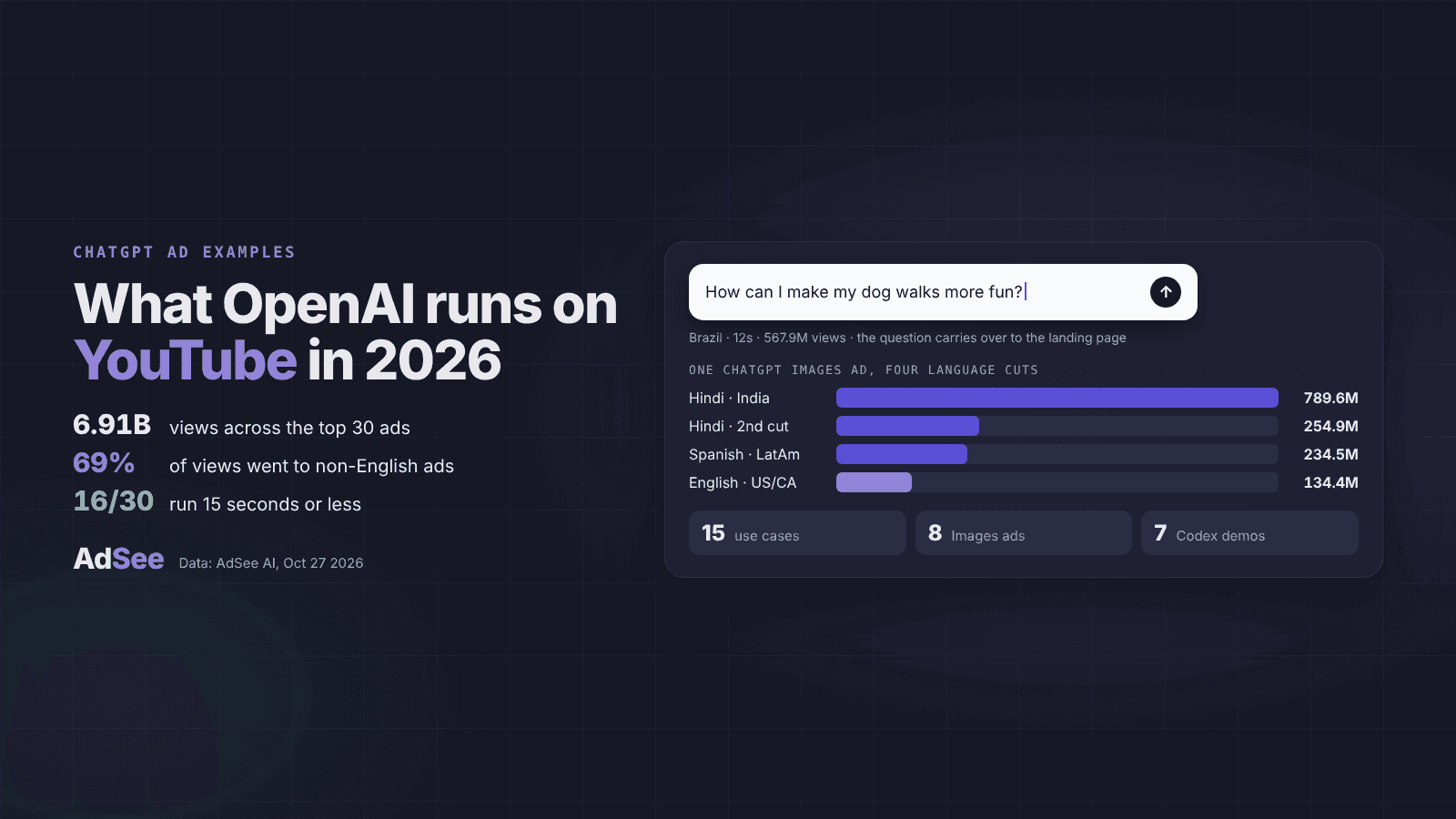
ChatGPT's 30 most-viewed YouTube ads reached 6.91B views, and 19 of them, carrying 69% of those views, are not in English, per AdSee AI data pulled on October 27, 2026. OpenAI runs three playbooks at once: 12-second everyday use cases, single-feature ads for ChatGPT Images, and Codex demos for developers.
ChatGPT is OpenAI's generative AI chatbot, first released on November 30, 2022. According to Wikipedia, it reached 900 million weekly active users in February 2026. At that scale, its YouTube advertising is less about awareness and more about showing new groups of people one thing they can do with it today.
ChatGPT's YouTube ads in numbers
ChatGPT's top YouTube ad is a 12-second ChatGPT Images spot in Hindi with 789.6M views and an estimated $15.8M–$39.5M in spend, per AdSee AI, which rates that estimate low confidence. The top 30 at a glance:
- 6.91B views across the 30 ads, all from chatgpt.com
- 19 of 30 are not in English: 13 Spanish, 3 Portuguese, 2 Hindi, 1 Indonesian
- 16 of 30 run 15 seconds or less; 21 run 20 seconds or less
- 15 everyday use cases, 8 ChatGPT Images ads and 7 Codex demos
- Only 4 of 30 are vertical
Views on YouTube ads are paid reach: they show where the budget went, not how viral an ad was. Spend is an estimate that AdSee AI derives from views and typical cost-per-view rates, so treat every figure as a range.
Three playbooks in ChatGPT's YouTube marketing campaign
ChatGPT's YouTube marketing campaign splits into three creative playbooks with different audiences, lengths and markets, per AdSee AI's analysis of the top 30 ads. Each one answers a different question a viewer might have about the product.
Playbook 1: one person, one question, 12 seconds
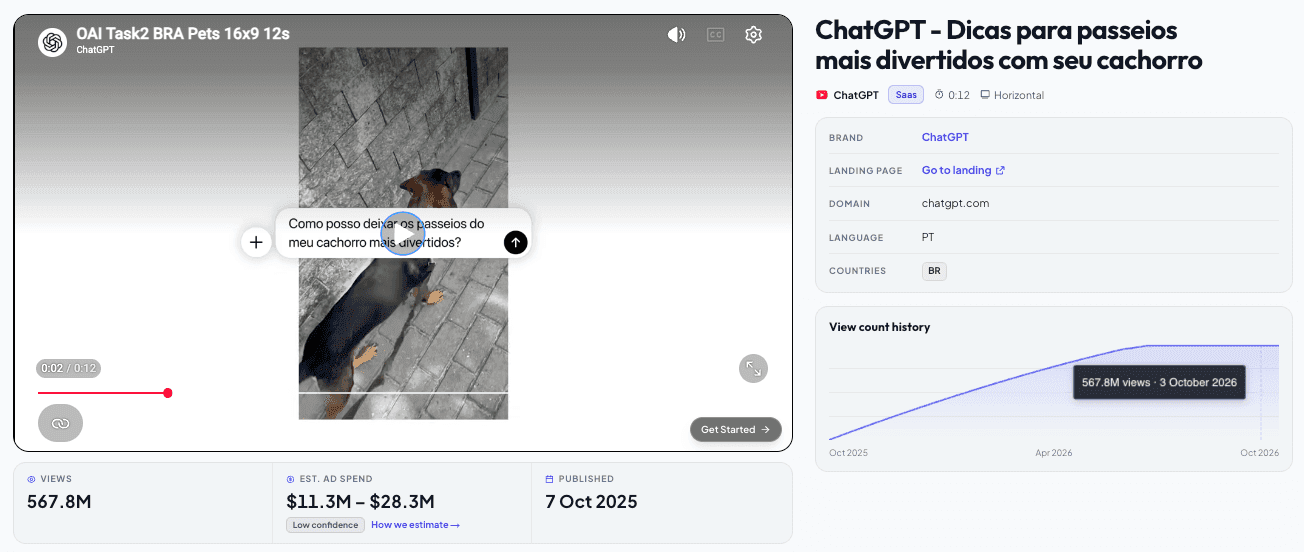
ChatGPT's everyday-use-case ads show one person asking one question, and the biggest, a 12-second spot for Brazil, reached 567.8M views with an estimated $11.3M–$28.3M in spend, per AdSee AI.
There is no voiceover. A woman walks her dog by the sea while a ChatGPT prompt bar types a question in Portuguese: "How can I make my dog walks more fun?" Four short tips appear, from changing the route to hiding a treat. The dog runs free on the beach. End card: "Try ChatGPT now."
The rest of the group follows the same shape with different people. View counts per AdSee AI: a runner in Brazil asks for post-run workout advice (288M views). A market vendor in Mexico City asks for recipe ideas (218.6M views, per AdSee AI). A rideshare driver practises a conversation with voice mode (172.6M, per AdSee AI). A woman asks how to style black slacks (120.7M in the US and India, per AdSee AI). Each ad is one task the viewer has had this week, shown from question to answer in under 20 seconds.
Playbook 2: ChatGPT Images, one creative in four languages
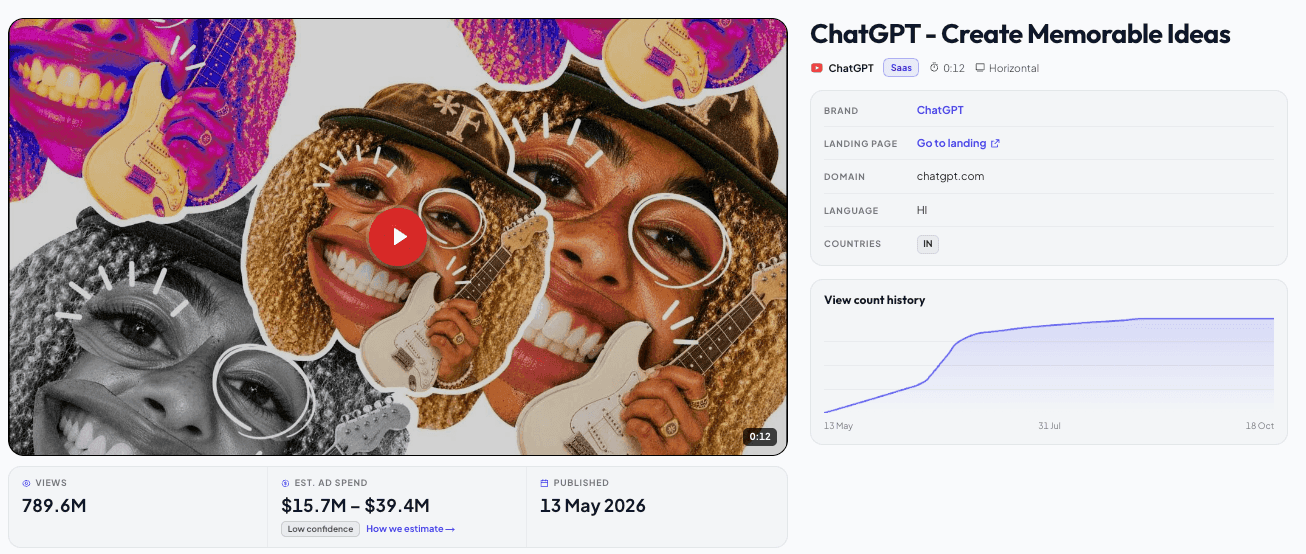
ChatGPT ran the same ChatGPT Images creative in four language cuts, and together they reached 1.41B views, per AdSee AI. The upload titles name it "OAI ImageGen2 Phase2 UC4", followed by the market.
A musician's photos pop onto a white canvas while a prompt types itself: "My first show is coming up! I want to give everyone stickers." The photos merge into a cartoon sticker, which then shows up on a wall and on the back of a van. Tagline: "Make your ideas memorable." CTA: "Try ChatGPT Images for free."
The four cuts:
- Hindi, India: 789.6M views
- Hindi for India, second cut labelled "IN RO": 254.9M views
- Spanish, Latin America: 234.5M views, with the tagline "Haz tus ideas más pegajosas"
- English, US and Canada: 134.4M views, with the tagline "Make your ideas stick"
A second Images concept, "ImageRatio", sells any image in any size. AdSee AI data shows it ran as an 11-second cut for Latin America (279.1M views), Indonesia (210.5M) and Brazil (133.9M). The creative stays the same; the language and the market change.
Playbook 3: Codex demos from the people who build it
ChatGPT's seven Codex ads in the top 30 reached 1.64B views, all in English, and six of them are workflow demos with titles like "Tracking Bugs" and "Fixing Merge Conflicts", per AdSee AI. Codex is OpenAI's AI coding agent for tasks such as writing code and fixing bugs.
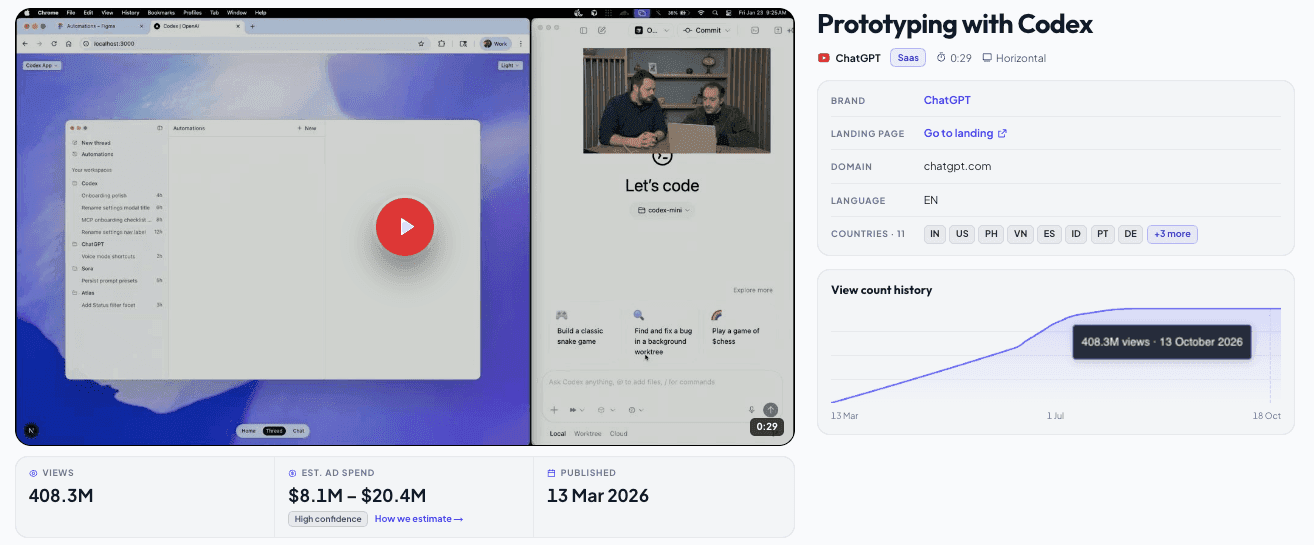
"Prototyping with Codex" runs 29 seconds in 11 countries, including the US, India, the UK and Germany. It has 408.3M views and an estimated $8.1M–$20.4M in spend, per AdSee AI, this time with high confidence. Ed Bayes from the Codex team copies a Figma link, pastes it into Codex with a one-line prompt and gets a working interface. "It was like 90% of the way there," he said.
"Tracking Bugs with Codex" (278.4M views, per AdSee AI) uses the same format. Andrew Ambrosino of the Codex team said there is a lot about the job "that I have now automated away almost entirely," while the screen shows Codex triaging Sentry issues in the background. No narrator, no lifestyle footage, no price. For a technical buyer, the screen recording is the proof.
When ChatGPT releases its ads: drops, not a drip
ChatGPT publishes its YouTube ads in batches: 7 of the top 30 went live on December 22, 2025, and 5 Codex ads on March 13, 2026, per AdSee AI publish dates. The calendar of the top 30 looks like this:
- October 7, 2025: the Brazilian "Task2" use cases, including the dog-walk and workout ads
- December 22, 2025: seven Latin American use cases, among them the Mexico City market vendor, the tour guide in Xochimilco and the rideshare driver
- March 13 and 25, 2026: six Codex workflow demos
- April 23 to May 15, 2026: the ChatGPT Images sticker ad, first in English for the US and Canada, then in Hindi for India and Spanish for Latin America three weeks later
- April 28, 2026: the "ImageRatio" Images ads for Latin America, Indonesia and Brazil
Each batch is one brief shot as several scenes or cut for several markets, then released together. For a competitor, that means a quiet month is not a sign that the budget stopped. It is more likely the gap between two batches.
Sound off, text on: how ChatGPT's ads use Google's rules
ChatGPT's consumer ads show the product in the first two seconds and carry the message in on-screen text, with music only and no voiceover, per AdSee AI's creative analysis of the top ads. That follows one Google rule closely and bends another.
According to Google's ABCD playbook for YouTube creative, the rule is: "Introduce your product or brand in the first five seconds." ChatGPT's ads do that with the prompt bar itself, which is both the product and the hook.
The same playbook advises "Build for sound on" and says 95% of YouTube video watch time is with sound on. ChatGPT's ads use music, but the meaning sits entirely in text: the typed question and the answer. That choice makes one creative easy to translate, because only the text changes between the Hindi, Spanish and English cuts.
Horizontal first: only 4 of 30 ChatGPT ads are vertical
ChatGPT's top YouTube ads are almost all horizontal: only 4 of the 30 are vertical, per AdSee AI. Two are Spanish-language use cases from March 2026, one is a Brazilian workout ad, and one is a vertical cut of "Prototyping with Codex".
That runs against the direction of much of the market. A Think with Google write-up of Google's own creative experiments advises teams to "always review vertical video specs and build for smaller screens." Read the Think with Google write-up. OpenAI's top 30 suggests its biggest budgets still go to horizontal in-stream placements, where a 12-second spot can play before the video the viewer chose.
Why 789.6M views earned 63 likes
ChatGPT's top ad earned 63 likes on 789.6M views, one like per 12.5M views, per AdSee AI. That ratio is a placement signal: people see in-stream ads on the way to something else, and very few stop to like them.
The Codex ads earn more, though still few. "Prototyping with Codex" has 1,712 likes on 408.3M views, one per 239K, per AdSee AI. "Tracking Bugs with Codex" has 2,104 likes on 278.4M views, one per 132K, per AdSee AI. The consumer Images ad in English has 12 likes on 134.4M views, per AdSee AI. Developers react to developer content more than general audiences react to a sticker ad.
Where the like-to-view ratio misleads
The like-to-view ratio is useful for ChatGPT's ads only as a rough placement signal, because likes depend on where the ad plays more than on how good it is, per AdSee AI's experience across the library. Three limits apply:
- Placement sets the baseline. A Short sits in a feed with a visible like button; an in-stream ad plays before another video.
- Likes are not sign-ups. An ad with one like per 12.5M views can still bring millions of people to the product.
- Audience changes behaviour. Developers watching a Codex demo are a smaller, more engaged group than the general audience of an Images ad.
How to run this teardown on any SaaS competitor
You can repeat this ChatGPT analysis on any SaaS competitor's top 30 ads in seven steps, using the same YouTube ads library data AdSee AI used here. The method works with any YouTube ad tracker that shows views, languages, landing pages and publish dates:
- Search the competitor's domain and sort by views.
- Open the top 30 and note language, length, orientation and countries.
- Group the ads by product or feature. That shows the playbooks.
- Group them by language. That shows where the budget goes.
- Open each landing URL and read the utm_campaign value for region and audience labels.
- Read the original upload titles for brief names and cut versions.
- Save the ads worth copying to a board, one board per playbook.
ChatGPT already has a brand page in AdSee AI with its top ads and markets: ChatGPT in the AdSee AI YouTube ads library. The library indexes 16M YouTube ads, including unlisted ones you won't find through YouTube search, and it's free to search.
Where this analysis stops working
This teardown covers ChatGPT's 30 most-viewed YouTube ads as of October 27, 2026, per AdSee AI, and that sample has three blind spots:
- Top 30 by views favours the biggest budgets. Smaller tests, retargeting and new markets sit below the cut.
- Spend is modelled. AdSee AI estimates it from views and typical cost-per-view rates, and most consumer ads here carry a low-confidence rating. Use the ranges to compare ads, not to rebuild OpenAI's budget.
- Views include organic plays. A popular ad can collect views beyond paid delivery, so view counts are an upper bound on paid reach.
None of this changes the main finding: OpenAI puts most of its biggest YouTube creative in front of people who don't speak English, and it sells one task at a time.
Takeaways from ChatGPT's YouTube ads
ChatGPT's top 30 give SaaS marketers five practical takeaways, based on the ads AdSee AI analysed:
- Sell one task, not the product. Every consumer ad answers one question a viewer already has.
- Carry the ad into the landing page. Prefill the form, prompt or search with the scenario from the creative.
- Put the message in on-screen text, so one creative can be translated into many markets.
- Split creative by buyer. Mass audiences get 12-second scenes with music; professionals get a 30-second demo from the people who build the product.
- Name campaigns so region, market and language are readable at a glance.
FAQ
What kind of ads does ChatGPT run on YouTube?
Mostly short everyday-use-case spots of 11 to 20 seconds, feature ads for ChatGPT Images, and longer Codex demos for developers.
Where does ChatGPT advertise on YouTube?
In the top 30 by views, most of the reach runs in Latin America (Mexico, Colombia, Chile, Peru, Argentina, Brazil) and India. Codex ads run in the US and UK, and the top Codex ad runs in 11 countries.
How much does ChatGPT spend on YouTube ads?
AdSee estimates spend per ad. The top ad alone carries an estimated $15.8M–$39.5M (low confidence). Treat these as ranges, not reported figures.
Where can I see more ChatGPT ad examples?
Search chatgpt.com in AdSee to see every ChatGPT ad in the library with views, countries and landing pages.