

Toyota's Ford ad is "Escape Vehicle", a 90-second film from Toyota Hellas in which a woman escapes an abusive home in a Ford Fiesta, and Toyota's only appearance is its logo in the last frame. Its two YouTube cuts reached 2.49M views on an estimated $49.8K–$124.6K in spend, per AdSee AI data pulled on November 5, 2026.
Toyota has been the world's largest automaker since 2020, according to Wikipedia, and its Greek importer, Toyota Hellas, normally advertises the way every car brand does: the car, the road, the offer. Escape Vehicle breaks that rule on purpose. It was created by Ogilvy Greece, directed by Argyris Papadimitropoulos and produced by Foss Productions, and it launched days before the International Day for the Elimination of Violence against Women on November 25, 2025.
Toyota's Escape Vehicle ad in numbers
Toyota Hellas ran Escape Vehicle as two YouTube cuts, both in Greek and both targeted only at Greece, and together they earned 1,447 likes, per AdSee AI. The key figures:
- 2.49M views across two cuts: a 90-second horizontal film and a 60-second vertical cut
- 1,747,544 views and 355 likes on the 90-second cut, published November 20, 2025
- 743,956 views and 1,092 likes on the 60-second cut, published November 24, 2025
- An estimated $35.0K–$87.4K in spend on the 90-second cut and $14.9K–$37.2K on the 60-second cut, both rated low confidence by AdSee AI
- 0 Toyota cars on screen; the hero car is a dark blue Ford Fiesta
- 1 market: Greece, with the landing page on toyota.gr explaining the partnership with DIOTIMA
- A Bronze Clio at the Clio Awards 2026, per Ogilvy Greece
Spend figures in this article are AdSee AI estimates modelled from views, so treat them as ranges for comparing ads, not as Toyota's reported budget.
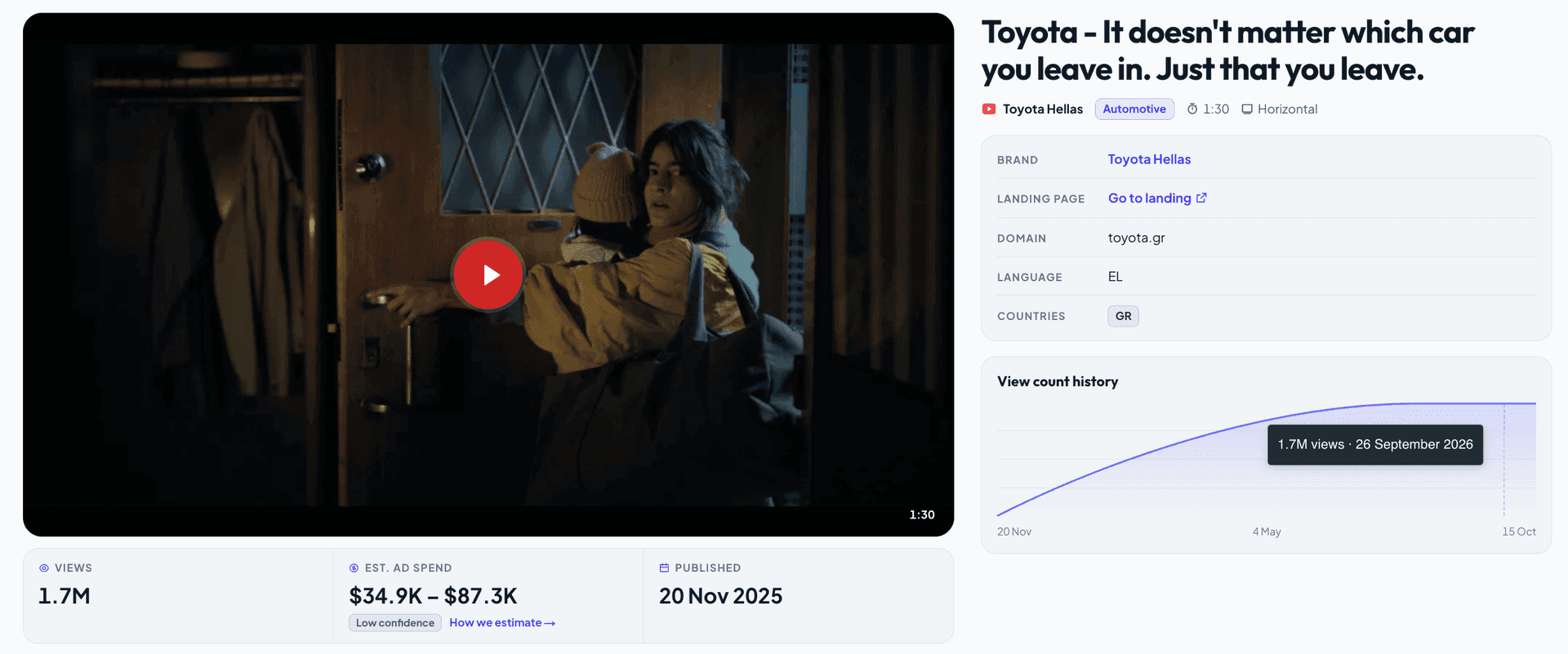
What happens in the Toyota Ford ad, scene by scene
The Toyota Ford ad tells one escape in a single unbroken mood, with no dialogue and no voiceover, and the product it is paid to sell never appears, per AdSee AI's visual description of the 90-second cut. Everything the viewer needs to understand comes from the pictures.
The structure is simple enough to describe in a few lines, which is part of why it travels. It is also why the reveal works: the viewer has all the time in the world to form the wrong assumption.
Before the reveal: a woman, a child and no product
The film opens in a dim hallway and a child's room with the blinds down. A woman, played by Greek actress Evgenia Lavda, picks up her half-asleep child, both bundled in warm clothes. She takes only what she can carry, walks through the apartment, goes down a spiral staircase and out through a decorative gate.
Outside, a dark blue Ford Fiesta is parked on a tree-lined street. She places the child in the car, gets in and drives away. The camera stays on the taillights as the car disappears. Nobody explains what she is leaving, and nobody needs to.
The last frame: the line and the logo
The film ends on a black screen with the line Ogilvy Greece translates as "It doesn't matter what car you drive, as long as you drive away." Only then does the Toyota logo appear. The YouTube description under both cuts adds that Toyota financially supports DIOTIMA and links to its site.
For most of the film, the viewer has been asking one question: is this a Ford ad? The ending answers it, and the answer is the message. Toyota does not care which car gets a woman out, as long as she gets out.
Why Toyota chose a Ford Fiesta for its own ad
Toyota chose a Ford because a Toyota in the hero role would have turned a safety message into product placement, and the brief was an 86% rise in recorded domestic violence incidents in Greece, per Ogilvy Greece's Clio entry. The same entry says NGOs supporting survivors were facing funding cuts after major reductions in USAID support.
The choice of car is the whole argument. If the woman drove away in a Yaris, the film would read as "Toyota keeps you safe", a claim no car brand can make about leaving an abuser. With a Ford, the film reads as "Toyota cares that you leave", and the funding behind it makes that believable.
An 86% rise and a funding gap
The 86% figure comes from the agency's award entry rather than an official statistical release, so it should be quoted as the campaign's own framing. It sits inside a much larger global problem. The World Health Organization estimates that about 1 in 3 women worldwide, around 840 million women and girls, have experienced physical or sexual violence from a partner or sexual violence from a non-partner in their lifetime.
The timing was deliberate. The United Nations International Day for the Elimination of Violence against Women on November 25 opens the 16 Days of Activism, which run to December 10. Toyota published the 90-second cut on November 20 and the vertical cut on November 24, so both were live when the day arrived.
DIOTIMA: what Toyota actually funded
DIOTIMA is a Greek women's NGO founded in 1989 that provides legal aid, court representation, psychosocial support and career counselling to survivors of gender-based violence. According to Toyota Hellas' campaign page, its 15-person team supported more than 850 women in 2024, and it is the only organisation in Greece that covers all court costs for survivors with limited means.
Toyota's role is financial support for that work, announced through the film. The film itself names no phone number or offer, so the description and the toyota.gr landing page do that job: they explain the partnership and send the viewer who wants to act to DIOTIMA.
A car Ford no longer makes
The Ford in the film is a car nobody can buy new. Ford ended production of the Fiesta on July 7, 2023, according to Wikipedia, more than two years before the campaign launched.
That detail quietly protects both brands. Toyota is not sending customers to a Ford showroom, and Ford is not being drafted into selling a current model through a rival's ad. The Fiesta is simply a common, ordinary car, the kind a woman in Greece might already have parked outside.
Two cuts, one story: how the horizontal and vertical versions performed
The vertical 60-second cut earned about 7.2 times more likes per view than the 90-second horizontal film, per AdSee AI: one like per 681 views against one per 4,923. It got less than half the views and three times the likes.
Both cuts tell the same story in the same order: hallway, staircase, gate, Ford, taillights, line, logo. The vertical cut is shorter and framed for a phone, and AdSee AI's description notes that the woman runs towards the car in it rather than walks.
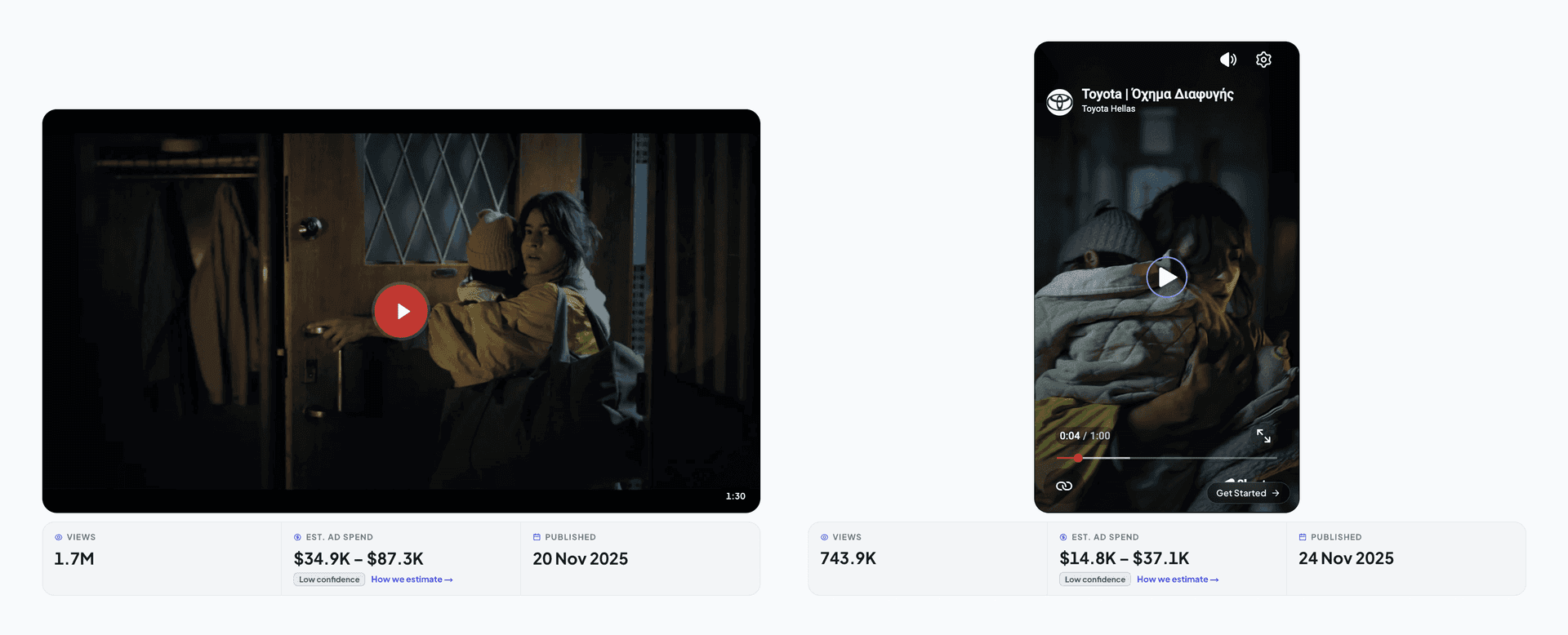
The horizontal cut did the reach work: 1.75M views is the bigger number, and its estimated spend of $35.0K–$87.4K is more than double the vertical cut's. The vertical cut did the reaction work, with 1,092 likes on 744.0K views, per AdSee AI. For a cause film whose goal is attention and conversation rather than clicks, that split is a useful pattern: one cut buys the audience, the other earns the response.
Where the like-to-view ratio misleads
Likes on YouTube ads depend heavily on format, and Toyota Greece's own product ads prove it. Per AdSee AI, the horizontal C-HR+ spot has 53 likes on 4.37M views, while the vertical cut of the same 30-second ad has 2,185 likes on 3.32M views. The Aygo X ad shows the same split: 27 likes horizontal, 2,268 vertical.
Vertical ads often run in Shorts and mobile feeds, where a like is one tap away, while horizontal in-stream ads are often watched in a TV-like context where few people reach for the button. So the 7.2x gap between the two Escape Vehicle cuts is mostly a placement effect, and comparing a vertical cut with a horizontal one says little about the creative.
How Escape Vehicle compares with Toyota Greece's product ads
Escape Vehicle out-performed Toyota Greece's biggest product ads on likes per view in both formats, per AdSee AI: its horizontal cut drew one like per 4,923 views against one per 82,397 for the horizontal C-HR+ spot, and its vertical cut one per 681 against one per 1,521 for the vertical C-HR+. Compared like for like, the cause film earned about twice the response of the product fleet in vertical and 17 to 31 times more in horizontal.
Toyota Greece's most-viewed product spots in the AdSee AI YouTube ads library are:
- Toyota C-HR+, "Get That Toyota Electric Feeling", 30 seconds, horizontal: 4.37M views, 53 likes, an estimated $87.3K–$218.4K in spend
- Toyota Aygo X, "Go Beyond Fun", 26 seconds, horizontal: 4.19M views, 27 likes, an estimated $83.7K–$209.3K
- Toyota C-HR+, same ad, vertical: 3.32M views, 2,185 likes, an estimated $66.5K–$166.2K
- Toyota Aygo X, "Unbox Fun", 26 seconds, vertical: 3.05M views, 2,268 likes, an estimated $61.0K–$152.6K
All four estimates are rated low confidence. All four show the car within the first seconds: a C-HR+ driving through a night city after an underwater mermaid opening, and a yellow Aygo X that multiplies into a swarm of toy copies of itself.
Spend: a cause film on a product-ad budget
Escape Vehicle did not need a launch budget. Its two cuts together carry an estimated $49.8K–$124.6K, less than the horizontal C-HR+ spot alone at $87.3K–$218.4K, per AdSee AI. Its 90-second cut also reached roughly the same views as Toyota's 6-second HomeCharge bumper, 1.75M against 1.78M, while running 15 times longer.
This is where effective YouTube ads in a cause category differ from product advertising. A product ad is paid to repeat a message until it sticks. A film like this is paid to be seen once and remembered, and the like count suggests it was.
Same week as a used-car campaign
Toyota Hellas did not pause selling cars to run this film. AdSee AI shows its Approved Used campaign, "Every Year Counts", published on November 14 and 17, 2025, with a warranty offer of up to 11 years or 200,000 km. Escape Vehicle followed on November 20.
That sequence matters for anyone planning a cause campaign. The brand kept its sales calendar and gave the cause film its own slot, its own landing page and its own message. It did not try to make the used-car ad carry a social message, or the social film carry an offer.
Domestic violence ads on YouTube: who usually runs them
Most domestic violence ads on YouTube come from governments, public agencies, NGOs and law firms, and only 3 of the 30 closest matches in an AdSee AI spoken-content search came from consumer brands. The query was about leaving an abuser and getting help, and the biggest results are public campaigns: a Minas Gerais state assembly ad in Brazil with 1.35M views, a Finnish public-health ad for shelters with 1.14M and a Dutch Ministry of Justice "Stop Femicide" ad with 389.5K.
The three brand-made ads are two Shoppers Drug Mart foundation campaigns for women's shelters in Canada and a German awareness video from insurers VGH and ÖVB tied to the film It Ends With Us.
Why Toyota's film doesn't show up in that search
Escape Vehicle is missing from those 30 results because it has no spoken words for a transcript search to match. The film carries its message in pictures and one closing line, so the way to find it is to describe what it shows.
In AdSee AI, a visual search for a woman leaving home at night with a child and driving away, filtered to Greece, returns the vertical cut as the first result. A brand search for Toyota surfaces the 90-second version. If you are using a YouTube ad tracker to study cause campaigns, search the visual channel as well as the spoken one, because the strongest films often say the least.
Why showing a competitor's car works here, and when it backfires
Showing a rival's product usually confuses viewers, per Creative Bloq, and Escape Vehicle works because confusion is the point rather than a side effect. Its design editor Daniel John wrote in April 2024 that "placing a competitor's actual product in the ad has been proven to confuse viewers", citing Pepsi print ads with a Coca-Cola can that many people read as Coke ads.
In most competitor ads, that confusion is a cost. The viewer remembers the wrong brand, and the advertiser pays for a rival's recall. In Escape Vehicle, the confusion is the setup for the line. The viewer spends the film thinking "this is a Ford ad", and the last frame turns that thought into the message.
Three conditions that make the reveal work
The reveal works because three things are true at once. First, the rival's product is incidental to the story: the Fiesta is a getaway car, not a feature comparison. Second, the payoff explicitly explains why the rival is there, so nobody leaves thinking Ford made the film. Third, the brand backs the line with money that can be checked, through DIOTIMA's work and the landing page.
Remove any of them and the idea breaks. A rival car with no explanation is just a Ford ad. An explanation with no funding behind it is a slogan.
How to run this teardown on any brand's cause campaign
You can reproduce this teardown in six steps with any YouTube ad library that shows views, likes, publish dates and landing pages. The steps below use AdSee AI, but each one works with public YouTube data and some patience.
- Find the cause ad. Search by what the film shows, not by what it says, and filter by the country where it ran. For Escape Vehicle, a visual description and a Greece filter were enough.
- Find every cut. Search the brand name and look for the same original title in different lengths and orientations. Toyota uploaded two cuts four days apart, both titled "Toyota | Όχημα Διαφυγής".
- Pull the brand's product ads from the same market. Sort the brand's ads by views and note views, likes, length and estimated spend for the top four or five.
- Compare likes per view across the two groups. A cause film that earns dozens of times more likes per view than the product fleet is behaving differently, and that is worth explaining.
- Check the calendar. Line up publish dates against the awareness day or event the campaign is tied to, and against the brand's sales campaigns that week.
- Open the landing page. A cause ad that lands on a partner page or an explanation of the funding is making a commitment. One that lands on a model page is a product ad in disguise.
Where this analysis stops working
This teardown has three limits that matter, starting with spend: AdSee AI rates both Escape Vehicle estimates low confidence. The figures are modelled from views, so the $49.8K–$124.6K range is a guide to scale, not Toyota's invoice. Likes are a weak proxy for impact, and they depend on placement and audience as much as on creative quality.
Second, nothing in YouTube data shows what the campaign did for DIOTIMA. Donations, calls to the help desk and women who reached out are the outcomes that matter, and none of them appear in a view count.
Third, the 86% rise in recorded incidents comes from the agency's award entry. It frames the brief, but it is not an official statistic, and a recorded rise can reflect more reporting as well as more violence. Quote it as the campaign's figure, not as a national fact.
Takeaways from Toyota's Ford ad
Toyota's Ford ad shows that a brand can win attention by visibly giving something up, as long as the sacrifice is backed by action. Five lessons apply to any YouTube video advertising with a social purpose:
- Give up something the audience will notice. Every car ad shows the car, so a car ad without one is impossible to miss.
- Let confusion carry the story, then resolve it in one line. The question "is this a Ford ad?" holds attention until the payoff.
- Back the message with money that can be checked. The slogan works because DIOTIMA's work is funded and named.
- Cut the film for every screen, and compare cuts only with cuts of the same shape. Toyota's vertical cuts, cause and product alike, drew far more likes than its horizontal ones.
- Keep the cause film separate from the sales calendar. Toyota ran its used-car campaign the same week and kept the two apart.
FAQ
What is the Toyota ad with a Ford in it?
The Toyota ad with a Ford is "Escape Vehicle", a 2025 film by Ogilvy Greece for Toyota Hellas. A woman escapes an abusive home with her child in a Ford Fiesta, and the closing line says it doesn't matter what car you drive, as long as you drive away. Its two YouTube cuts reached 2.49M views, per AdSee AI.
Why did Toyota show a Ford in its own ad?
Toyota showed a Ford to make clear the film was about women leaving abuse, not about selling cars. Toyota Hellas financially supports DIOTIMA, a Greek NGO that helps survivors, and the Ford proves the point of the line. Per Ogilvy Greece's Clio entry, recorded domestic violence incidents in Greece had risen 86% in a year.
How many views did Toyota's Escape Vehicle ad get on YouTube?
Toyota's Escape Vehicle ad got 2.49M views across two YouTube cuts, per AdSee AI data as of November 5, 2026. The 90-second horizontal film has 1.75M views and 355 likes, and the 60-second vertical cut has 744.0K views and 1,092 likes. Both ran only in Greece and in Greek.
How much did Toyota spend on the Escape Vehicle campaign?
AdSee AI estimates Toyota's YouTube spend on Escape Vehicle at $49.8K–$124.6K across both cuts: $35.0K–$87.4K for the 90-second film and $14.9K–$37.2K for the vertical cut. Both estimates are rated low confidence and are modelled from views, so they compare ads rather than report Toyota's actual budget or its donation to DIOTIMA.
Did the Escape Vehicle campaign win awards?
Yes. Escape Vehicle won a Bronze Clio at the Clio Awards 2026, according to Ogilvy Greece's case page, and was included in Lürzer's Archive online selection. On YouTube, its horizontal cut drew one like per 4,923 views, against one per 82,397 for Toyota Greece's most-viewed horizontal product ad, per AdSee AI.
What makes a cause ad on YouTube effective?
Effective YouTube ads for a cause pair a single clear idea with a visible commitment. Escape Vehicle shows a rival's car to prove Toyota isn't selling anything, then names the NGO it funds. Per AdSee AI, its vertical cut drew one like per 681 views, against one per 1,521 for the vertical cut of Toyota Greece's top product ad.
How do I find a competitor's cause campaign on YouTube?
You can find a competitor's cause campaign by searching a YouTube ads library for what the ad shows, filtered by country, then searching the brand name for other cuts. In AdSee AI, a visual search for a woman leaving home at night with a child, filtered to Greece, returns Escape Vehicle first. Check publish dates against awareness days.
Do likes show whether a cause ad worked?
Not directly. Likes show how many viewers reacted, and Escape Vehicle's vertical cut drew about 7.2 times more likes per view than its horizontal cut, per AdSee AI. But Toyota's product ads show the same vertical skew, so likes reflect placement, and they say nothing about donations, calls for help or brand trust.