
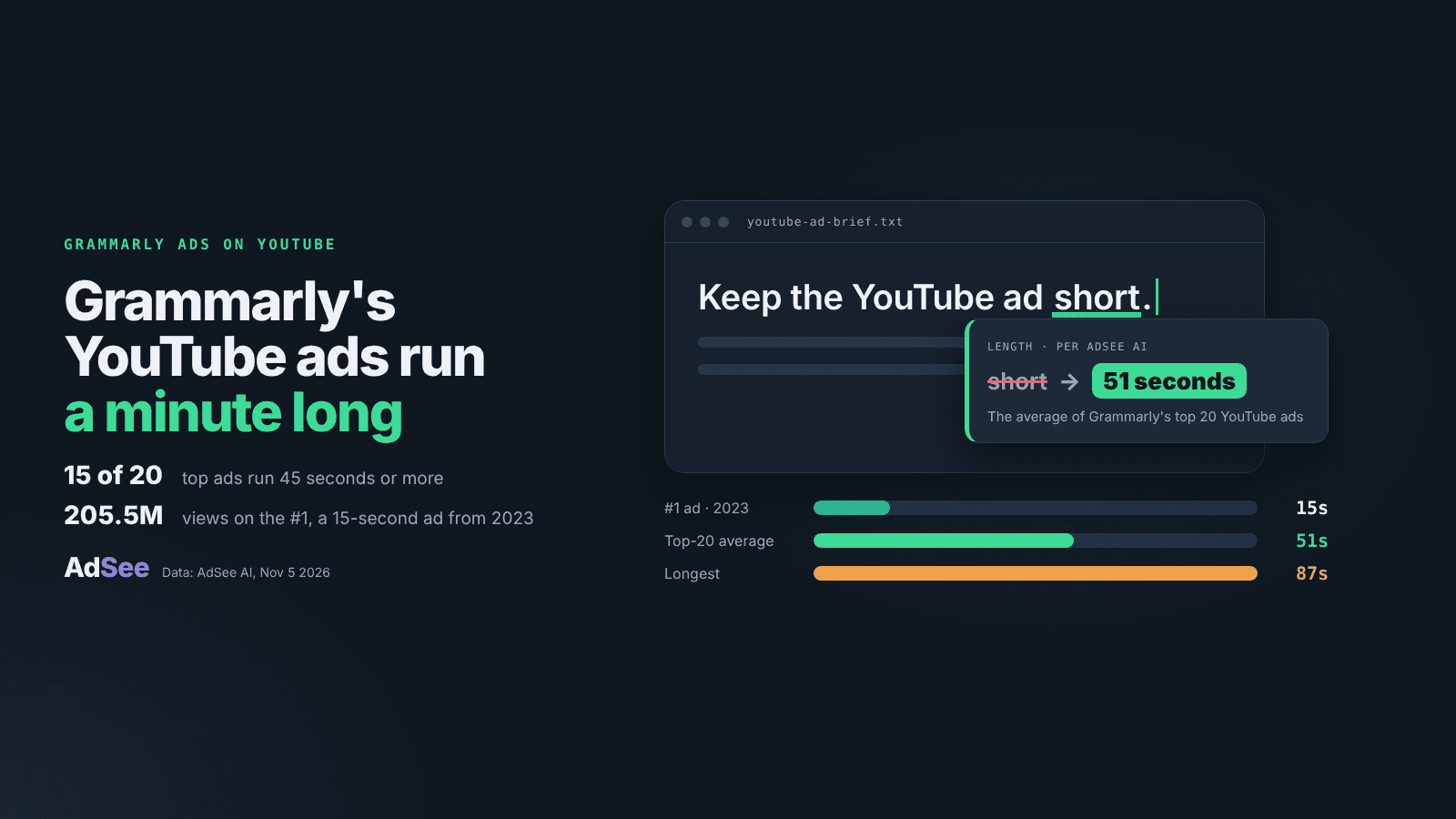
Grammarly's 20 most-viewed YouTube ads reached 858.5M views, and 15 of them run 45 seconds or longer, per AdSee AI data pulled on November 5, 2026. The exception is the biggest one: a 15-second Gmail demo from September 2023 with 205.5M views, which still leads the set three years later.
Grammarly was founded in 2009 by Max Lytvyn, Alex Shevchenko and Dmytro Lider and was developed in Ukraine. According to Wikipedia, it bought the productivity startup Coda in December 2024 and the email client Superhuman in July 2025, and in October 2025 its parent company renamed itself Superhuman. Its YouTube ads, however, still carry one name: Grammarly.
Grammarly's top YouTube ads in numbers
Grammarly has 97 YouTube ads on AdSee AI's Grammarly page, with 919M views and an estimated $1.8M–$46.0M in all-time spend, per AdSee AI. They ran in 109 countries, most often in the US, the UK, Canada, New Zealand and Australia, mainly in English and then Spanish. The top 20 at a glance:
- 858.5M views across the top 20 ads
- The #1 ad, from 2023, has 24% of those views
- 15 of 20 run 45 seconds or longer; the average is 51 seconds
- 4 of 20 run a minute or more, up to 87 seconds
- 3 of 20 are in Spanish, with 116.4M views
Grammarly also buys wide. Six of the ten top ads checked for this article were shown in more than 90 countries each, per AdSee AI's country data, from the US and the UK to India, Nigeria, the Philippines and Brazil. The students' ad "AI built for school" alone lists over 100 markets. English-language ads reach English speakers far beyond the five core markets, and that wide net helps explain the large view counts.
AdSee AI rates most Grammarly spend estimates as high confidence, but they are still modelled from views and typical cost-per-view rates, not reported by Grammarly. Views on YouTube ads are mostly paid reach: they show where the budget went, not how viral an ad was. You can browse the full set on AdSee AI's Grammarly page in its YouTube ads library.
The #1 ad: a 15-second Gmail demo from 2023
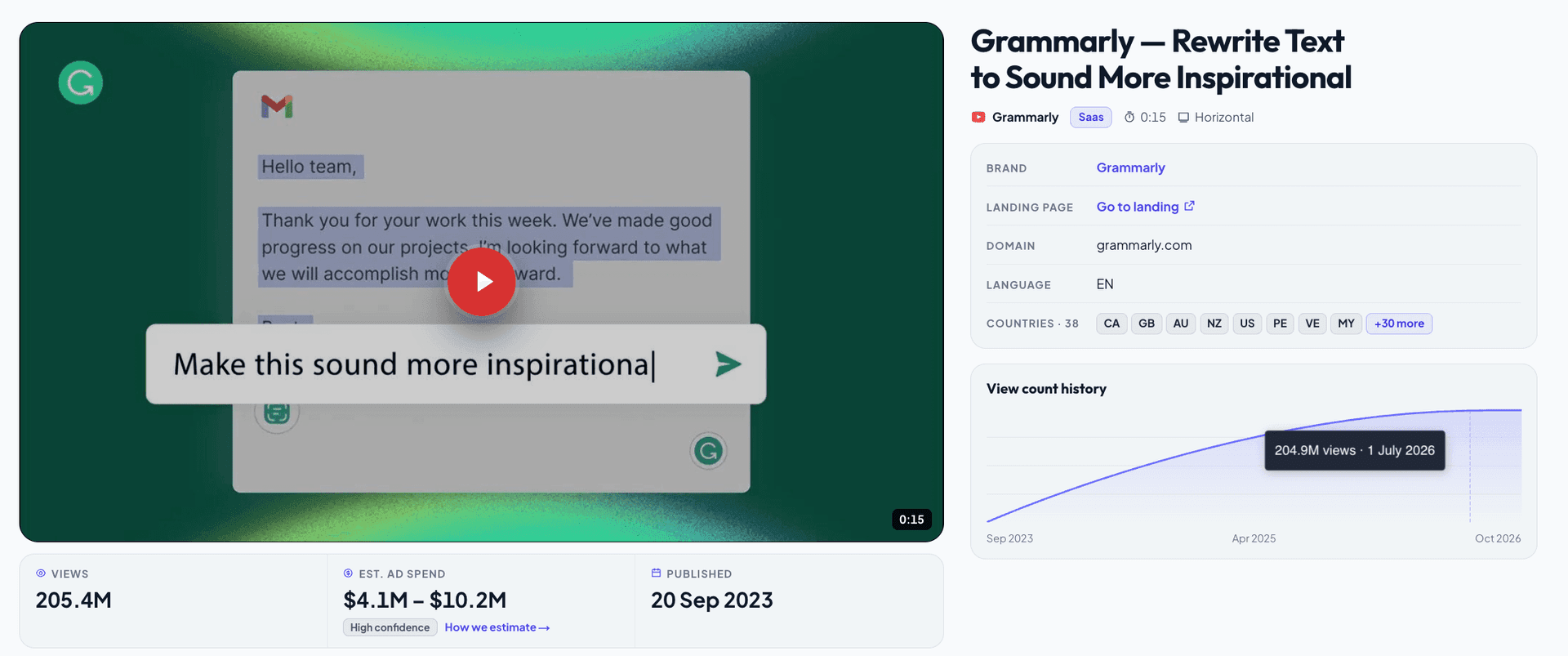
Grammarly's most-viewed YouTube ad is a 15-second product demo published on September 20, 2023, with 205.5M views and an estimated $4.11M–$10.27M in spend, per AdSee AI. Its original title is "Write With The Tone You Want Using Grammarly's Generative AI", and it ran in 38 countries, led by Canada, the UK, Australia and New Zealand.
One prompt, one click, one install
The ad opens on a familiar Gmail screen. A cursor highlights the text of an email, and a prompt appears: make it sound more inspirational. Grammarly rewrites the email, the cursor clicks "Insert", and the last frame asks the viewer to download Grammarly.
There is no actor, no voiceover and no story. The whole ad is the product doing one job in a tool the viewer already uses. It is also the most-liked ad in the set, with 16,666 likes, about one per 12,328 views. AdSee AI's display title for it, "Rewrite Text to Sound More Inspirational", describes the prompt rather than the original title.
What the landing URL says
The #1 ad's landing URL reads like a targeting brief, per AdSee AI: utm_source=pmax, audience=professional, value=error-free-writing, hook=none, funnel=install, region=tier3 and language=english. Each parameter tells you something about how the ad was bought.
"pmax" points to Performance Max, the automated campaign type in Google Ads that places ads across YouTube, Search and other Google surfaces. "funnel=install" says the goal was a download, not awareness. "region=tier3" suggests Grammarly groups its markets into price or priority tiers, and the ad's country list includes many lower-cost markets beyond the core five. Read these as labels Grammarly chose, not as a published glossary.
The Performance Max label also helps explain the ad's long life. An automated campaign keeps serving the creative that performs, and a 15-second demo with no dated references never looks old. A teacher, a manager or a job seeker in 2026 still writes emails in Gmail, so the ad still works, and its views keep growing three years after launch.
Since 2025: ads that run almost a minute
Grammarly's newer YouTube ads are long, per AdSee AI: the other 19 ads in its top 20, all published from September 2024 on, average 53 seconds, and the two longest run 86 and 87 seconds. The 15-second demo is the only ad in the top 20 that runs under 30 seconds.
Longer ads give Grammarly room to show a whole task, from a blank page to a finished essay or a client pitch, instead of a single click. They also suit skippable placements, where viewers who stay past the first seconds are the ones most likely to care.
According to Think with Google, long-form ads can carry more than brand recall: in one test, "creator-led long-form ads yielded 5X the awareness and consideration lift" of short non-creator ads. Read Think with Google's video experiments. Grammarly's long ads are not creator-led, but they make the same bet on time spent with the product.
Students: "AI built for school"
Grammarly's biggest YouTube push since 2025 targets students, per AdSee AI: four of the ten top ads checked for this article land on grammarly.com/a/students, and together they reach 207.8M views. The campaign shows Grammarly's AI tools working inside an assignment.
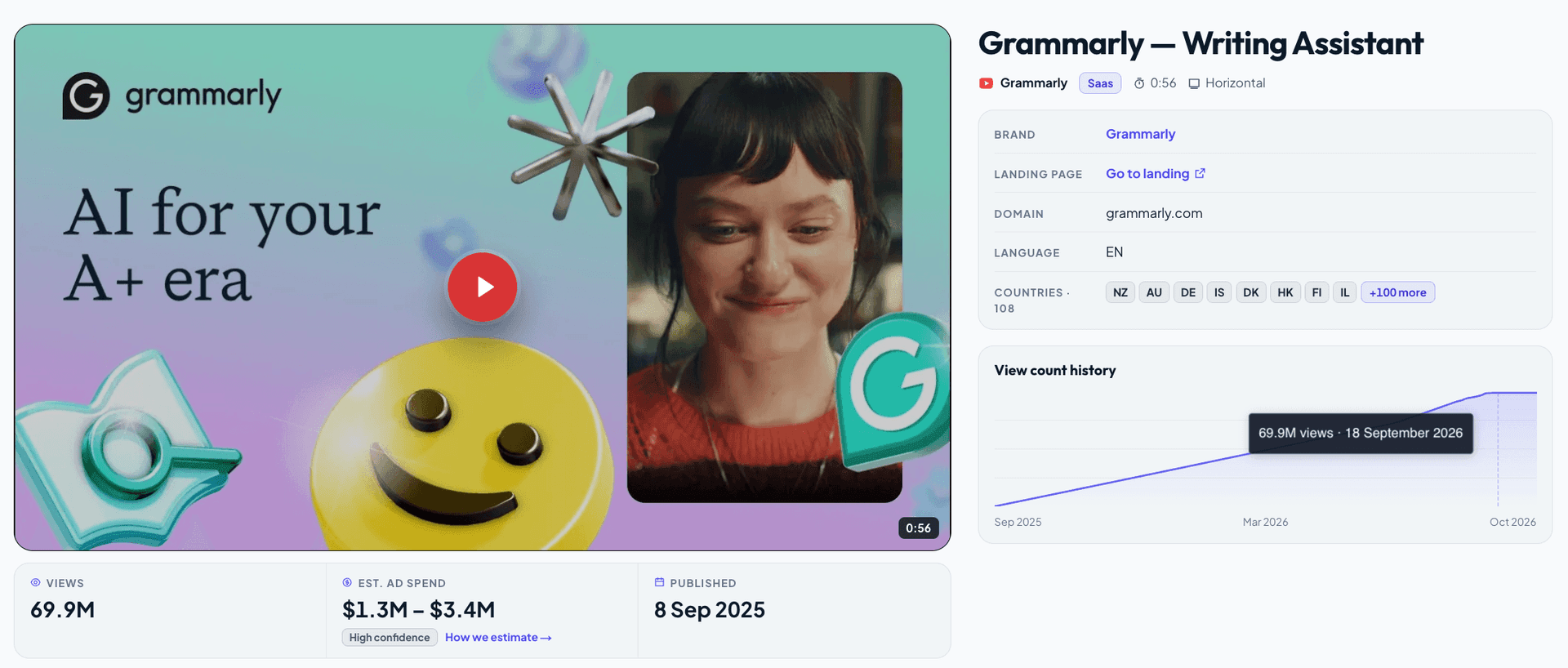
- "AI built for school", 56 seconds, 69.9M views. A student on a couch, a cat beside her, writes an essay about cats in art history, from ancient Egypt to internet memes, then drives off with a friend.
- "AI that helps you put the A in GPA", 86 seconds, 37.5M views. The same student, a "Final Due!" date on the calendar, and an AI Grader whose predicted grade rises as she edits. The cat walks across the keyboard.
- "Ensure Your Writing Sounds True to You", 50 seconds, 77.1M views. An internship cover letter that "starts to sound a little not like you", fixed with the AI Detector and AI Rewriter.
- "Find Sources Fast With Grammarly's Citation Finder", 47 seconds, 23.3M views. An essay on fictional detectives, with each claim marked supported, debated or contradicted.
The academic integrity line
The student ads sell AI with a condition attached. The GPA ad's description says: "Unlike other AI platforms, Grammarly is focused on helping students use AI without breaking their school's academic integrity policies." It ends: "It's your essay, after all; it should sound like you."
That line answers the question a student, or a teacher, would ask first, and it turns a common worry about AI in school into a reason to choose this tool over a general chatbot. Grammarly does not promise to write the essay. It promises a better grade on an essay that is still the student's own.
Work: "Your Credibility Is in Your Voice"
Grammarly's two biggest work ads on YouTube reach 109.5M views together, per AdSee AI, and both sell clearer messages to colleagues and clients. The biggest, "Your Credibility Is in Your Voice. Use It.", has 62.3M views and an estimated $1.25M–$3.11M in spend. It runs 59 seconds and was published on December 23, 2025.
A man works at a laptop in an open office, with notifications reflected in his eyes. Grammarly's AI chat and humanizer options appear on screen, and the ad ends with a manager approving his work. The description opens with a joke: "Are pings, boops, bops, and dings pulling your focus away from that client proposal?"
A 30-second work ad, "Pitch perfectly, every time", has 47.2M views. A woman gets a text from "Brad" asking for updated messaging by Friday, rewrites a sales pitch with the paraphrasing tool set to "Engaging", and ends the week at a '90s-themed company karaoke night.
"Sounds like you": the message against generic AI
Grammarly's 2025 and 2026 YouTube ads repeat one idea across students and professionals, per AdSee AI's original titles: your writing should sound like you. "Ensure Your Writing Sounds True to You" and "Your Credibility Is in Your Voice" alone reach 139.4M views, and the student ads close on the same line.
The products in these ads point the same way. The AI Detector flags text that sounds machine-written, the Humanizer and AI Rewriter smooth it, and the Proofreader keeps the writer's own phrasing. Where a general chatbot offers to write the text, Grammarly offers to keep the writer in it.
That is a clear position in a crowded market. It also explains the length of the ads: showing that a draft still sounds like its author takes longer than showing a rewrite.
Spanish: three ads with 116.4M views
Grammarly runs a Spanish-language campaign for the US and Latin America, per AdSee AI, and its three Spanish ads in the top 20 reach 116.4M views. The two checked for this article share the original title "Escribe con precisión y aumenta tu productividad con Grammarly" and land on grammarly.com/es/a, the Spanish version of the sign-up page.
- A 58-second horizontal ad with 46.5M views, shown in the US, Spain and across Latin America.
- A 45-second horizontal ad with 38.5M views. It opens on "Escribir en múltiples idiomas ahora es más fácil", writing in multiple languages is now easier, and shows Grammarly in Gmail and Slack.
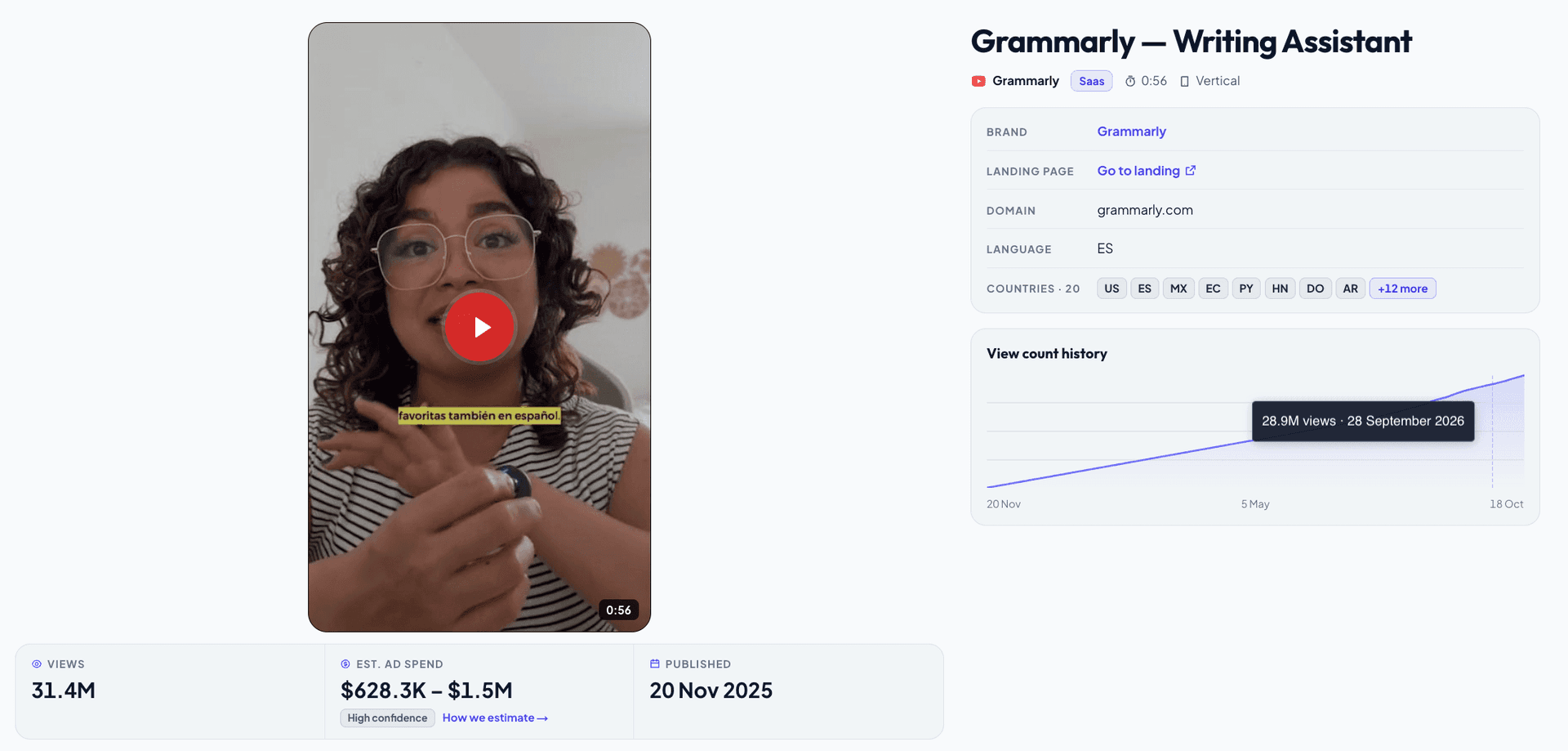
- A 56-second vertical ad with 31.4M views, in which a woman in glasses talks to camera between screen recordings of an email.
The Spanish campaign is also the main place where Grammarly sells multilingual writing and translation. The English ads sell better writing in English; the Spanish ads sell writing in more than one language, which fits bilingual users in the US as well as readers in Mexico, Colombia or Argentina.
The company is now Superhuman. The ads still say Grammarly
Grammarly's parent company renamed itself Superhuman in October 2025, according to Wikipedia, yet every top YouTube ad AdSee AI checked for this article still leads with the Grammarly name and logo. The new name appears in a product, Superhuman Go, and only in small ads.
The Superhuman Go ads published on April 16, 2026, reach at most 2.1M views each, per AdSee AI. The biggest is a 59-second student ad that lands on grammarly.com/a/students-go-ai-assistant, in which a student in a beanie talks to camera about panicking over essays while a Google Docs sidebar shows Proofreader, Humanizer and AI Detector.
For a brand in the middle of a rename, that split is sensible: keep the known name on the big budget, and test the new one on small placements first.
Grammarly vs. ChatGPT and Canva on YouTube
ChatGPT has 218 YouTube ads with 11.6B views in AdSee AI and Canva has 272 with 2.2B, against 97 ads and 919M views for Grammarly, per AdSee AI's SaaS rankings. Grammarly ranks #47 by estimated spend in that list, with $1.8M–$46.0M against $23.1M–$578M for ChatGPT.
The comparison explains Grammarly's creative choices. It cannot outspend a general AI assistant, so it does not compete on the same promise. ChatGPT's ads show what AI can do for you. Grammarly's ads show what AI can do with you, inside the writing you already own, in Gmail, Google Docs or Slack.
For any SaaS team, the lesson is that budget shapes the message as much as the product does. A smaller brand next to a giant can still win attention on YouTube if it picks a narrower promise and repeats it in every ad.
How Grammarly's ads follow Google's ABCD framework
Grammarly's top YouTube ads follow Google's ABCD framework for YouTube ads, short for Attract, Brand, Connect and Direct, per AdSee AI's review of the top 20. The Brand step is the most consistent.
- Attract. A Gmail screen, a cat on a keyboard, a "Final Due!" date, a text from a manager.
- Brand. The Grammarly logo appears over the first scene in most of the long ads.
- Connect. Real tasks: an essay, a cover letter, a client proposal, a sales pitch.
- Direct. Each ad lands on a page for its audience: /a/students, /es/a or the general /a page.
According to Google, ads that show the brand early tend to drive stronger recall. Grammarly's long ads still put the logo in the first seconds, so viewers who skip still see it.
How to run this teardown on any brand
This teardown used 3 kinds of AdSee AI data: the brand page, searches sorted by views, and the details of 10 individual ads. You can repeat it for any SaaS brand in a YouTube ads library in under an hour.
- Start from AdSee AI's page for the brand and sort the ads by views.
- Note each ad's length and publish date. Grammarly's shift to long ads shows up as soon as you sort by date.
- Read the landing URLs. Grammarly's paths separate students, Spanish speakers and the general audience, and its oldest URL names the funnel stage.
- Read the original titles and descriptions for the message, such as "sounds like you".
- Check whether a rename or a new product shows up in the ads, and with what budget.
- Compare the brand with two or three competitors on the same ranking page.
A YouTube ad tracker that stores views, length, dates and landing pages turns these steps into a short checklist.
Where this analysis stops working
This analysis covers Grammarly's 20 most-viewed YouTube ads as of November 5, 2026, per AdSee AI, and it has 4 limits worth knowing. Treat each conclusion as a reading of the public ads, not of Grammarly's internal results.
- Views show where the budget went, not which ad brought sign-ups. Grammarly does not publish YouTube results.
- Spend is an estimate derived from views and typical cost-per-view rates.
- The #1 ad has been running since 2023, so its views add up over three years, not one campaign.
- URL parameters such as region=tier3 are Grammarly's own labels, read from their names, not confirmed by the brand.
Takeaways from Grammarly's YouTube ads
Grammarly's top YouTube ads, per AdSee AI, offer 6 lessons for any SaaS brand that studies top YouTube ads before planning its own.
- A simple demo can last for years. A 15-second Gmail demo from 2023 still leads with 205.5M views.
- Go long when the product needs a whole task. 15 of the top 20 run 45 seconds or more.
- Pick one audience per campaign. Students get their own landing page, AI Grader and Citation Finder.
- Own a position against the giants. "Sounds like you" sets Grammarly apart from general AI.
- Write a separate campaign for a second language. Three Spanish ads reach 116.4M views.
- Keep the known name during a rename. The ads still say Grammarly; Superhuman Go is tested small.
FAQ
What is Grammarly's most-viewed ad on YouTube?
Grammarly's most-viewed YouTube ad is a 15-second demo published on September 20, 2023, with 205.5M views and an estimated $4.11M–$10.27M in spend, per AdSee AI. It rewrites a Gmail email to sound more inspirational, and its original title is "Write With The Tone You Want Using Grammarly's Generative AI".
How long are Grammarly's YouTube ads?
Most of Grammarly's top YouTube ads are long: 15 of its 20 most-viewed run 45 seconds or more, and the average is 51 seconds, per AdSee AI. The longest run 86 and 87 seconds. Only the 2023 Gmail demo, the #1 ad, runs 15 seconds.
Does Grammarly advertise to students on YouTube?
Yes. Four of the ten top Grammarly ads checked by AdSee AI land on grammarly.com/a/students, with 207.8M views together. They show the AI Grader, Citation Finder, AI Detector and AI Rewriter, and promise help that respects a school's academic integrity policies.
Is Grammarly now called Superhuman?
Grammarly's parent company renamed itself Superhuman in October 2025, according to Wikipedia, after buying the email client Superhuman. Grammarly remains the product name, and its top YouTube ads still lead with it. Ads for Superhuman Go, published in April 2026, reach about 2.1M views each at most, per AdSee AI.
Does Grammarly advertise in Spanish?
Yes. Three of Grammarly's top 20 YouTube ads are in Spanish, with 116.4M views together, per AdSee AI. They run in the US, Spain and Latin America, land on grammarly.com/es/a, and focus on writing in several languages, including one vertical ad with a presenter talking to camera.
How much does Grammarly spend on YouTube ads?
AdSee AI estimates Grammarly's all-time YouTube spend at $1.8M–$46.0M across 97 ads, modelled from views and typical cost-per-view rates rather than reported by Grammarly. Its top ad carries an estimated $4.11M–$10.27M. Treat these ranges as a way to compare ads, not as Grammarly's actual budget.
How can I track Grammarly's YouTube ads?
You can track Grammarly's YouTube ads with any YouTube ad tracker that lists views, length, markets and landing pages. In AdSee AI, open AdSee AI's Grammarly ads page, sort by views or date, and read the landing paths, which separate students, Spanish speakers and general users.
Where can I see all Grammarly ads?
You can see Grammarly's top ads, markets and estimated spend on AdSee AI's Grammarly page in its YouTube ads library: adsee.ai/ad-examples/youtube/brands/grammarly. Searching Grammarly in AdSee AI shows every indexed ad, with filters for country, language, date range and orientation, including the Superhuman Go ads.